

4.5 Extension and Torsion of a Cylindrical Bar
187
(a)
(b)
(c)
(d)
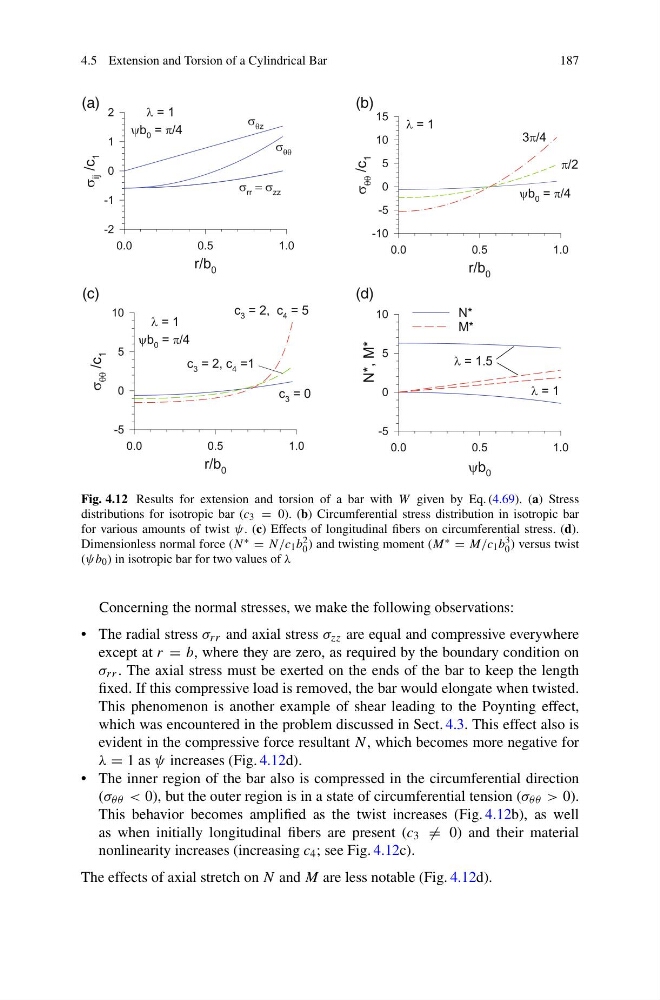
Fig. 4.12 Results for extension and torsion of a bar with W given by Eq. (4.69). (a) Stress
distributions for isotropic bar (c 3 = 0). (b) Circumferential stress distribution in isotropic bar
for various amounts of twist ψ. (c) Effects of longitudinal fibers on circumferential stress. (d).
Dimensionless normal force (N ∗ = N/c 1 b 2
0 ) and twisting moment (M ∗ = M/c 1 b 3
0 ) versus twist
(ψb 0 ) in isotropic bar for two values of λ
Concerning the normal stresses, we make the following observations:
• The radial stress σ rr and axial stress σ zz are equal and compressive everywhere
except at r = b, where they are zero, as required by the boundary condition on
σ rr . The axial stress must be exerted on the ends of the bar to keep the length
fixed. If this compressive load is removed, the bar would elongate when twisted.
This phenomenon is another example of shear leading to the Poynting effect,
which was encountered in the problem discussed in Sect. 4.3. This effect also is
evident in the compressive force resultant N , which becomes more negative for
λ = 1 as ψ increases (Fig. 4.12d).
• The inner region of the bar also is compressed in the circumferential direction
(σ θθ < 0), but the outer region is in a state of circumferential tension (σ θθ > 0).
This behavior becomes amplified as the twist increases (Fig. 4.12b), as well
as when initially longitudinal fibers are present (c 3 = 0) and their material
nonlinearity increases (increasing c 4 ; see Fig. 4.12c).
The effects of axial stretch on N and M are less notable (Fig. 4.12d).
187
(a)
(b)
(c)
(d)
Fig. 4.12 Results for extension and torsion of a bar with W given by Eq. (4.69). (a) Stress
distributions for isotropic bar (c 3 = 0). (b) Circumferential stress distribution in isotropic bar
for various amounts of twist ψ. (c) Effects of longitudinal fibers on circumferential stress. (d).
Dimensionless normal force (N ∗ = N/c 1 b 2
0 ) and twisting moment (M ∗ = M/c 1 b 3
0 ) versus twist
(ψb 0 ) in isotropic bar for two values of λ
Concerning the normal stresses, we make the following observations:
• The radial stress σ rr and axial stress σ zz are equal and compressive everywhere
except at r = b, where they are zero, as required by the boundary condition on
σ rr . The axial stress must be exerted on the ends of the bar to keep the length
fixed. If this compressive load is removed, the bar would elongate when twisted.
This phenomenon is another example of shear leading to the Poynting effect,
which was encountered in the problem discussed in Sect. 4.3. This effect also is
evident in the compressive force resultant N , which becomes more negative for
λ = 1 as ψ increases (Fig. 4.12d).
• The inner region of the bar also is compressed in the circumferential direction
(σ θθ < 0), but the outer region is in a state of circumferential tension (σ θθ > 0).
This behavior becomes amplified as the twist increases (Fig. 4.12b), as well
as when initially longitudinal fibers are present (c 3 = 0) and their material
nonlinearity increases (increasing c 4 ; see Fig. 4.12c).
The effects of axial stretch on N and M are less notable (Fig. 4.12d).