

4.5 Extension and Torsion of a Cylindrical Bar
185
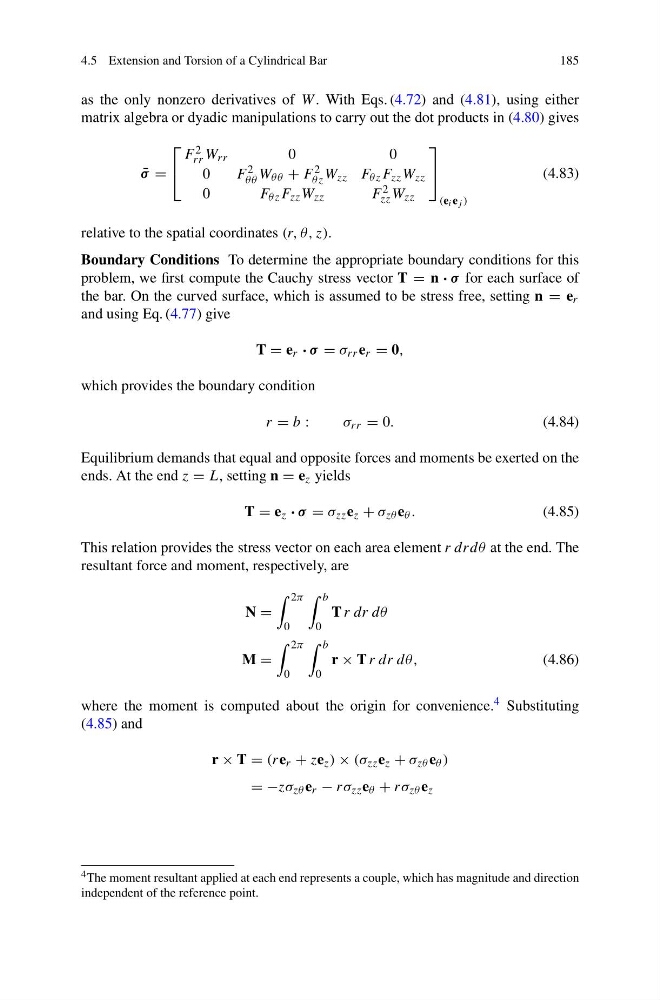
as the only nonzero derivatives of W . With Eqs. (4.72) and (4.81), using either
matrix algebra or dyadic manipulations to carry out the dot products in (4.80) gives
¯
σ =
⎡
⎣
F 2
rr W rr
0
0
0
F 2
θθ W θθ + F 2
θz W zz F θz F zz W zz
0
F θz F zz W zz
F 2
zz W zz
⎤
⎦
(e i e j )
(4.83)
relative to the spatial coordinates (r, θ, z).
Boundary Conditions To determine the appropriate boundary conditions for this
problem, we first compute the Cauchy stress vector T = n · σ for each surface of
the bar. On the curved surface, which is assumed to be stress free, setting n = e r
and using Eq. (4.77) give
T = e r · σ = σ rr e r = 0,
which provides the boundary condition
r = b :
σ rr = 0.
(4.84)
Equilibrium demands that equal and opposite forces and moments be exerted on the
ends. At the end z = L, setting n = e z yields
T = e z · σ = σ zz e z + σ zθ e θ .
(4.85)
This relation provides the stress vector on each area element r drdθ at the end. The
resultant force and moment, respectively, are
N =
2π
0
b
0
T r dr dθ
M =
2π
0
b
0
r × T r dr dθ,
(4.86)
where the moment is computed about the origin for convenience. 4 Substituting
(4.85) and
r × T = (re r + ze z ) × (σ zz e z + σ zθ e θ )
= −zσ zθ e r − rσ zz e θ + rσ zθ e z
4 The moment resultant applied at each end represents a couple, which has magnitude and direction
independent of the reference point.
185
as the only nonzero derivatives of W . With Eqs. (4.72) and (4.81), using either
matrix algebra or dyadic manipulations to carry out the dot products in (4.80) gives
¯
σ =
⎡
⎣
F 2
rr W rr
0
0
0
F 2
θθ W θθ + F 2
θz W zz F θz F zz W zz
0
F θz F zz W zz
F 2
zz W zz
⎤
⎦
(e i e j )
(4.83)
relative to the spatial coordinates (r, θ, z).
Boundary Conditions To determine the appropriate boundary conditions for this
problem, we first compute the Cauchy stress vector T = n · σ for each surface of
the bar. On the curved surface, which is assumed to be stress free, setting n = e r
and using Eq. (4.77) give
T = e r · σ = σ rr e r = 0,
which provides the boundary condition
r = b :
σ rr = 0.
(4.84)
Equilibrium demands that equal and opposite forces and moments be exerted on the
ends. At the end z = L, setting n = e z yields
T = e z · σ = σ zz e z + σ zθ e θ .
(4.85)
This relation provides the stress vector on each area element r drdθ at the end. The
resultant force and moment, respectively, are
N =
2π
0
b
0
T r dr dθ
M =
2π
0
b
0
r × T r dr dθ,
(4.86)
where the moment is computed about the origin for convenience. 4 Substituting
(4.85) and
r × T = (re r + ze z ) × (σ zz e z + σ zθ e θ )
= −zσ zθ e r − rσ zz e θ + rσ zθ e z
4 The moment resultant applied at each end represents a couple, which has magnitude and direction
independent of the reference point.