

174
4 Problems in Soft Tissue Biomechanics
σ xx = 0 and σ yy < 0 for the MR material, while σ xx > 0 and σ yy = 0 for the
neo-Hookean material. If these stresses are not imposed on the boundaries, the MR
block would lengthen in the y-direction, and the neo-Hookean block would shorten
in the x-direction. This behavior is called the Poynting effect.
4.4 Extension and Inflation of a Circular Tube
Tubular structures are ubiquitous in biology. Many involve transport of substances
from one place to another, e.g., blood vessels, ureter, intestines, trachea, esophagus,
and plant stems. The tubular shape of the earthworm is used for locomotion. The
cochlea is a coiled tube that is essential for hearing. In cells, microtubules are
involved in mitosis, cilia dynamics, and changes in cell shape. In the embryo, the
heart and brain begin as simple tubes that develop into complex organs. This section
deals with deformation of a cylindrical tube subjected to axial extension and internal
pressure.
4.4.1 Problem Statement
Prior to deformation, a circular cylinder has an inner radius a 0 , outer radius b 0 ,
and length L 0 . The tube is composed of transversely isotropic, incompressible,
hyperelastic material consisting of circumferentially oriented fibers embedded in
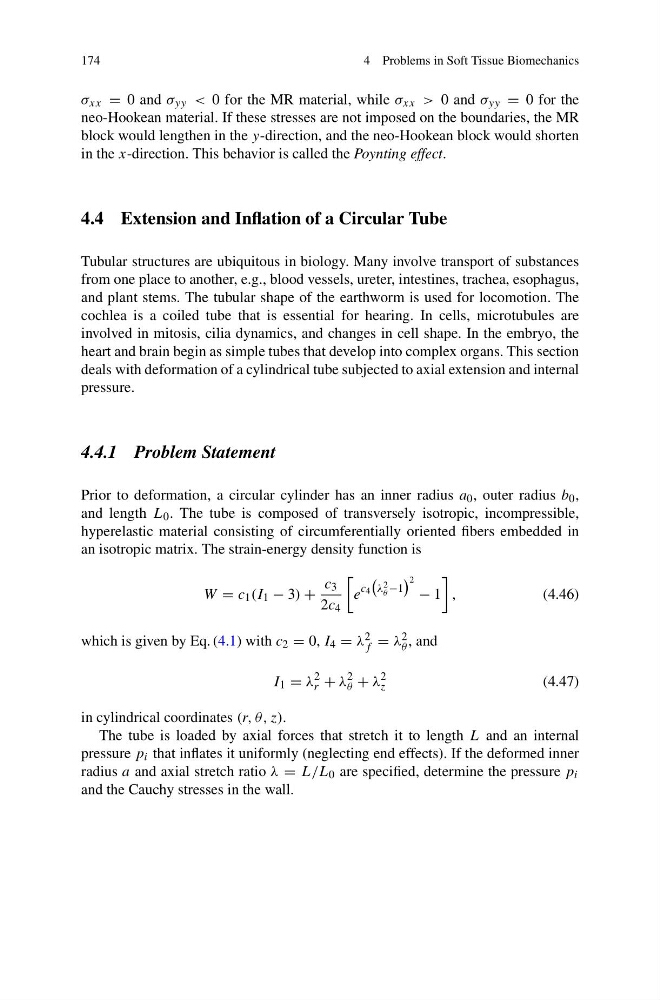
an isotropic matrix. The strain-energy density function is
W = c 1 (I 1 − 3) +
c 3
2c 4
e
c 4
λ 2
θ −1
2
− 1
,
(4.46)
which is given by Eq. (4.1) with c 2 = 0, I 4 = λ 2
f = λ 2
θ , and
I 1 = λ
2
r + λ
2
θ + λ
2
z
(4.47)
in cylindrical coordinates (r, θ, z).
The tube is loaded by axial forces that stretch it to length L and an internal
pressure p i that inflates it uniformly (neglecting end effects). If the deformed inner
radius a and axial stretch ratio λ = L/L 0 are specified, determine the pressure p i
and the Cauchy stresses in the wall.
4 Problems in Soft Tissue Biomechanics
σ xx = 0 and σ yy < 0 for the MR material, while σ xx > 0 and σ yy = 0 for the
neo-Hookean material. If these stresses are not imposed on the boundaries, the MR
block would lengthen in the y-direction, and the neo-Hookean block would shorten
in the x-direction. This behavior is called the Poynting effect.
4.4 Extension and Inflation of a Circular Tube
Tubular structures are ubiquitous in biology. Many involve transport of substances
from one place to another, e.g., blood vessels, ureter, intestines, trachea, esophagus,
and plant stems. The tubular shape of the earthworm is used for locomotion. The
cochlea is a coiled tube that is essential for hearing. In cells, microtubules are
involved in mitosis, cilia dynamics, and changes in cell shape. In the embryo, the
heart and brain begin as simple tubes that develop into complex organs. This section
deals with deformation of a cylindrical tube subjected to axial extension and internal
pressure.
4.4.1 Problem Statement
Prior to deformation, a circular cylinder has an inner radius a 0 , outer radius b 0 ,
and length L 0 . The tube is composed of transversely isotropic, incompressible,
hyperelastic material consisting of circumferentially oriented fibers embedded in
an isotropic matrix. The strain-energy density function is
W = c 1 (I 1 − 3) +
c 3
2c 4
e
c 4
λ 2
θ −1
2
− 1
,
(4.46)
which is given by Eq. (4.1) with c 2 = 0, I 4 = λ 2
f = λ 2
θ , and
I 1 = λ
2
r + λ
2
θ + λ
2
z
(4.47)
in cylindrical coordinates (r, θ, z).
The tube is loaded by axial forces that stretch it to length L and an internal
pressure p i that inflates it uniformly (neglecting end effects). If the deformed inner
radius a and axial stretch ratio λ = L/L 0 are specified, determine the pressure p i
and the Cauchy stresses in the wall.