

4.4 Extension and Inflation of a Circular Tube
175
P
r θ
p i
)
b
(
)
a
(
z
r
r
p i
a b
a
b
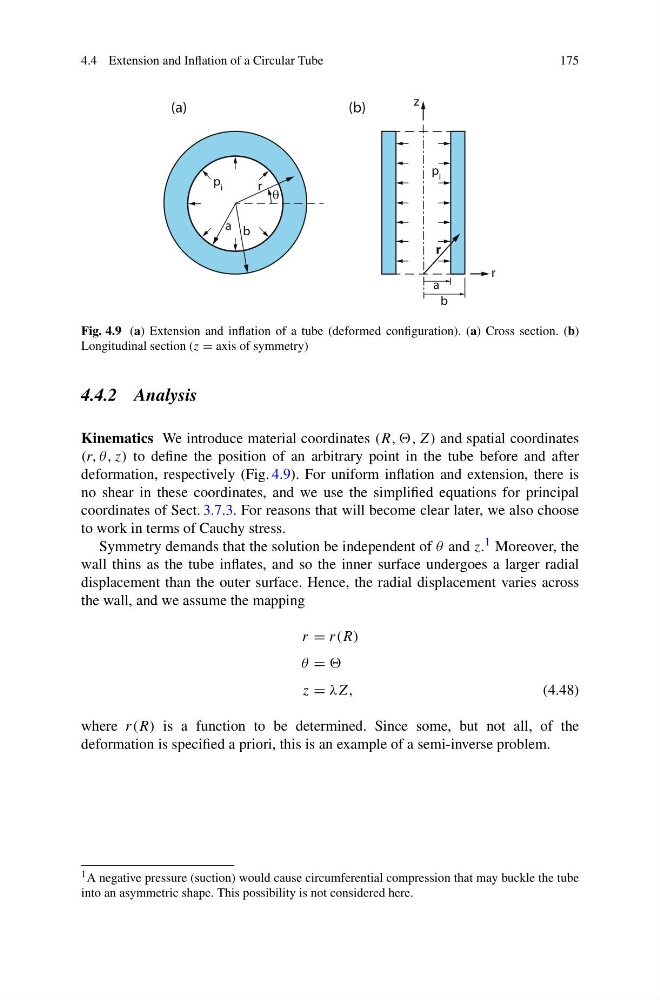
Fig. 4.9 (a) Extension and inflation of a tube (deformed configuration). (a) Cross section. (b)
Longitudinal section (z = axis of symmetry)
4.4.2 Analysis
Kinematics We introduce material coordinates (R, ,, Z) and spatial coordinates
(r, θ, z) to define the position of an arbitrary point in the tube before and after
deformation, respectively (Fig. 4.9). For uniform inflation and extension, there is
no shear in these coordinates, and we use the simplified equations for principal
coordinates of Sect. 3.7.3. For reasons that will become clear later, we also choose
to work in terms of Cauchy stress.
Symmetry demands that the solution be independent of θ and z. 1 Moreover, the
wall thins as the tube inflates, and so the inner surface undergoes a larger radial
displacement than the outer surface. Hence, the radial displacement varies across
the wall, and we assume the mapping
r = r(R)
θ =
z = λZ,
(4.48)
where r(R) is a function to be determined. Since some, but not all, of the
deformation is specified a priori, this is an example of a semi-inverse problem.
1 A negative pressure (suction) would cause circumferential compression that may buckle the tube
into an asymmetric shape. This possibility is not considered here.
175
P
r θ
p i
)
b
(
)
a
(
z
r
r
p i
a b
a
b
Fig. 4.9 (a) Extension and inflation of a tube (deformed configuration). (a) Cross section. (b)
Longitudinal section (z = axis of symmetry)
4.4.2 Analysis
Kinematics We introduce material coordinates (R, ,, Z) and spatial coordinates
(r, θ, z) to define the position of an arbitrary point in the tube before and after
deformation, respectively (Fig. 4.9). For uniform inflation and extension, there is
no shear in these coordinates, and we use the simplified equations for principal
coordinates of Sect. 3.7.3. For reasons that will become clear later, we also choose
to work in terms of Cauchy stress.
Symmetry demands that the solution be independent of θ and z. 1 Moreover, the
wall thins as the tube inflates, and so the inner surface undergoes a larger radial
displacement than the outer surface. Hence, the radial displacement varies across
the wall, and we assume the mapping
r = r(R)
θ =
z = λZ,
(4.48)
where r(R) is a function to be determined. Since some, but not all, of the
deformation is specified a priori, this is an example of a semi-inverse problem.
1 A negative pressure (suction) would cause circumferential compression that may buckle the tube
into an asymmetric shape. This possibility is not considered here.