

4.3 Shear of a Block
171
n T = e y ,
t T = e x ,
n R =
e x − ke y
√
1 + k 2
,
t R =
ke x + e y
√
1 + k 2
.
The corresponding vectors on the opposite sides are the negatives of these vectors.
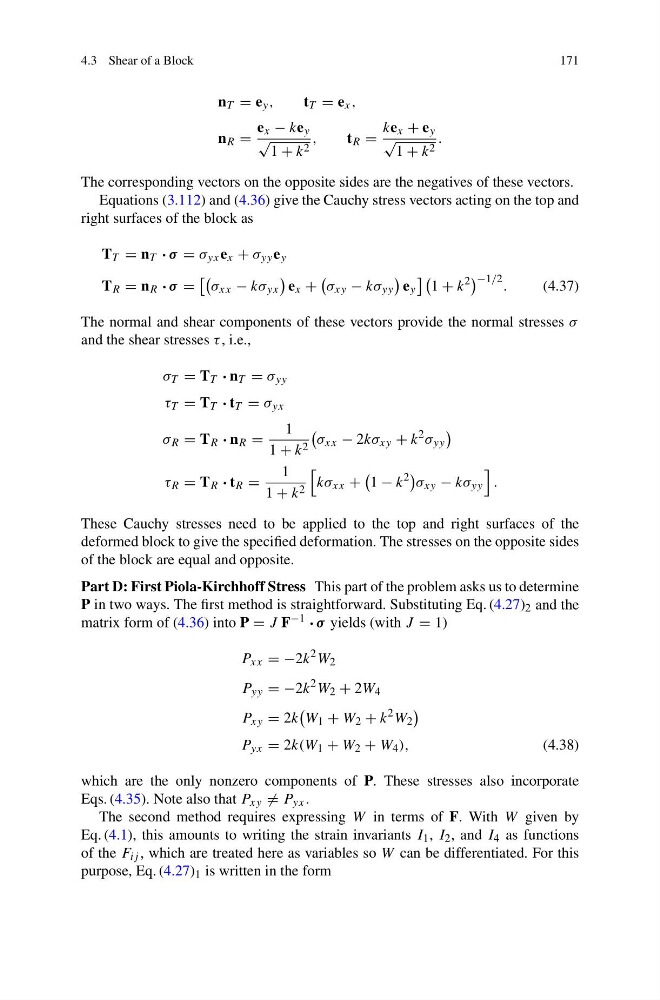
Equations (3.112) and (4.36) give the Cauchy stress vectors acting on the top and
right surfaces of the block as
T T = n T · σ = σ yx e x + σ yy e y
T R = n R · σ =
σ xx − kσ yx
e x +
σ xy − kσ yy
e y
1 + k
2
−1/2 .
(4.37)
The normal and shear components of these vectors provide the normal stresses σ
and the shear stresses τ , i.e.,
σ T = T T · n T = σ yy
τ T = T T · t T = σ yx
σ R = T R · n R =
1
1 + k 2
σ xx − 2kσ xy + k
2 σ yy
τ R = T R · t R =
1
1 + k 2
kσ xx +
1 − k
2
σ xy − kσ yy
.
These Cauchy stresses need to be applied to the top and right surfaces of the
deformed block to give the specified deformation. The stresses on the opposite sides
of the block are equal and opposite.
Part D: First Piola-Kirchhoff Stress This part of the problem asks us to determine
P in two ways. The first method is straightforward. Substituting Eq. (4.27) 2 and the
matrix form of (4.36) into P = J F −1 · σ yields (with J = 1)
P xx = −2k
2 W 2
P yy = −2k
2 W 2 + 2W 4
P xy = 2k
W 1 + W 2 + k
2 W 2
P yx = 2k(W 1 + W 2 + W 4 ),
(4.38)
which are the only nonzero components of P. These stresses also incorporate
Eqs. (4.35). Note also that P xy = P yx .
The second method requires expressing W in terms of F. With W given by
Eq. (4.1), this amounts to writing the strain invariants I 1 , I 2 , and I 4 as functions
of the F ij , which are treated here as variables so W can be differentiated. For this
purpose, Eq. (4.27) 1 is written in the form
171
n T = e y ,
t T = e x ,
n R =
e x − ke y
√
1 + k 2
,
t R =
ke x + e y
√
1 + k 2
.
The corresponding vectors on the opposite sides are the negatives of these vectors.
Equations (3.112) and (4.36) give the Cauchy stress vectors acting on the top and
right surfaces of the block as
T T = n T · σ = σ yx e x + σ yy e y
T R = n R · σ =
σ xx − kσ yx
e x +
σ xy − kσ yy
e y
1 + k
2
−1/2 .
(4.37)
The normal and shear components of these vectors provide the normal stresses σ
and the shear stresses τ , i.e.,
σ T = T T · n T = σ yy
τ T = T T · t T = σ yx
σ R = T R · n R =
1
1 + k 2
σ xx − 2kσ xy + k
2 σ yy
τ R = T R · t R =
1
1 + k 2
kσ xx +
1 − k
2
σ xy − kσ yy
.
These Cauchy stresses need to be applied to the top and right surfaces of the
deformed block to give the specified deformation. The stresses on the opposite sides
of the block are equal and opposite.
Part D: First Piola-Kirchhoff Stress This part of the problem asks us to determine
P in two ways. The first method is straightforward. Substituting Eq. (4.27) 2 and the
matrix form of (4.36) into P = J F −1 · σ yields (with J = 1)
P xx = −2k
2 W 2
P yy = −2k
2 W 2 + 2W 4
P xy = 2k
W 1 + W 2 + k
2 W 2
P yx = 2k(W 1 + W 2 + W 4 ),
(4.38)
which are the only nonzero components of P. These stresses also incorporate
Eqs. (4.35). Note also that P xy = P yx .
The second method requires expressing W in terms of F. With W given by
Eq. (4.1), this amounts to writing the strain invariants I 1 , I 2 , and I 4 as functions
of the F ij , which are treated here as variables so W can be differentiated. For this
purpose, Eq. (4.27) 1 is written in the form