

96
3 Continuum Mechanics and Nonlinear Elasticity
The second Piola-Kirchhoff stress vector is defined by
˜
T =
d ˜ f
dA 0 ,
(3.103)
which has no clear physical interpretation, although it will prove to be useful later.
All of these stress vectors also are called traction vectors.
In 2D, each of the stress vectors can be written in terms of components relative
to any two axes. One reasonable choice would be axes normal and tangential to the
corresponding surface element, giving
T = σ nn n + σ nm m
T
0
= P NN N + P NM M
˜
T = S NN N + S NM M,
(3.104)
where m and M are unit vectors tangent to the area elements dA and dA 0 ,
respectively (Fig. 3.13c). The σ ij are Cauchy stress components, while P I J and S I J
are first and second Piola-Kirchhoff stress components, respectively. For each case,
like subscripts indicate normal stresses, whereas unlike subscripts indicate shear
stresses.
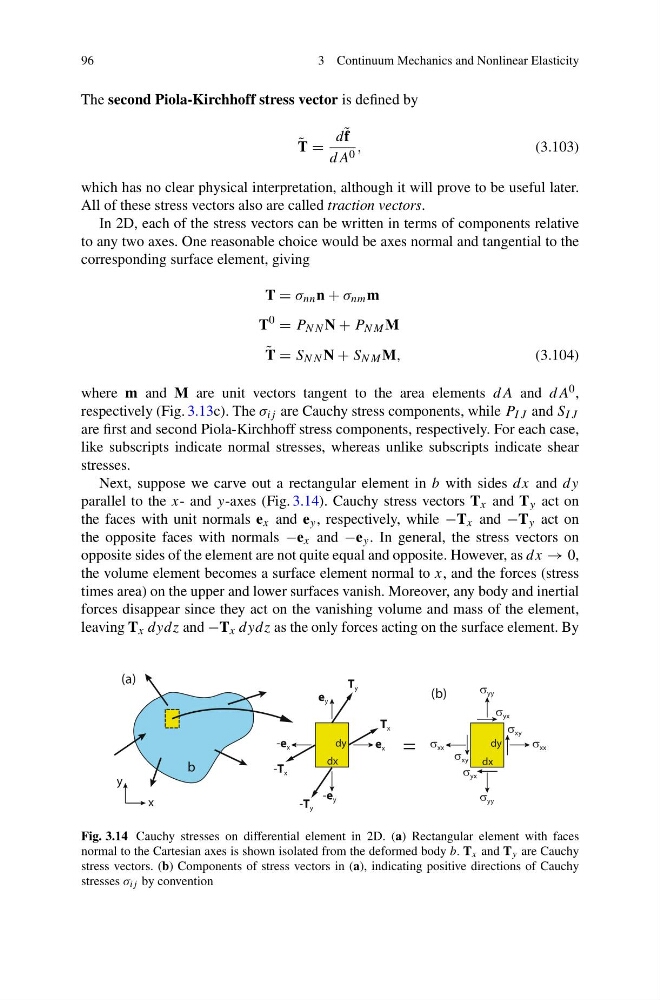
Next, suppose we carve out a rectangular element in b with sides dx and dy
parallel to the x- and y-axes (Fig. 3.14). Cauchy stress vectors T x and T y act on
the faces with unit normals e x and e y , respectively, while −T x and −T y act on
the opposite faces with normals −e x and −e y . In general, the stress vectors on
opposite sides of the element are not quite equal and opposite. However, as dx → 0,
the volume element becomes a surface element normal to x, and the forces (stress
times area) on the upper and lower surfaces vanish. Moreover, any body and inertial
forces disappear since they act on the vanishing volume and mass of the element,
leaving T x dydz and −T x dydz as the only forces acting on the surface element. By
b
dx
dy
e x
-e y
-e x
e y
T x
-T x
T y
-T y
dx
dy
σ xx
= σ xx
σ xy
σ xy
σ yx
σ yx
σ yy
σ yy
(a)
(b)
y
x
Fig. 3.14 Cauchy stresses on differential element in 2D. (a) Rectangular element with faces
normal to the Cartesian axes is shown isolated from the deformed body b. T x and T y are Cauchy
stress vectors. (b) Components of stress vectors in (a), indicating positive directions of Cauchy
stresses σ ij by convention
3 Continuum Mechanics and Nonlinear Elasticity
The second Piola-Kirchhoff stress vector is defined by
˜
T =
d ˜ f
dA 0 ,
(3.103)
which has no clear physical interpretation, although it will prove to be useful later.
All of these stress vectors also are called traction vectors.
In 2D, each of the stress vectors can be written in terms of components relative
to any two axes. One reasonable choice would be axes normal and tangential to the
corresponding surface element, giving
T = σ nn n + σ nm m
T
0
= P NN N + P NM M
˜
T = S NN N + S NM M,
(3.104)
where m and M are unit vectors tangent to the area elements dA and dA 0 ,
respectively (Fig. 3.13c). The σ ij are Cauchy stress components, while P I J and S I J
are first and second Piola-Kirchhoff stress components, respectively. For each case,
like subscripts indicate normal stresses, whereas unlike subscripts indicate shear
stresses.
Next, suppose we carve out a rectangular element in b with sides dx and dy
parallel to the x- and y-axes (Fig. 3.14). Cauchy stress vectors T x and T y act on
the faces with unit normals e x and e y , respectively, while −T x and −T y act on
the opposite faces with normals −e x and −e y . In general, the stress vectors on
opposite sides of the element are not quite equal and opposite. However, as dx → 0,
the volume element becomes a surface element normal to x, and the forces (stress
times area) on the upper and lower surfaces vanish. Moreover, any body and inertial
forces disappear since they act on the vanishing volume and mass of the element,
leaving T x dydz and −T x dydz as the only forces acting on the surface element. By
b
dx
dy
e x
-e y
-e x
e y
T x
-T x
T y
-T y
dx
dy
σ xx
= σ xx
σ xy
σ xy
σ yx
σ yx
σ yy
σ yy
(a)
(b)
y
x
Fig. 3.14 Cauchy stresses on differential element in 2D. (a) Rectangular element with faces
normal to the Cartesian axes is shown isolated from the deformed body b. T x and T y are Cauchy
stress vectors. (b) Components of stress vectors in (a), indicating positive directions of Cauchy
stresses σ ij by convention