

3.4 Analysis of Stress
97
Newton’s second law (f = ma), these forces must be equal and opposite, as depicted
on the element in Fig. 3.14a. A similar result holds as dy → 0.
It is important to emphasize that stress acts on a plane, and an infinite number of
planes pass through each point in a body. Here, we are considering the stress on only
two planes, which are normal to the Cartesian axes and pass through the point at the
center of the infinitesimal element. Planes of arbitrary orientation are examined in
the 3D analysis of the next subsection.
Consider now the stress components acting on these surfaces. By convention, T x
and T y point in the directions of increasing x and y (Fig. 3.14a). Resolving these
vectors along the x- and y-axes yields
T x = σ xx e x + σ xy e y
T y = σ yx e x + σ yy e y ,
(3.105)
where the σ ij are Cauchy stress components relative to the Cartesian axes. Figure 3.14b shows these stresses in their positive directions by definition. Note that
the first subscript corresponds to the face on which the stress acts, and the second to
the direction in which it acts.
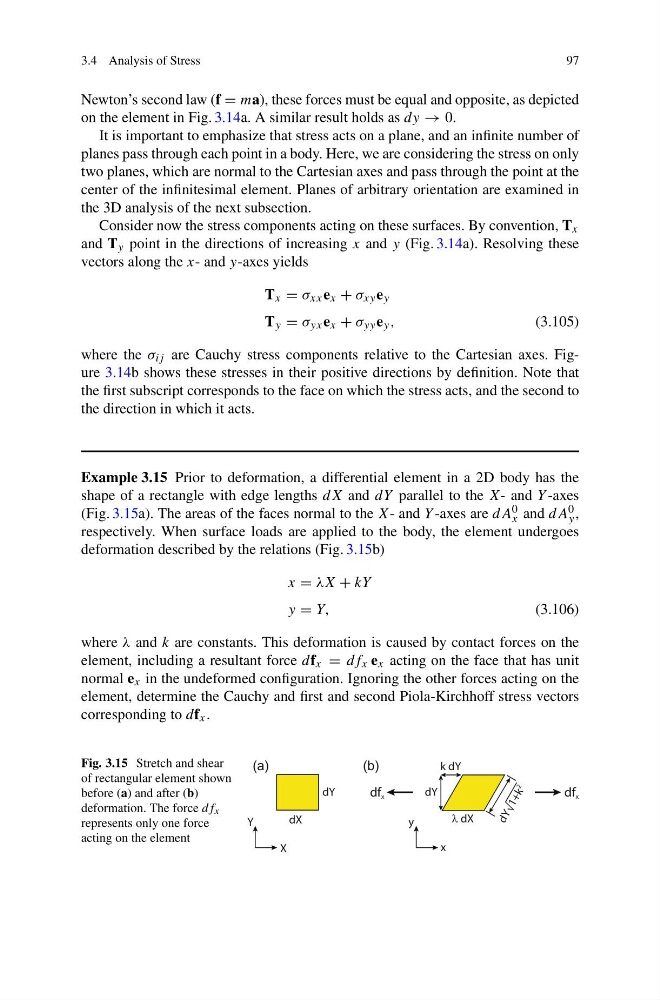
Example 3.15 Prior to deformation, a differential element in a 2D body has the
shape of a rectangle with edge lengths dX and dY parallel to the X- and Y -axes
(Fig. 3.15a). The areas of the faces normal to the X- and Y -axes are dA 0
x and dA 0
y ,
respectively. When surface loads are applied to the body, the element undergoes
deformation described by the relations (Fig. 3.15b)
x = λX + kY
y = Y,
(3.106)
where λ and k are constants. This deformation is caused by contact forces on the
element, including a resultant force df x = df x e x acting on the face that has unit
normal e x in the undeformed configuration. Ignoring the other forces acting on the
element, determine the Cauchy and first and second Piola-Kirchhoff stress vectors
corresponding to df x .
Fig. 3.15 Stretch and shear
of rectangular element shown
before (a) and after (b)
deformation. The force df x
represents only one force
acting on the element
dX
dY
Y
X
y
x
dX
dY
k dY
d Y √ 1 + k 2
df x
df x
(a)
(b)
97
Newton’s second law (f = ma), these forces must be equal and opposite, as depicted
on the element in Fig. 3.14a. A similar result holds as dy → 0.
It is important to emphasize that stress acts on a plane, and an infinite number of
planes pass through each point in a body. Here, we are considering the stress on only
two planes, which are normal to the Cartesian axes and pass through the point at the
center of the infinitesimal element. Planes of arbitrary orientation are examined in
the 3D analysis of the next subsection.
Consider now the stress components acting on these surfaces. By convention, T x
and T y point in the directions of increasing x and y (Fig. 3.14a). Resolving these
vectors along the x- and y-axes yields
T x = σ xx e x + σ xy e y
T y = σ yx e x + σ yy e y ,
(3.105)
where the σ ij are Cauchy stress components relative to the Cartesian axes. Figure 3.14b shows these stresses in their positive directions by definition. Note that
the first subscript corresponds to the face on which the stress acts, and the second to
the direction in which it acts.
Example 3.15 Prior to deformation, a differential element in a 2D body has the
shape of a rectangle with edge lengths dX and dY parallel to the X- and Y -axes
(Fig. 3.15a). The areas of the faces normal to the X- and Y -axes are dA 0
x and dA 0
y ,
respectively. When surface loads are applied to the body, the element undergoes
deformation described by the relations (Fig. 3.15b)
x = λX + kY
y = Y,
(3.106)
where λ and k are constants. This deformation is caused by contact forces on the
element, including a resultant force df x = df x e x acting on the face that has unit
normal e x in the undeformed configuration. Ignoring the other forces acting on the
element, determine the Cauchy and first and second Piola-Kirchhoff stress vectors
corresponding to df x .
Fig. 3.15 Stretch and shear
of rectangular element shown
before (a) and after (b)
deformation. The force df x
represents only one force
acting on the element
dX
dY
Y
X
y
x
dX
dY
k dY
d Y √ 1 + k 2
df x
df x
(a)
(b)