

92
3 Continuum Mechanics and Nonlinear Elasticity
where
◦
F = ˙
F · F −1 .
(3.93)
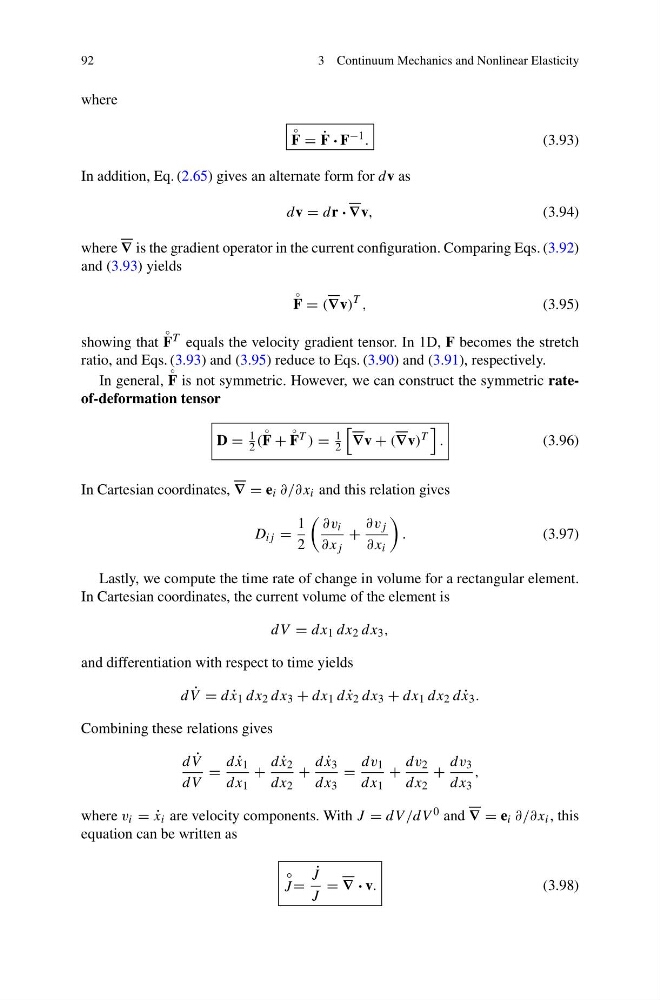
In addition, Eq. (2.65) gives an alternate form for dv as
dv = dr · ∇v,
(3.94)
where ∇ is the gradient operator in the current configuration. Comparing Eqs. (3.92)
and (3.93) yields
◦
F = (∇v)
T ,
(3.95)
showing that
◦
F T equals the velocity gradient tensor. In 1D, F becomes the stretch
ratio, and Eqs. (3.93) and (3.95) reduce to Eqs. (3.90) and (3.91), respectively.
In general,
◦
F is not symmetric. However, we can construct the symmetric rateof-deformation tensor
D =
1
2 (
◦
F +
◦
F T ) =
1
2
∇v + (∇v) T
.
(3.96)
In Cartesian coordinates, ∇ = e i ∂/∂x i and this relation gives
D ij =
1
2
∂v i
∂x j
+
∂v j
∂x i
.
(3.97)
Lastly, we compute the time rate of change in volume for a rectangular element.
In Cartesian coordinates, the current volume of the element is
dV = dx 1 dx 2 dx 3 ,
and differentiation with respect to time yields
d ˙
V = d ˙
x 1 dx 2 dx 3 + dx 1 d ˙
x 2 dx 3 + dx 1 dx 2 d ˙
x 3 .
Combining these relations gives
d ˙
V
dV
=
d ˙
x 1
dx 1
+
d ˙
x 2
dx 2
+
d ˙
x 3
dx 3
=
dv 1
dx 1
+
dv 2
dx 2
+
dv 3
dx 3
,
where v i = ˙
x i are velocity components. With J = dV /dV 0 and ∇ = e i ∂/∂x i , this
equation can be written as
◦
J =
˙
J
J
= ∇ · v.
(3.98)
3 Continuum Mechanics and Nonlinear Elasticity
where
◦
F = ˙
F · F −1 .
(3.93)
In addition, Eq. (2.65) gives an alternate form for dv as
dv = dr · ∇v,
(3.94)
where ∇ is the gradient operator in the current configuration. Comparing Eqs. (3.92)
and (3.93) yields
◦
F = (∇v)
T ,
(3.95)
showing that
◦
F T equals the velocity gradient tensor. In 1D, F becomes the stretch
ratio, and Eqs. (3.93) and (3.95) reduce to Eqs. (3.90) and (3.91), respectively.
In general,
◦
F is not symmetric. However, we can construct the symmetric rateof-deformation tensor
D =
1
2 (
◦
F +
◦
F T ) =
1
2
∇v + (∇v) T
.
(3.96)
In Cartesian coordinates, ∇ = e i ∂/∂x i and this relation gives
D ij =
1
2
∂v i
∂x j
+
∂v j
∂x i
.
(3.97)
Lastly, we compute the time rate of change in volume for a rectangular element.
In Cartesian coordinates, the current volume of the element is
dV = dx 1 dx 2 dx 3 ,
and differentiation with respect to time yields
d ˙
V = d ˙
x 1 dx 2 dx 3 + dx 1 d ˙
x 2 dx 3 + dx 1 dx 2 d ˙
x 3 .
Combining these relations gives
d ˙
V
dV
=
d ˙
x 1
dx 1
+
d ˙
x 2
dx 2
+
d ˙
x 3
dx 3
=
dv 1
dx 1
+
dv 2
dx 2
+
dv 3
dx 3
,
where v i = ˙
x i are velocity components. With J = dV /dV 0 and ∇ = e i ∂/∂x i , this
equation can be written as
◦
J =
˙
J
J
= ∇ · v.
(3.98)