

3.4 Analysis of Stress
93
3.4 Analysis of Stress
Forces exerted on an object consist of two types. Body forces act at a distance on the
material volume of the object, e.g., gravitational and magnetic forces. In contrast,
contact forces act through direct contact on surfaces, e.g., pressure and frictional
forces. Contact forces can be exerted on any surface of a body, including the surface
of an internal cavity. Forces exerted on the surface of an element by surrounding
material also can be considered contact forces.
Stress is a type of contact force that is defined as force per unit area. This seems
like a simple concept, but it is not always as simple as it seems, especially when
deformations are large. Here again, it is helpful to introduce complexities gradually
by moving sequentially from one to two to three dimensions.
3.4.1 Stress in 1D
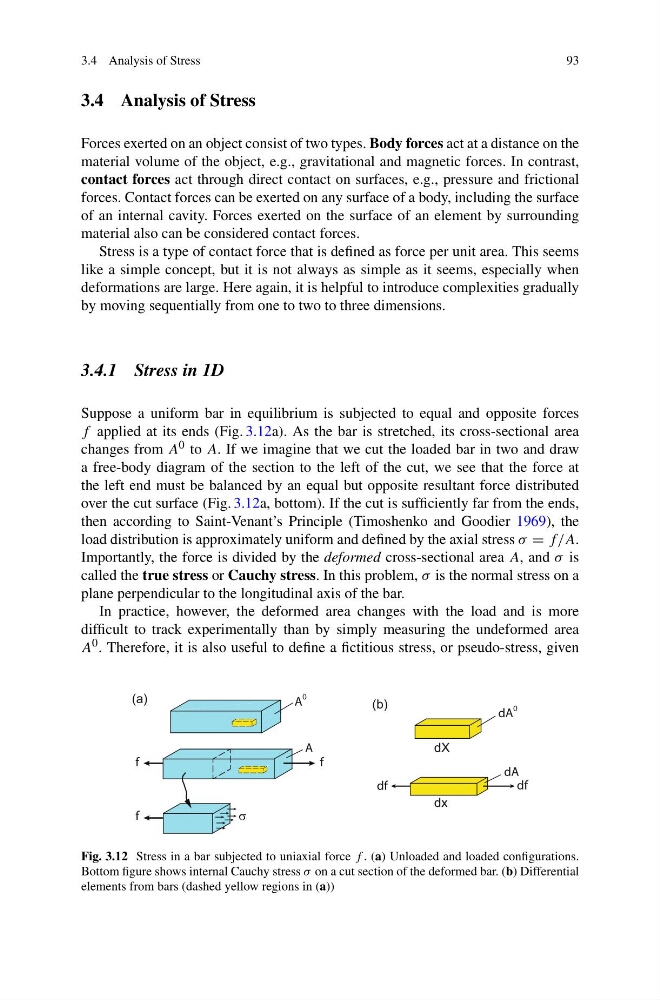
Suppose a uniform bar in equilibrium is subjected to equal and opposite forces
f applied at its ends (Fig. 3.12a). As the bar is stretched, its cross-sectional area
changes from A 0 to A. If we imagine that we cut the loaded bar in two and draw
a free-body diagram of the section to the left of the cut, we see that the force at
the left end must be balanced by an equal but opposite resultant force distributed
over the cut surface (Fig. 3.12a, bottom). If the cut is sufficiently far from the ends,
then according to Saint-Venant’s Principle (Timoshenko and Goodier 1969), the
load distribution is approximately uniform and defined by the axial stress σ = f/A.
Importantly, the force is divided by the deformed cross-sectional area A, and σ is
called the true stress or Cauchy stress. In this problem, σ is the normal stress on a
plane perpendicular to the longitudinal axis of the bar.
In practice, however, the deformed area changes with the load and is more
difficult to track experimentally than by simply measuring the undeformed area
A 0 . Therefore, it is also useful to define a fictitious stress, or pseudo-stress, given
A
0
A
f
f
f
σ
dA
0
dA
df
df
dX
dx
(a)
(b)
Fig. 3.12 Stress in a bar subjected to uniaxial force f . (a) Unloaded and loaded configurations.
Bottom figure shows internal Cauchy stress σ on a cut section of the deformed bar. (b) Differential
elements from bars (dashed yellow regions in (a))
93
3.4 Analysis of Stress
Forces exerted on an object consist of two types. Body forces act at a distance on the
material volume of the object, e.g., gravitational and magnetic forces. In contrast,
contact forces act through direct contact on surfaces, e.g., pressure and frictional
forces. Contact forces can be exerted on any surface of a body, including the surface
of an internal cavity. Forces exerted on the surface of an element by surrounding
material also can be considered contact forces.
Stress is a type of contact force that is defined as force per unit area. This seems
like a simple concept, but it is not always as simple as it seems, especially when
deformations are large. Here again, it is helpful to introduce complexities gradually
by moving sequentially from one to two to three dimensions.
3.4.1 Stress in 1D
Suppose a uniform bar in equilibrium is subjected to equal and opposite forces
f applied at its ends (Fig. 3.12a). As the bar is stretched, its cross-sectional area
changes from A 0 to A. If we imagine that we cut the loaded bar in two and draw
a free-body diagram of the section to the left of the cut, we see that the force at
the left end must be balanced by an equal but opposite resultant force distributed
over the cut surface (Fig. 3.12a, bottom). If the cut is sufficiently far from the ends,
then according to Saint-Venant’s Principle (Timoshenko and Goodier 1969), the
load distribution is approximately uniform and defined by the axial stress σ = f/A.
Importantly, the force is divided by the deformed cross-sectional area A, and σ is
called the true stress or Cauchy stress. In this problem, σ is the normal stress on a
plane perpendicular to the longitudinal axis of the bar.
In practice, however, the deformed area changes with the load and is more
difficult to track experimentally than by simply measuring the undeformed area
A 0 . Therefore, it is also useful to define a fictitious stress, or pseudo-stress, given
A
0
A
f
f
f
σ
dA
0
dA
df
df
dX
dx
(a)
(b)
Fig. 3.12 Stress in a bar subjected to uniaxial force f . (a) Unloaded and loaded configurations.
Bottom figure shows internal Cauchy stress σ on a cut section of the deformed bar. (b) Differential
elements from bars (dashed yellow regions in (a))