

3.3 Analysis of Deformation
91
example, viscoelastic materials are inherently rate dependent. Mechanobiological
processes, such as growth, also generally depend on time. Thus, it is important to
consider rate effects for some of the problems we will encounter.
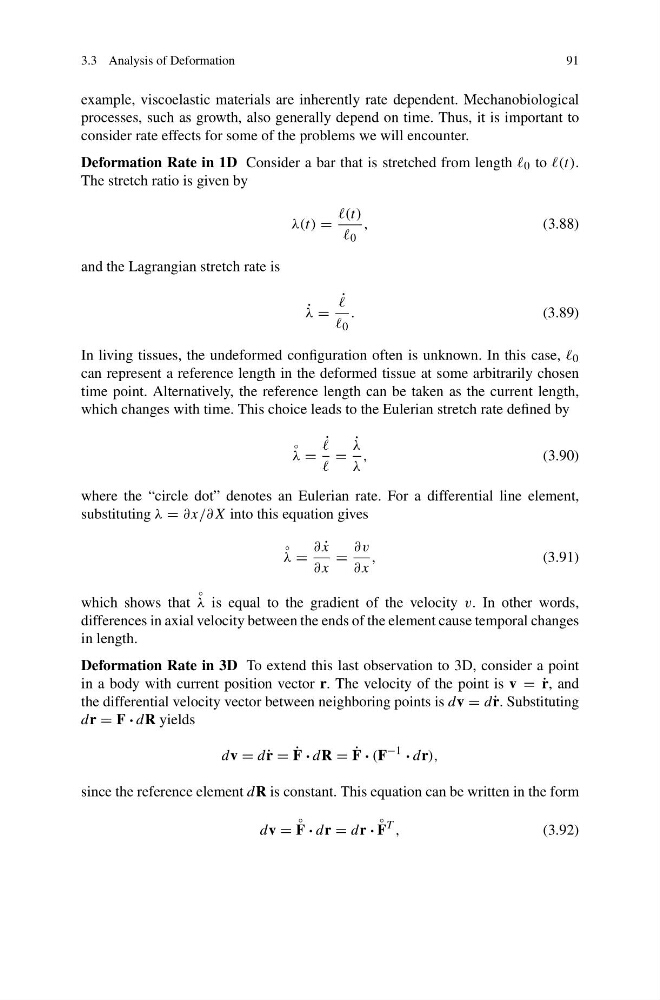
Deformation Rate in 1D Consider a bar that is stretched from length 0 to (t).
The stretch ratio is given by
λ(t) =
0
,
(3.88)
and the Lagrangian stretch rate is
˙
λ =
˙
0
.
(3.89)
In living tissues, the undeformed configuration often is unknown. In this case, 0
can represent a reference length in the deformed tissue at some arbitrarily chosen
time point. Alternatively, the reference length can be taken as the current length,
which changes with time. This choice leads to the Eulerian stretch rate defined by
◦
λ =
˙
=
˙
λ
λ
,
(3.90)
where the “circle dot” denotes an Eulerian rate. For a differential line element,
substituting λ = ∂x/∂X into this equation gives
◦
λ =
∂ ˙
x
∂x
=
∂v
∂x
,
(3.91)
which shows that
◦
λ is equal to the gradient of the velocity v. In other words,
differences in axial velocity between the ends of the element cause temporal changes
in length.
Deformation Rate in 3D To extend this last observation to 3D, consider a point
in a body with current position vector r. The velocity of the point is v = ˙
r, and
the differential velocity vector between neighboring points is dv = d˙ r. Substituting
dr = F · dR yields
dv = d˙ r = ˙
F · dR = ˙
F · (F
−1
· dr),
since the reference element dR is constant. This equation can be written in the form
dv =
◦
F · dr = dr ·
◦
F
T ,
(3.92)
91
example, viscoelastic materials are inherently rate dependent. Mechanobiological
processes, such as growth, also generally depend on time. Thus, it is important to
consider rate effects for some of the problems we will encounter.
Deformation Rate in 1D Consider a bar that is stretched from length 0 to (t).
The stretch ratio is given by
λ(t) =
0
,
(3.88)
and the Lagrangian stretch rate is
˙
λ =
˙
0
.
(3.89)
In living tissues, the undeformed configuration often is unknown. In this case, 0
can represent a reference length in the deformed tissue at some arbitrarily chosen
time point. Alternatively, the reference length can be taken as the current length,
which changes with time. This choice leads to the Eulerian stretch rate defined by
◦
λ =
˙
=
˙
λ
λ
,
(3.90)
where the “circle dot” denotes an Eulerian rate. For a differential line element,
substituting λ = ∂x/∂X into this equation gives
◦
λ =
∂ ˙
x
∂x
=
∂v
∂x
,
(3.91)
which shows that
◦
λ is equal to the gradient of the velocity v. In other words,
differences in axial velocity between the ends of the element cause temporal changes
in length.
Deformation Rate in 3D To extend this last observation to 3D, consider a point
in a body with current position vector r. The velocity of the point is v = ˙
r, and
the differential velocity vector between neighboring points is dv = d˙ r. Substituting
dr = F · dR yields
dv = d˙ r = ˙
F · dR = ˙
F · (F
−1
· dr),
since the reference element dR is constant. This equation can be written in the form
dv =
◦
F · dr = dr ·
◦
F
T ,
(3.92)