

90
3 Continuum Mechanics and Nonlinear Elasticity
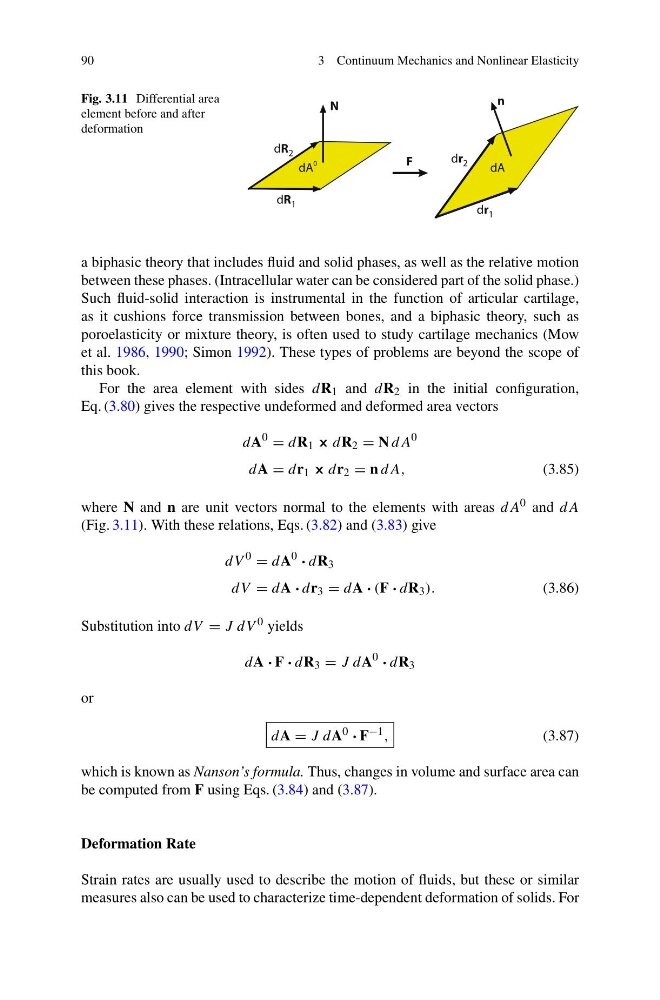
Fig. 3.11 Differential area
element before and after
deformation
dR 1
dR 2
dA
0
N
n
dr 2
dr 1
F
dA
a biphasic theory that includes fluid and solid phases, as well as the relative motion
between these phases. (Intracellular water can be considered part of the solid phase.)
Such fluid-solid interaction is instrumental in the function of articular cartilage,
as it cushions force transmission between bones, and a biphasic theory, such as
poroelasticity or mixture theory, is often used to study cartilage mechanics (Mow
et al. 1986, 1990; Simon 1992). These types of problems are beyond the scope of
this book.
For the area element with sides dR 1 and dR 2 in the initial configuration,
Eq. (3.80) gives the respective undeformed and deformed area vectors
dA
0
= dR 1 × dR 2 = N dA
0
dA = dr 1 × dr 2 = n dA,
(3.85)
where N and n are unit vectors normal to the elements with areas dA 0 and dA
(Fig. 3.11). With these relations, Eqs. (3.82) and (3.83) give
dV
0
= dA
0
· dR 3
dV = dA · dr 3 = dA · (F · dR 3 ).
(3.86)
Substitution into dV = J dV 0 yields
dA · F · dR 3 = J dA
0
· dR 3
or
dA = J dA 0 · F −1 ,
(3.87)
which is known as Nanson’s formula. Thus, changes in volume and surface area can
be computed from F using Eqs. (3.84) and (3.87).
Deformation Rate
Strain rates are usually used to describe the motion of fluids, but these or similar
measures also can be used to characterize time-dependent deformation of solids. For
3 Continuum Mechanics and Nonlinear Elasticity
Fig. 3.11 Differential area
element before and after
deformation
dR 1
dR 2
dA
0
N
n
dr 2
dr 1
F
dA
a biphasic theory that includes fluid and solid phases, as well as the relative motion
between these phases. (Intracellular water can be considered part of the solid phase.)
Such fluid-solid interaction is instrumental in the function of articular cartilage,
as it cushions force transmission between bones, and a biphasic theory, such as
poroelasticity or mixture theory, is often used to study cartilage mechanics (Mow
et al. 1986, 1990; Simon 1992). These types of problems are beyond the scope of
this book.
For the area element with sides dR 1 and dR 2 in the initial configuration,
Eq. (3.80) gives the respective undeformed and deformed area vectors
dA
0
= dR 1 × dR 2 = N dA
0
dA = dr 1 × dr 2 = n dA,
(3.85)
where N and n are unit vectors normal to the elements with areas dA 0 and dA
(Fig. 3.11). With these relations, Eqs. (3.82) and (3.83) give
dV
0
= dA
0
· dR 3
dV = dA · dr 3 = dA · (F · dR 3 ).
(3.86)
Substitution into dV = J dV 0 yields
dA · F · dR 3 = J dA
0
· dR 3
or
dA = J dA 0 · F −1 ,
(3.87)
which is known as Nanson’s formula. Thus, changes in volume and surface area can
be computed from F using Eqs. (3.84) and (3.87).
Deformation Rate
Strain rates are usually used to describe the motion of fluids, but these or similar
measures also can be used to characterize time-dependent deformation of solids. For