

630
P. Liu
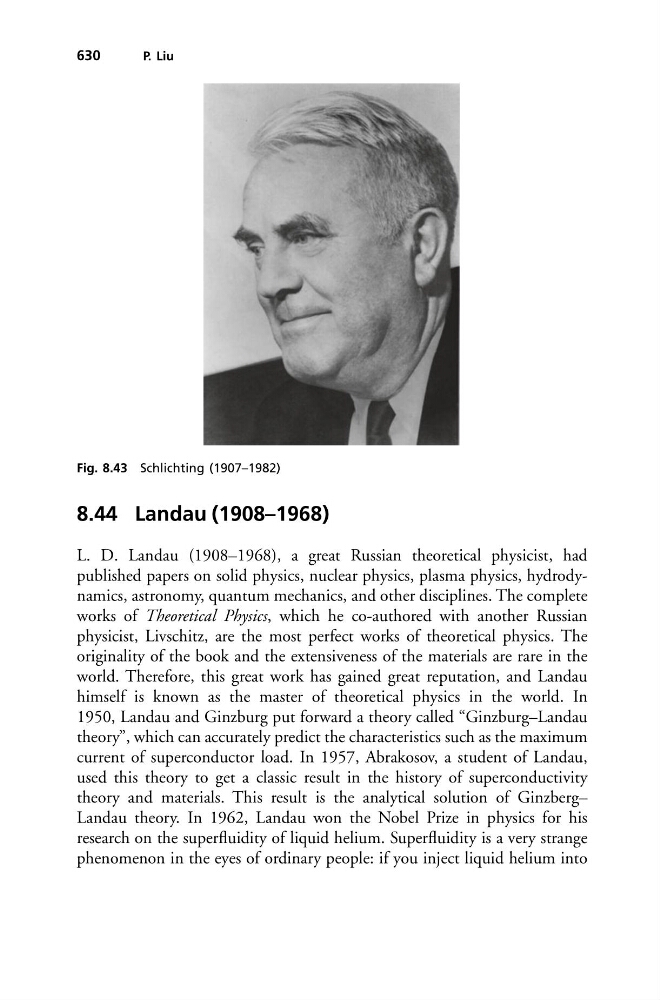
Fig. 8.43 Schlichting (1907–1982)
8.44 Landau (1908–1968)
L. D. Landau (1908–1968), a great Russian theoretical physicist, had
published papers on solid physics, nuclear physics, plasma physics, hydrodynamics, astronomy, quantum mechanics, and other disciplines. The complete
works of Theoretical Physics, which he co-authored with another Russian
physicist, Livschitz, are the most perfect works of theoretical physics. The
originality of the book and the extensiveness of the materials are rare in the
world. Therefore, this great work has gained great reputation, and Landau
himself is known as the master of theoretical physics in the world. In
1950, Landau and Ginzburg put forward a theory called “Ginzburg–Landau
theory”, which can accurately predict the characteristics such as the maximum
current of superconductor load. In 1957, Abrakosov, a student of Landau,
used this theory to get a classic result in the history of superconductivity
theory and materials. This result is the analytical solution of Ginzberg–
Landau theory. In 1962, Landau won the Nobel Prize in physics for his
research on the superfluidity of liquid helium. Superfluidity is a very strange
phenomenon in the eyes of ordinary people: if you inject liquid helium into
P. Liu
Fig. 8.43 Schlichting (1907–1982)
8.44 Landau (1908–1968)
L. D. Landau (1908–1968), a great Russian theoretical physicist, had
published papers on solid physics, nuclear physics, plasma physics, hydrodynamics, astronomy, quantum mechanics, and other disciplines. The complete
works of Theoretical Physics, which he co-authored with another Russian
physicist, Livschitz, are the most perfect works of theoretical physics. The
originality of the book and the extensiveness of the materials are rare in the
world. Therefore, this great work has gained great reputation, and Landau
himself is known as the master of theoretical physics in the world. In
1950, Landau and Ginzburg put forward a theory called “Ginzburg–Landau
theory”, which can accurately predict the characteristics such as the maximum
current of superconductor load. In 1957, Abrakosov, a student of Landau,
used this theory to get a classic result in the history of superconductivity
theory and materials. This result is the analytical solution of Ginzberg–
Landau theory. In 1962, Landau won the Nobel Prize in physics for his
research on the superfluidity of liquid helium. Superfluidity is a very strange
phenomenon in the eyes of ordinary people: if you inject liquid helium into