

8 Introduction to Celebrities in Fluid Mechanics
629
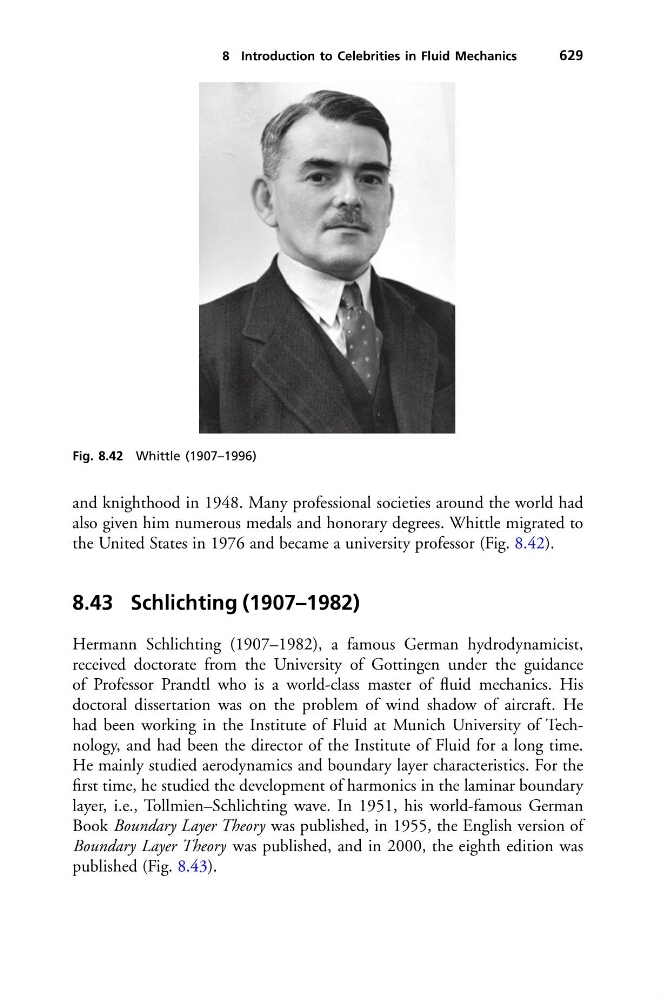
Fig. 8.42 Whittle (1907–1996)
and knighthood in 1948. Many professional societies around the world had
also given him numerous medals and honorary degrees. Whittle migrated to
the United States in 1976 and became a university professor (Fig. 8.42).
8.43 Schlichting (1907–1982)
Hermann Schlichting (1907–1982), a famous German hydrodynamicist,
received doctorate from the University of Gottingen under the guidance
of Professor Prandtl who is a world-class master of fluid mechanics. His
doctoral dissertation was on the problem of wind shadow of aircraft. He
had been working in the Institute of Fluid at Munich University of Technology, and had been the director of the Institute of Fluid for a long time.
He mainly studied aerodynamics and boundary layer characteristics. For the
first time, he studied the development of harmonics in the laminar boundary
layer, i.e., Tollmien–Schlichting wave. In 1951, his world-famous German
Book Boundary Layer Theory was published, in 1955, the English version of
Boundary Layer Theory was published, and in 2000, the eighth edition was
published (Fig. 8.43).
629
Fig. 8.42 Whittle (1907–1996)
and knighthood in 1948. Many professional societies around the world had
also given him numerous medals and honorary degrees. Whittle migrated to
the United States in 1976 and became a university professor (Fig. 8.42).
8.43 Schlichting (1907–1982)
Hermann Schlichting (1907–1982), a famous German hydrodynamicist,
received doctorate from the University of Gottingen under the guidance
of Professor Prandtl who is a world-class master of fluid mechanics. His
doctoral dissertation was on the problem of wind shadow of aircraft. He
had been working in the Institute of Fluid at Munich University of Technology, and had been the director of the Institute of Fluid for a long time.
He mainly studied aerodynamics and boundary layer characteristics. For the
first time, he studied the development of harmonics in the laminar boundary
layer, i.e., Tollmien–Schlichting wave. In 1951, his world-famous German
Book Boundary Layer Theory was published, in 1955, the English version of
Boundary Layer Theory was published, and in 2000, the eighth edition was
published (Fig. 8.43).