

8 Introduction to Celebrities in Fluid Mechanics
625
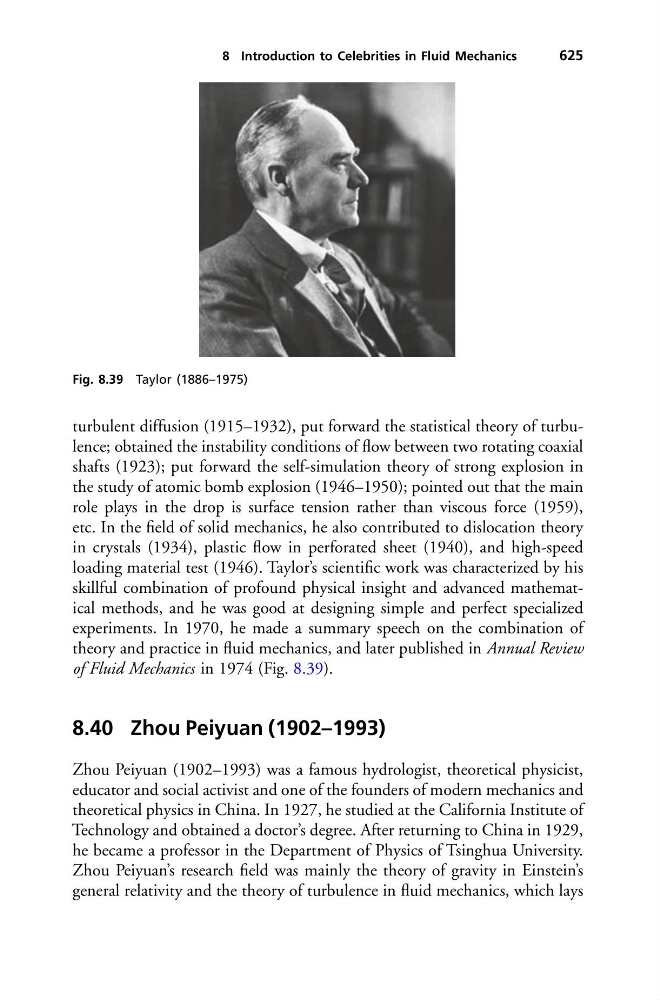
Fig. 8.39 Taylor (1886–1975)
turbulent diffusion (1915–1932), put forward the statistical theory of turbulence; obtained the instability conditions of flow between two rotating coaxial
shafts (1923); put forward the self-simulation theory of strong explosion in
the study of atomic bomb explosion (1946–1950); pointed out that the main
role plays in the drop is surface tension rather than viscous force (1959),
etc. In the field of solid mechanics, he also contributed to dislocation theory
in crystals (1934), plastic flow in perforated sheet (1940), and high-speed
loading material test (1946). Taylor’s scientific work was characterized by his
skillful combination of profound physical insight and advanced mathematical methods, and he was good at designing simple and perfect specialized
experiments. In 1970, he made a summary speech on the combination of
theory and practice in fluid mechanics, and later published in Annual Review
of Fluid Mechanics in 1974 (Fig. 8.39).
8.40 Zhou Peiyuan (1902–1993)
Zhou Peiyuan (1902–1993) was a famous hydrologist, theoretical physicist,
educator and social activist and one of the founders of modern mechanics and
theoretical physics in China. In 1927, he studied at the California Institute of
Technology and obtained a doctor’s degree. After returning to China in 1929,
he became a professor in the Department of Physics of Tsinghua University.
Zhou Peiyuan’s research field was mainly the theory of gravity in Einstein’s
general relativity and the theory of turbulence in fluid mechanics, which lays
625
Fig. 8.39 Taylor (1886–1975)
turbulent diffusion (1915–1932), put forward the statistical theory of turbulence; obtained the instability conditions of flow between two rotating coaxial
shafts (1923); put forward the self-simulation theory of strong explosion in
the study of atomic bomb explosion (1946–1950); pointed out that the main
role plays in the drop is surface tension rather than viscous force (1959),
etc. In the field of solid mechanics, he also contributed to dislocation theory
in crystals (1934), plastic flow in perforated sheet (1940), and high-speed
loading material test (1946). Taylor’s scientific work was characterized by his
skillful combination of profound physical insight and advanced mathematical methods, and he was good at designing simple and perfect specialized
experiments. In 1970, he made a summary speech on the combination of
theory and practice in fluid mechanics, and later published in Annual Review
of Fluid Mechanics in 1974 (Fig. 8.39).
8.40 Zhou Peiyuan (1902–1993)
Zhou Peiyuan (1902–1993) was a famous hydrologist, theoretical physicist,
educator and social activist and one of the founders of modern mechanics and
theoretical physics in China. In 1927, he studied at the California Institute of
Technology and obtained a doctor’s degree. After returning to China in 1929,
he became a professor in the Department of Physics of Tsinghua University.
Zhou Peiyuan’s research field was mainly the theory of gravity in Einstein’s
general relativity and the theory of turbulence in fluid mechanics, which lays