

8 Introduction to Celebrities in Fluid Mechanics
609
8.25 Langley (1834–1906)
Langley (1834–1906), American astronomer and pioneer of flight, invented
a bolometer in 1881, which was used to precisely measure a tiny amount of
heat (a temperature difference of up to one hundred thousandths of a degree),
measured by the amount of current generated by heating a blackened white
gold wire. In order to commemorate him, the radiation unit of 1 cal per
square centimeter is called 1 Langley. During Langley’s visit to Whitney hills,
California, the instrument was used to measure the solar radiation intensity in
the visible and infrared regions of the spectrums. In this process, he extended
the knowledge of solar spectrum to far-infrared region for the first time.
Langley had never been to a university, but he was a scholar famous for his
tenacious self-study. He had enough ability to engage in astronomy and aeronautics. In 1865, he became an assistant professor of astronomy at Harvard
University, and finally obtained the professorship of this subject in several
colleges. Langley studied the principles of aerodynamics, showing how birds
glide with their wings, and how air can support thin wings of special shapes.
His formula for lifting force is still used today. Although Langley’s theory is
feasible, in practice, due to the structural strength of the materials he used or
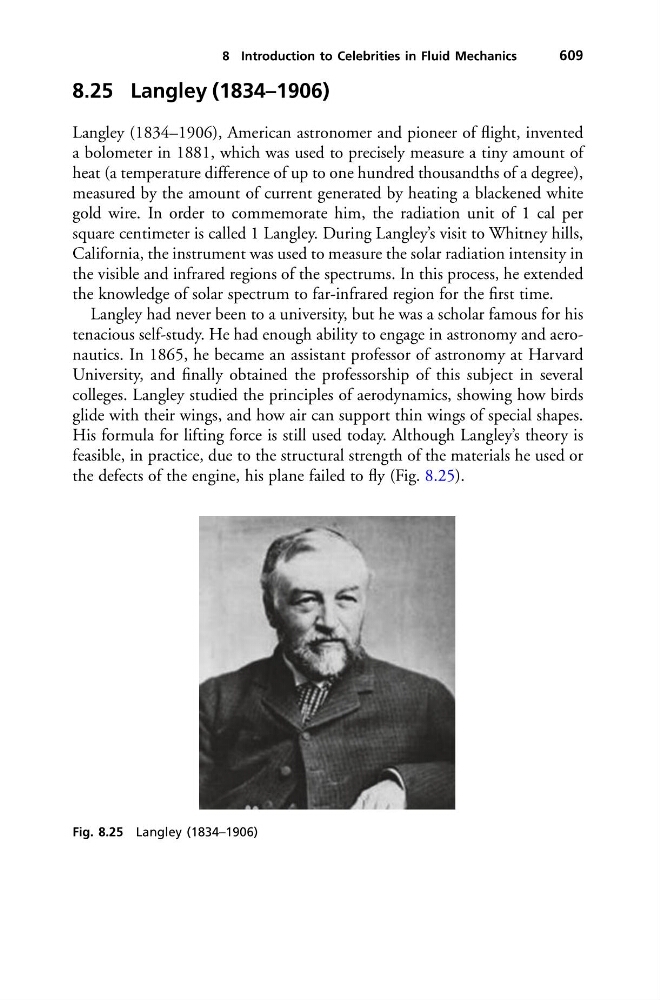
the defects of the engine, his plane failed to fly (Fig. 8.25).
Fig. 8.25 Langley (1834–1906)
609
8.25 Langley (1834–1906)
Langley (1834–1906), American astronomer and pioneer of flight, invented
a bolometer in 1881, which was used to precisely measure a tiny amount of
heat (a temperature difference of up to one hundred thousandths of a degree),
measured by the amount of current generated by heating a blackened white
gold wire. In order to commemorate him, the radiation unit of 1 cal per
square centimeter is called 1 Langley. During Langley’s visit to Whitney hills,
California, the instrument was used to measure the solar radiation intensity in
the visible and infrared regions of the spectrums. In this process, he extended
the knowledge of solar spectrum to far-infrared region for the first time.
Langley had never been to a university, but he was a scholar famous for his
tenacious self-study. He had enough ability to engage in astronomy and aeronautics. In 1865, he became an assistant professor of astronomy at Harvard
University, and finally obtained the professorship of this subject in several
colleges. Langley studied the principles of aerodynamics, showing how birds
glide with their wings, and how air can support thin wings of special shapes.
His formula for lifting force is still used today. Although Langley’s theory is
feasible, in practice, due to the structural strength of the materials he used or
the defects of the engine, his plane failed to fly (Fig. 8.25).
Fig. 8.25 Langley (1834–1906)