

610
P. Liu
8.26 Mach (1838–1916)
Ernst Mach (1838–1916), Austrian physicist and philosopher, received his
doctorate from the University of Vienna in 1860. He had contributed to
mechanics, acoustics, thermodynamics, experimental psychology, and philosophy. Mach used schlieren technique to study the flying projectiles. In 1887,
he studied the spherical disturbance wave propagating at the speed of sound
c emitted by the moving object in the air. When the velocity v of the object
is greater than c, the wavefront of the disturbance wave forms a conical envelope surface. The relationship between the angle α, formed by the generatrix
of the conical surface and the moving direction of the object v and c is sin α
= c / v. In 1907, L. Prandtl called the angle “Mach angle” for the first time. In
1929, in view of the increasing importance of the ratio v/c in aerodynamics,
J. Akerlett suggested using the term Mach number. In the late 1930s, Mach
number became an important parameter to characterize the state of fluid
motion. As a philosopher, Mach was skeptical of many basic ideas of physics
at that time. In his important work Mechanics, he made a profound criticism on the space–time view, movement view, and material view of classical
mechanics. Mach also contributed to the study of the history of mechanics
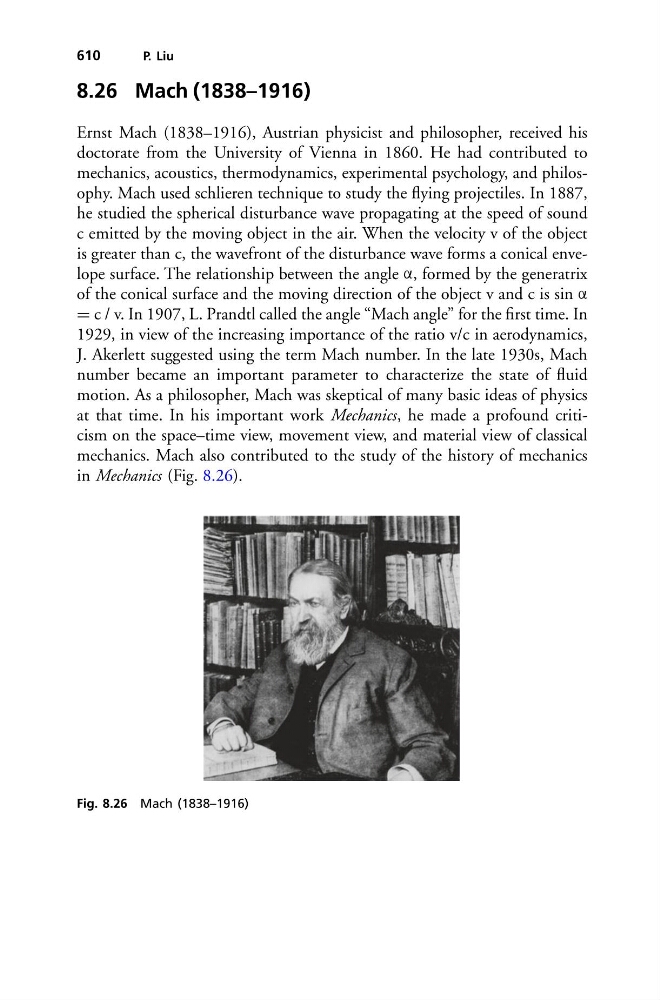
in Mechanics (Fig. 8.26).
Fig. 8.26 Mach (1838–1916)
P. Liu
8.26 Mach (1838–1916)
Ernst Mach (1838–1916), Austrian physicist and philosopher, received his
doctorate from the University of Vienna in 1860. He had contributed to
mechanics, acoustics, thermodynamics, experimental psychology, and philosophy. Mach used schlieren technique to study the flying projectiles. In 1887,
he studied the spherical disturbance wave propagating at the speed of sound
c emitted by the moving object in the air. When the velocity v of the object
is greater than c, the wavefront of the disturbance wave forms a conical envelope surface. The relationship between the angle α, formed by the generatrix
of the conical surface and the moving direction of the object v and c is sin α
= c / v. In 1907, L. Prandtl called the angle “Mach angle” for the first time. In
1929, in view of the increasing importance of the ratio v/c in aerodynamics,
J. Akerlett suggested using the term Mach number. In the late 1930s, Mach
number became an important parameter to characterize the state of fluid
motion. As a philosopher, Mach was skeptical of many basic ideas of physics
at that time. In his important work Mechanics, he made a profound criticism on the space–time view, movement view, and material view of classical
mechanics. Mach also contributed to the study of the history of mechanics
in Mechanics (Fig. 8.26).
Fig. 8.26 Mach (1838–1916)