

608
P. Liu
analysis, differential geometry, differential equations, thermology, electromagnetic non-over distance interaction, and shock theory. He introduced the
theory of trigonometric series, pointed out the direction of integral theory,
laid the foundation of modern analytic number theory, and put forward a
series of problems. He first introduced the concept of Riemannian surface,
which had a great influence on modern topology. In the field of algebraic
function theory, Riemann–Roch theorem is also very important. In differential geometry, Riemann geometry was established after Gauss. His name
appears in Riemannian ζ function, Riemannian integral, Riemannian lemma,
Riemannian manifold, Riemannian space, Riemannian mapping theorem,
Riemannian–Hilbert problem, Cauchy–Riemannian equation, and Riemannian loop matrix. In addition, he had made a great contribution to the
partial differential equation and its application in physics. Riemann’s work
had a direct impact on the development of mathematics in the second half of
the nineteenth century. Many outstanding mathematicians demonstrated the
theorems that Riemann asserted, and many branches of mathematics made
brilliant achievements under the influence of Riemann’s thought. Riemann
first proposed a new idea and method to study number theory with complex
function theory, especially with ζ function, which ushered in a new era of
analytic number theory and had a profound impact on the development of
single complex function theory. He is one of the most innovative mathematicians in the history of mathematics in the world. Riemann’s works are limited
in number, but they are all extremely profound. He was good at imagination
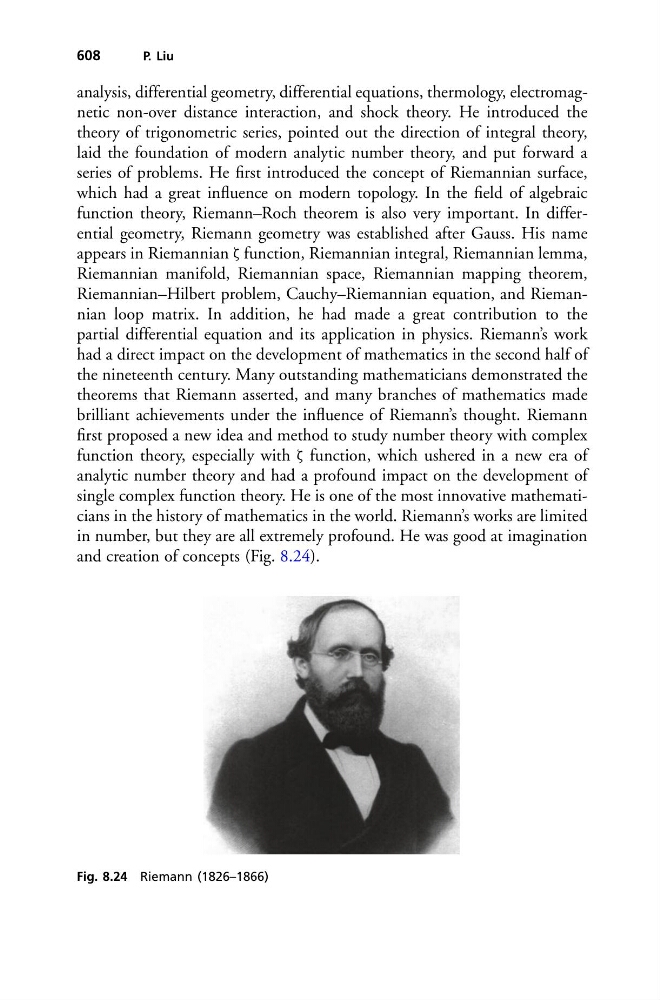
and creation of concepts (Fig. 8.24).
Fig. 8.24 Riemann (1826–1866)
P. Liu
analysis, differential geometry, differential equations, thermology, electromagnetic non-over distance interaction, and shock theory. He introduced the
theory of trigonometric series, pointed out the direction of integral theory,
laid the foundation of modern analytic number theory, and put forward a
series of problems. He first introduced the concept of Riemannian surface,
which had a great influence on modern topology. In the field of algebraic
function theory, Riemann–Roch theorem is also very important. In differential geometry, Riemann geometry was established after Gauss. His name
appears in Riemannian ζ function, Riemannian integral, Riemannian lemma,
Riemannian manifold, Riemannian space, Riemannian mapping theorem,
Riemannian–Hilbert problem, Cauchy–Riemannian equation, and Riemannian loop matrix. In addition, he had made a great contribution to the
partial differential equation and its application in physics. Riemann’s work
had a direct impact on the development of mathematics in the second half of
the nineteenth century. Many outstanding mathematicians demonstrated the
theorems that Riemann asserted, and many branches of mathematics made
brilliant achievements under the influence of Riemann’s thought. Riemann
first proposed a new idea and method to study number theory with complex
function theory, especially with ζ function, which ushered in a new era of
analytic number theory and had a profound impact on the development of
single complex function theory. He is one of the most innovative mathematicians in the history of mathematics in the world. Riemann’s works are limited
in number, but they are all extremely profound. He was good at imagination
and creation of concepts (Fig. 8.24).
Fig. 8.24 Riemann (1826–1866)