

8 Introduction to Celebrities in Fluid Mechanics
607
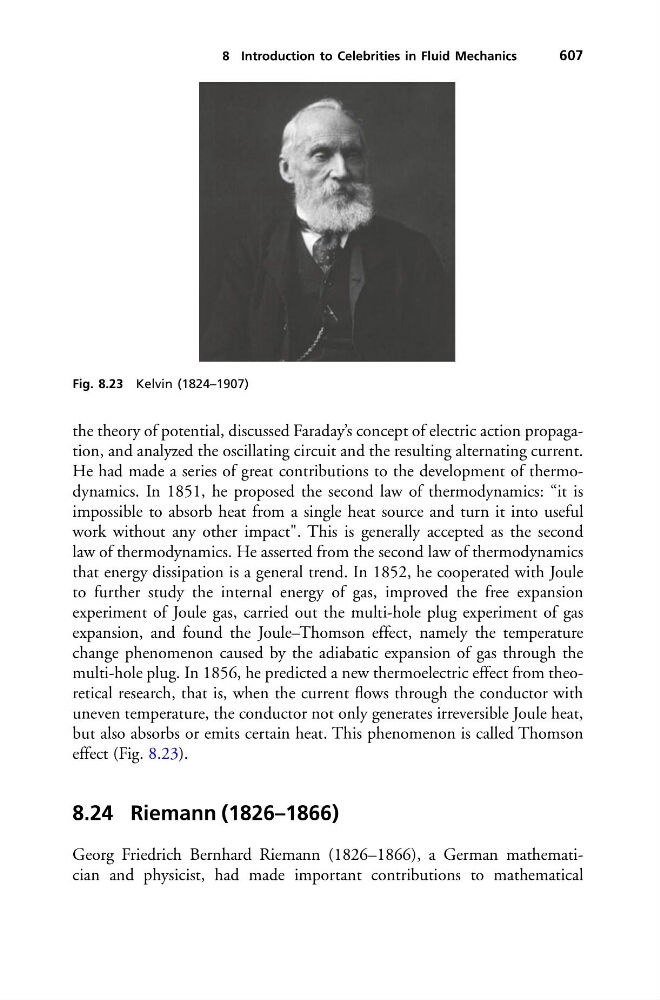
Fig. 8.23 Kelvin (1824–1907)
the theory of potential, discussed Faraday’s concept of electric action propagation, and analyzed the oscillating circuit and the resulting alternating current.
He had made a series of great contributions to the development of thermodynamics. In 1851, he proposed the second law of thermodynamics: “it is
impossible to absorb heat from a single heat source and turn it into useful
work without any other impact". This is generally accepted as the second
law of thermodynamics. He asserted from the second law of thermodynamics
that energy dissipation is a general trend. In 1852, he cooperated with Joule
to further study the internal energy of gas, improved the free expansion
experiment of Joule gas, carried out the multi-hole plug experiment of gas
expansion, and found the Joule–Thomson effect, namely the temperature
change phenomenon caused by the adiabatic expansion of gas through the
multi-hole plug. In 1856, he predicted a new thermoelectric effect from theoretical research, that is, when the current flows through the conductor with
uneven temperature, the conductor not only generates irreversible Joule heat,
but also absorbs or emits certain heat. This phenomenon is called Thomson
effect (Fig. 8.23).
8.24 Riemann (1826–1866)
Georg Friedrich Bernhard Riemann (1826–1866), a German mathematician and physicist, had made important contributions to mathematical
607
Fig. 8.23 Kelvin (1824–1907)
the theory of potential, discussed Faraday’s concept of electric action propagation, and analyzed the oscillating circuit and the resulting alternating current.
He had made a series of great contributions to the development of thermodynamics. In 1851, he proposed the second law of thermodynamics: “it is
impossible to absorb heat from a single heat source and turn it into useful
work without any other impact". This is generally accepted as the second
law of thermodynamics. He asserted from the second law of thermodynamics
that energy dissipation is a general trend. In 1852, he cooperated with Joule
to further study the internal energy of gas, improved the free expansion
experiment of Joule gas, carried out the multi-hole plug experiment of gas
expansion, and found the Joule–Thomson effect, namely the temperature
change phenomenon caused by the adiabatic expansion of gas through the
multi-hole plug. In 1856, he predicted a new thermoelectric effect from theoretical research, that is, when the current flows through the conductor with
uneven temperature, the conductor not only generates irreversible Joule heat,
but also absorbs or emits certain heat. This phenomenon is called Thomson
effect (Fig. 8.23).
8.24 Riemann (1826–1866)
Georg Friedrich Bernhard Riemann (1826–1866), a German mathematician and physicist, had made important contributions to mathematical