

602
P. Liu
8.19 Darcy (1803–1858)
Henri-Philibert-Gaspard Darcy (1803–1858), a French dynamicist and engineer, was one of the founders of hydrogeology. His experimental results
created a science of groundwater dynamics to study the movement of groundwater flow in porous media. In his whole life, he was responsible for the
design and construction of canals, railways, highways, bridges, tunnels, and
other civil works. After 1845 in France, because of the rapid development of
industry and the rapid increase of water consumption, the excavation of deep
wells to extract groundwater was very popular and promoted the research of
groundwater. Darcy focused on the mechanism of groundwater movement in
alluvium. In 1856, through the sand penetration test, it was first proposed
that the flow through the sample was directly proportional to the crosssectional area of the sample and the head difference of the piezometer at both
ends of the sample, and inversely proportional to the height of the sample.
The penetration law is called Darcy’s law in the international academia, which
lays the foundation for the experimental research method of water movement
in soil, the theory of groundwater movement, and its application in different
situations. In 1858, he put forward a famous formula of pipeline resistance
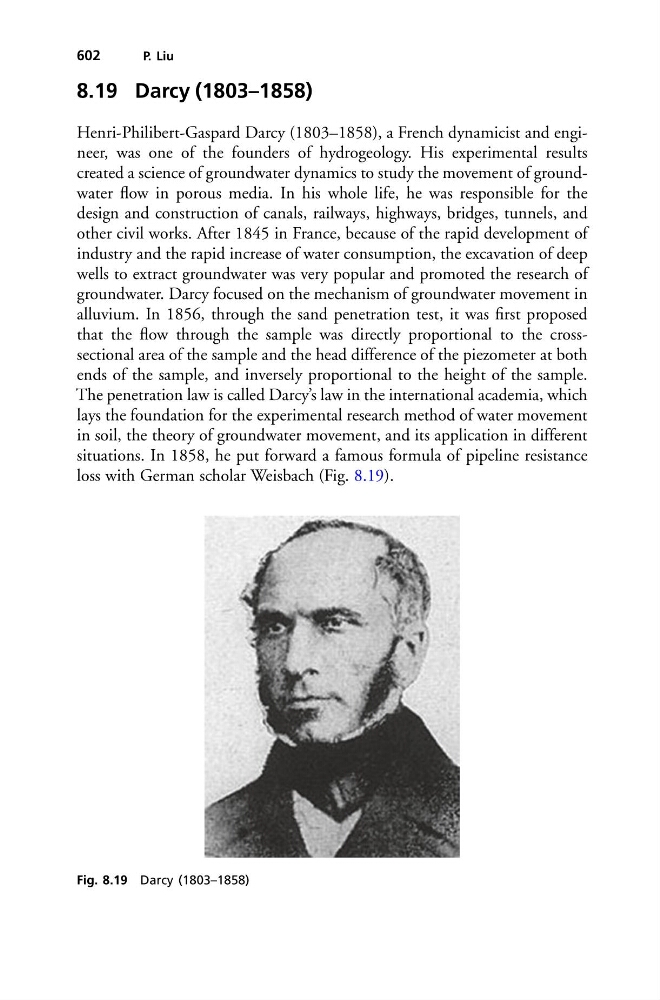
loss with German scholar Weisbach (Fig. 8.19).
Fig. 8.19 Darcy (1803–1858)
P. Liu
8.19 Darcy (1803–1858)
Henri-Philibert-Gaspard Darcy (1803–1858), a French dynamicist and engineer, was one of the founders of hydrogeology. His experimental results
created a science of groundwater dynamics to study the movement of groundwater flow in porous media. In his whole life, he was responsible for the
design and construction of canals, railways, highways, bridges, tunnels, and
other civil works. After 1845 in France, because of the rapid development of
industry and the rapid increase of water consumption, the excavation of deep
wells to extract groundwater was very popular and promoted the research of
groundwater. Darcy focused on the mechanism of groundwater movement in
alluvium. In 1856, through the sand penetration test, it was first proposed
that the flow through the sample was directly proportional to the crosssectional area of the sample and the head difference of the piezometer at both
ends of the sample, and inversely proportional to the height of the sample.
The penetration law is called Darcy’s law in the international academia, which
lays the foundation for the experimental research method of water movement
in soil, the theory of groundwater movement, and its application in different
situations. In 1858, he put forward a famous formula of pipeline resistance
loss with German scholar Weisbach (Fig. 8.19).
Fig. 8.19 Darcy (1803–1858)