

8 Introduction to Celebrities in Fluid Mechanics
603
8.20 Froude (1810–1879)
William Froude (1810–1879), British hydrologist and shipbuilding engineer,
carried out the first research on ship hydrodynamics in 1846. It was found
that adding a fin bilge keel along the horizontal direction below the waterline
on both sides of the ship could reduce the roll of the ship. The device was
later adopted by the British navy. In 1868, a series of experiments on ship
motion were carried out with ship models, and the data obtained from the
experiments were applied to ship construction. The ship resistance is divided
into friction resistance and residual resistance (mainly wave-making resistance). When the ratio of velocity to the square root of length of ship and
model is the same, the residual resistance per unit displacement is equal. This
ratio is often called “Froude number". According to this similarity law, the
basis of modern ship model test technology is established, and the accuracy
of using ship model test to estimate real ship power is improved, which has a
significant impact on ship design and construction. Early aerodynamic scientists used similar techniques to conduct model aircraft experiments in wind
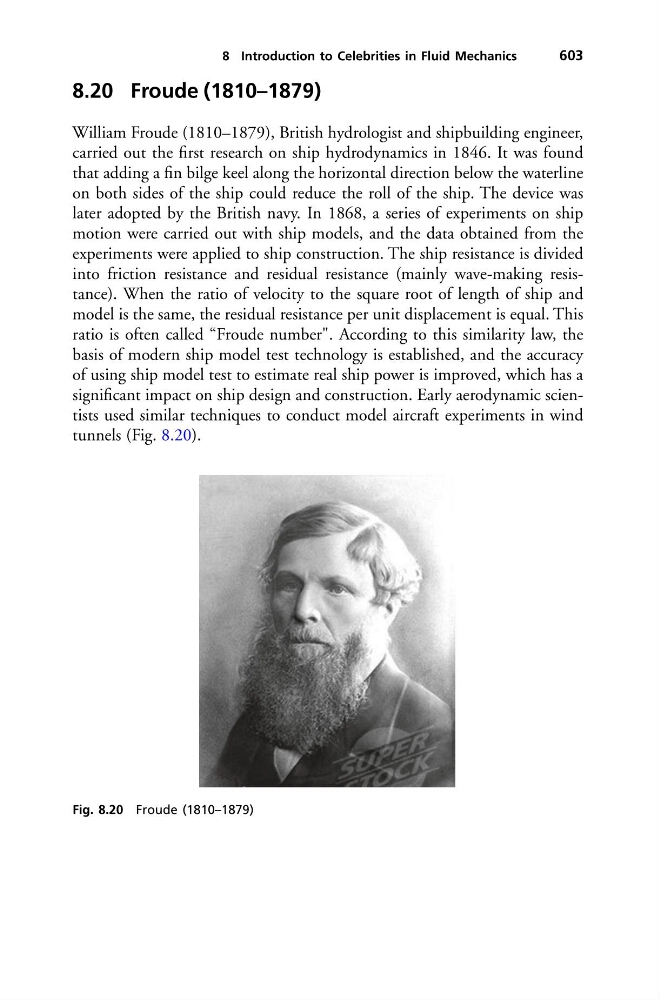
tunnels (Fig. 8.20).
Fig. 8.20 Froude (1810–1879)
603
8.20 Froude (1810–1879)
William Froude (1810–1879), British hydrologist and shipbuilding engineer,
carried out the first research on ship hydrodynamics in 1846. It was found
that adding a fin bilge keel along the horizontal direction below the waterline
on both sides of the ship could reduce the roll of the ship. The device was
later adopted by the British navy. In 1868, a series of experiments on ship
motion were carried out with ship models, and the data obtained from the
experiments were applied to ship construction. The ship resistance is divided
into friction resistance and residual resistance (mainly wave-making resistance). When the ratio of velocity to the square root of length of ship and
model is the same, the residual resistance per unit displacement is equal. This
ratio is often called “Froude number". According to this similarity law, the
basis of modern ship model test technology is established, and the accuracy
of using ship model test to estimate real ship power is improved, which has a
significant impact on ship design and construction. Early aerodynamic scientists used similar techniques to conduct model aircraft experiments in wind
tunnels (Fig. 8.20).
Fig. 8.20 Froude (1810–1879)