

8 Introduction to Celebrities in Fluid Mechanics
601
8.18 Poiseuille (1799–1869)
Jean-Louis-Marie Poiseuille (1799–1869), a French physiologist, had
invented a sphygmomanometer to measure the blood pressure of the dog’s
aorta since he was a student. He has published a series of papers on the flow
of blood in arteries and veins. Among them, the paper Experimental Study
of Liquid Flow in Small Diameter published from 1840 to 1841 has played
an important role in the development of hydrodynamics. He pointed out
that the volume flow is proportional to the pressure drop per unit length and
to the fourth power of pipe diameter. This law is later known as Poiseuille’s
law. As a German engineer Hagen got the same result in 1839, W. Ostwald
proposed to call the law Hagen–Poiseuille law in 1925. The empirical law
of Poiseuille and Hagen is an important experimental proof of the basic
theory of viscous fluid motion established by G. G. Stokes in 1845. Nowadays, the flow of viscous fluid in a circular pipe is often called Poiseuille flow
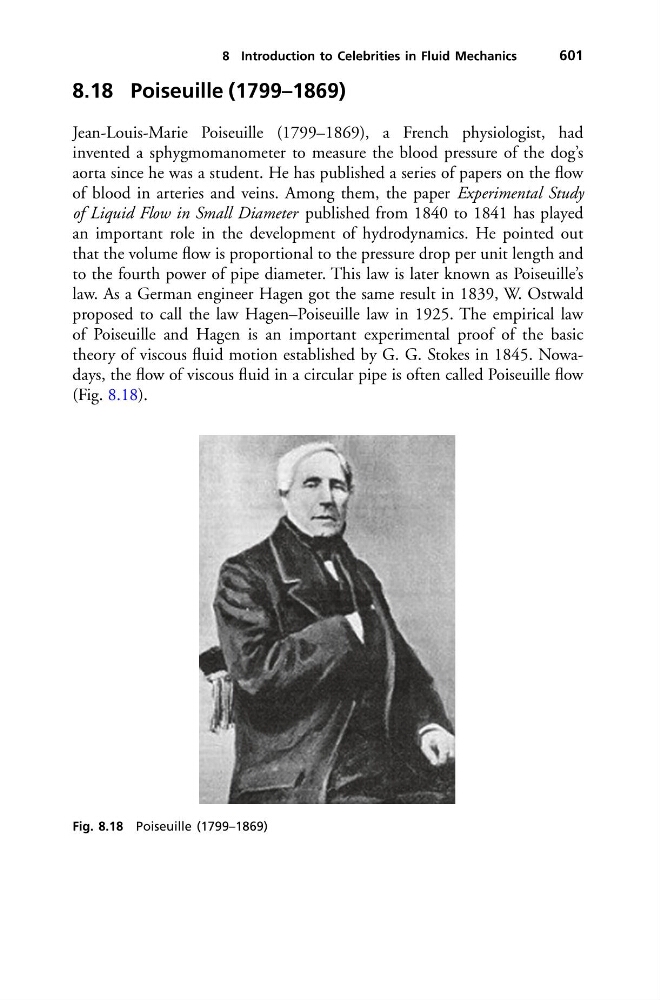
(Fig. 8.18).
Fig. 8.18 Poiseuille (1799–1869)
601
8.18 Poiseuille (1799–1869)
Jean-Louis-Marie Poiseuille (1799–1869), a French physiologist, had
invented a sphygmomanometer to measure the blood pressure of the dog’s
aorta since he was a student. He has published a series of papers on the flow
of blood in arteries and veins. Among them, the paper Experimental Study
of Liquid Flow in Small Diameter published from 1840 to 1841 has played
an important role in the development of hydrodynamics. He pointed out
that the volume flow is proportional to the pressure drop per unit length and
to the fourth power of pipe diameter. This law is later known as Poiseuille’s
law. As a German engineer Hagen got the same result in 1839, W. Ostwald
proposed to call the law Hagen–Poiseuille law in 1925. The empirical law
of Poiseuille and Hagen is an important experimental proof of the basic
theory of viscous fluid motion established by G. G. Stokes in 1845. Nowadays, the flow of viscous fluid in a circular pipe is often called Poiseuille flow
(Fig. 8.18).
Fig. 8.18 Poiseuille (1799–1869)