

8 Introduction to Celebrities in Fluid Mechanics
597
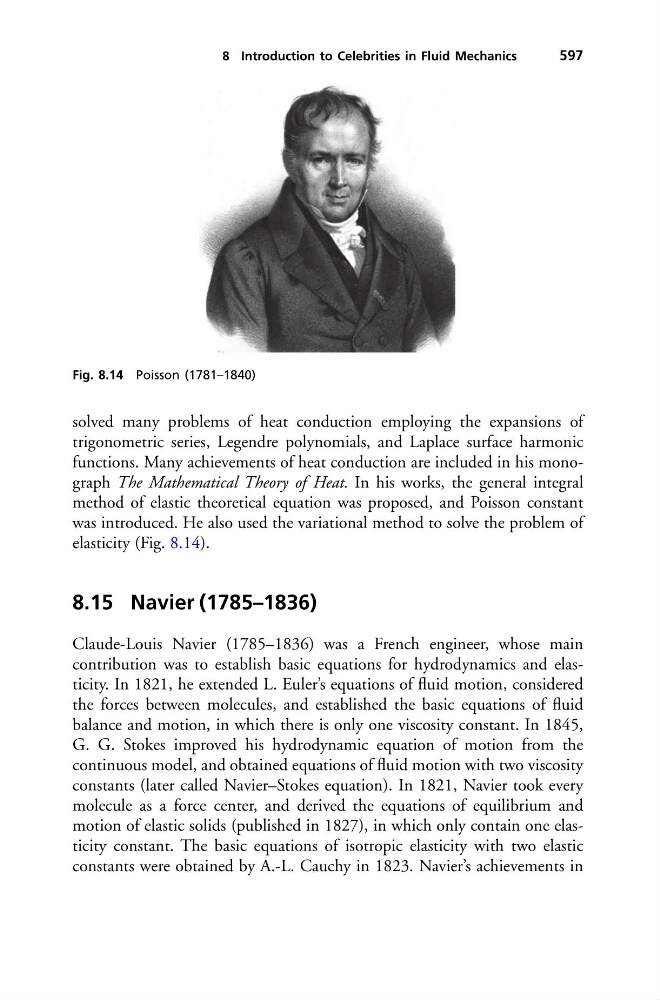
Fig. 8.14 Poisson (1781–1840)
solved many problems of heat conduction employing the expansions of
trigonometric series, Legendre polynomials, and Laplace surface harmonic
functions. Many achievements of heat conduction are included in his monograph The Mathematical Theory of Heat. In his works, the general integral
method of elastic theoretical equation was proposed, and Poisson constant
was introduced. He also used the variational method to solve the problem of
elasticity (Fig. 8.14).
8.15 Navier (1785–1836)
Claude-Louis Navier (1785–1836) was a French engineer, whose main
contribution was to establish basic equations for hydrodynamics and elasticity. In 1821, he extended L. Euler’s equations of fluid motion, considered
the forces between molecules, and established the basic equations of fluid
balance and motion, in which there is only one viscosity constant. In 1845,
G. G. Stokes improved his hydrodynamic equation of motion from the
continuous model, and obtained equations of fluid motion with two viscosity
constants (later called Navier–Stokes equation). In 1821, Navier took every
molecule as a force center, and derived the equations of equilibrium and
motion of elastic solids (published in 1827), in which only contain one elasticity constant. The basic equations of isotropic elasticity with two elastic
constants were obtained by A.-L. Cauchy in 1823. Navier’s achievements in
597
Fig. 8.14 Poisson (1781–1840)
solved many problems of heat conduction employing the expansions of
trigonometric series, Legendre polynomials, and Laplace surface harmonic
functions. Many achievements of heat conduction are included in his monograph The Mathematical Theory of Heat. In his works, the general integral
method of elastic theoretical equation was proposed, and Poisson constant
was introduced. He also used the variational method to solve the problem of
elasticity (Fig. 8.14).
8.15 Navier (1785–1836)
Claude-Louis Navier (1785–1836) was a French engineer, whose main
contribution was to establish basic equations for hydrodynamics and elasticity. In 1821, he extended L. Euler’s equations of fluid motion, considered
the forces between molecules, and established the basic equations of fluid
balance and motion, in which there is only one viscosity constant. In 1845,
G. G. Stokes improved his hydrodynamic equation of motion from the
continuous model, and obtained equations of fluid motion with two viscosity
constants (later called Navier–Stokes equation). In 1821, Navier took every
molecule as a force center, and derived the equations of equilibrium and
motion of elastic solids (published in 1827), in which only contain one elasticity constant. The basic equations of isotropic elasticity with two elastic
constants were obtained by A.-L. Cauchy in 1823. Navier’s achievements in