

596
P. Liu
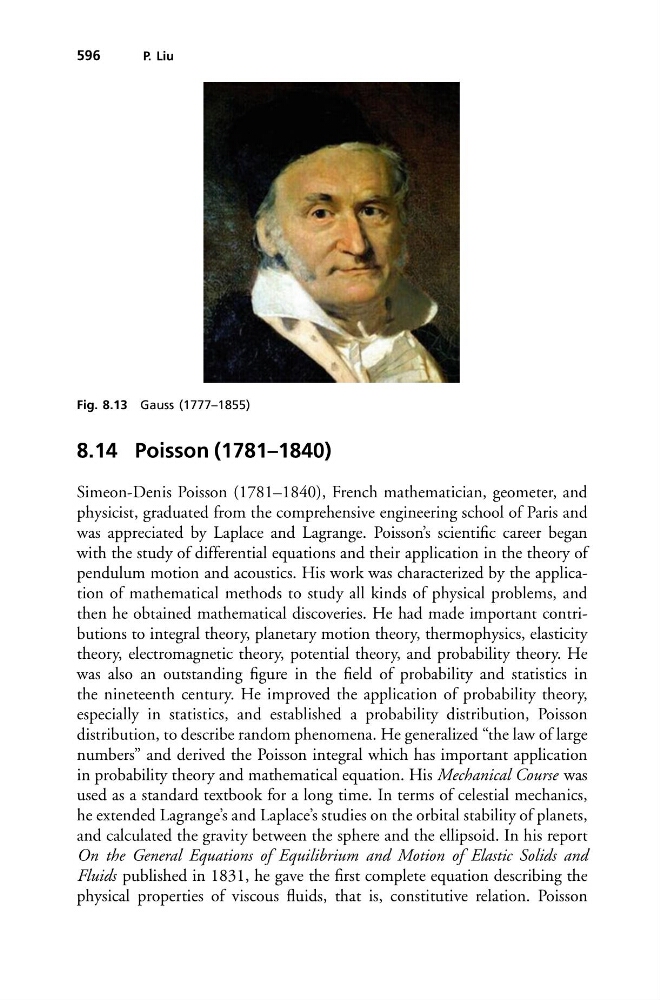
Fig. 8.13 Gauss (1777–1855)
8.14 Poisson (1781–1840)
Simeon-Denis Poisson (1781–1840), French mathematician, geometer, and
physicist, graduated from the comprehensive engineering school of Paris and
was appreciated by Laplace and Lagrange. Poisson’s scientific career began
with the study of differential equations and their application in the theory of
pendulum motion and acoustics. His work was characterized by the application of mathematical methods to study all kinds of physical problems, and
then he obtained mathematical discoveries. He had made important contributions to integral theory, planetary motion theory, thermophysics, elasticity
theory, electromagnetic theory, potential theory, and probability theory. He
was also an outstanding figure in the field of probability and statistics in
the nineteenth century. He improved the application of probability theory,
especially in statistics, and established a probability distribution, Poisson
distribution, to describe random phenomena. He generalized “the law of large
numbers” and derived the Poisson integral which has important application
in probability theory and mathematical equation. His Mechanical Course was
used as a standard textbook for a long time. In terms of celestial mechanics,
he extended Lagrange’s and Laplace’s studies on the orbital stability of planets,
and calculated the gravity between the sphere and the ellipsoid. In his report
On the General Equations of Equilibrium and Motion of Elastic Solids and
Fluids published in 1831, he gave the first complete equation describing the
physical properties of viscous fluids, that is, constitutive relation. Poisson
P. Liu
Fig. 8.13 Gauss (1777–1855)
8.14 Poisson (1781–1840)
Simeon-Denis Poisson (1781–1840), French mathematician, geometer, and
physicist, graduated from the comprehensive engineering school of Paris and
was appreciated by Laplace and Lagrange. Poisson’s scientific career began
with the study of differential equations and their application in the theory of
pendulum motion and acoustics. His work was characterized by the application of mathematical methods to study all kinds of physical problems, and
then he obtained mathematical discoveries. He had made important contributions to integral theory, planetary motion theory, thermophysics, elasticity
theory, electromagnetic theory, potential theory, and probability theory. He
was also an outstanding figure in the field of probability and statistics in
the nineteenth century. He improved the application of probability theory,
especially in statistics, and established a probability distribution, Poisson
distribution, to describe random phenomena. He generalized “the law of large
numbers” and derived the Poisson integral which has important application
in probability theory and mathematical equation. His Mechanical Course was
used as a standard textbook for a long time. In terms of celestial mechanics,
he extended Lagrange’s and Laplace’s studies on the orbital stability of planets,
and calculated the gravity between the sphere and the ellipsoid. In his report
On the General Equations of Equilibrium and Motion of Elastic Solids and
Fluids published in 1831, he gave the first complete equation describing the
physical properties of viscous fluids, that is, constitutive relation. Poisson