

8 Introduction to Celebrities in Fluid Mechanics
595
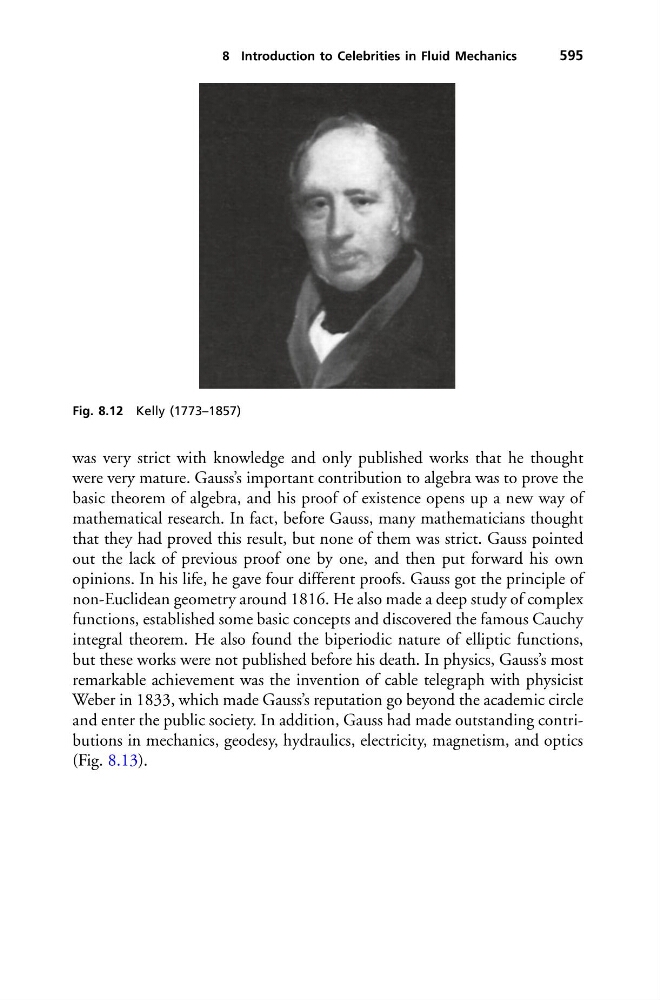
Fig. 8.12 Kelly (1773–1857)
was very strict with knowledge and only published works that he thought
were very mature. Gauss’s important contribution to algebra was to prove the
basic theorem of algebra, and his proof of existence opens up a new way of
mathematical research. In fact, before Gauss, many mathematicians thought
that they had proved this result, but none of them was strict. Gauss pointed
out the lack of previous proof one by one, and then put forward his own
opinions. In his life, he gave four different proofs. Gauss got the principle of
non-Euclidean geometry around 1816. He also made a deep study of complex
functions, established some basic concepts and discovered the famous Cauchy
integral theorem. He also found the biperiodic nature of elliptic functions,
but these works were not published before his death. In physics, Gauss’s most
remarkable achievement was the invention of cable telegraph with physicist
Weber in 1833, which made Gauss’s reputation go beyond the academic circle
and enter the public society. In addition, Gauss had made outstanding contributions in mechanics, geodesy, hydraulics, electricity, magnetism, and optics
(Fig. 8.13).
595
Fig. 8.12 Kelly (1773–1857)
was very strict with knowledge and only published works that he thought
were very mature. Gauss’s important contribution to algebra was to prove the
basic theorem of algebra, and his proof of existence opens up a new way of
mathematical research. In fact, before Gauss, many mathematicians thought
that they had proved this result, but none of them was strict. Gauss pointed
out the lack of previous proof one by one, and then put forward his own
opinions. In his life, he gave four different proofs. Gauss got the principle of
non-Euclidean geometry around 1816. He also made a deep study of complex
functions, established some basic concepts and discovered the famous Cauchy
integral theorem. He also found the biperiodic nature of elliptic functions,
but these works were not published before his death. In physics, Gauss’s most
remarkable achievement was the invention of cable telegraph with physicist
Weber in 1833, which made Gauss’s reputation go beyond the academic circle
and enter the public society. In addition, Gauss had made outstanding contributions in mechanics, geodesy, hydraulics, electricity, magnetism, and optics
(Fig. 8.13).