

8 Introduction to Celebrities in Fluid Mechanics
593
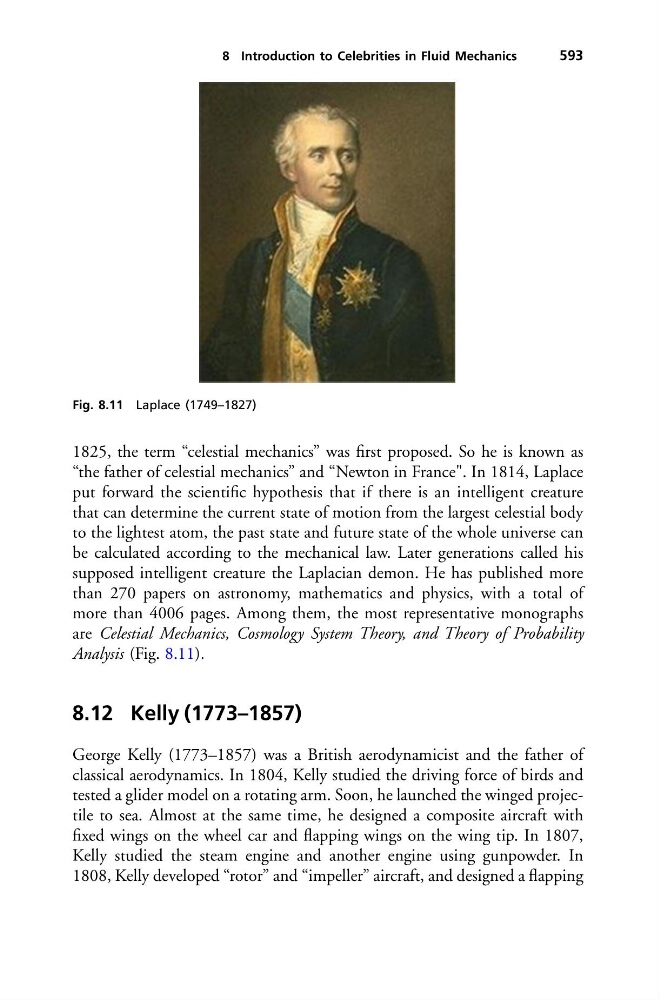
Fig. 8.11 Laplace (1749–1827)
1825, the term “celestial mechanics” was first proposed. So he is known as
“the father of celestial mechanics” and “Newton in France". In 1814, Laplace
put forward the scientific hypothesis that if there is an intelligent creature
that can determine the current state of motion from the largest celestial body
to the lightest atom, the past state and future state of the whole universe can
be calculated according to the mechanical law. Later generations called his
supposed intelligent creature the Laplacian demon. He has published more
than 270 papers on astronomy, mathematics and physics, with a total of
more than 4006 pages. Among them, the most representative monographs
are Celestial Mechanics, Cosmology System Theory, and Theory of Probability
Analysis (Fig. 8.11).
8.12 Kelly (1773–1857)
George Kelly (1773–1857) was a British aerodynamicist and the father of
classical aerodynamics. In 1804, Kelly studied the driving force of birds and
tested a glider model on a rotating arm. Soon, he launched the winged projectile to sea. Almost at the same time, he designed a composite aircraft with
fixed wings on the wheel car and flapping wings on the wing tip. In 1807,
Kelly studied the steam engine and another engine using gunpowder. In
1808, Kelly developed “rotor” and “impeller” aircraft, and designed a flapping
593
Fig. 8.11 Laplace (1749–1827)
1825, the term “celestial mechanics” was first proposed. So he is known as
“the father of celestial mechanics” and “Newton in France". In 1814, Laplace
put forward the scientific hypothesis that if there is an intelligent creature
that can determine the current state of motion from the largest celestial body
to the lightest atom, the past state and future state of the whole universe can
be calculated according to the mechanical law. Later generations called his
supposed intelligent creature the Laplacian demon. He has published more
than 270 papers on astronomy, mathematics and physics, with a total of
more than 4006 pages. Among them, the most representative monographs
are Celestial Mechanics, Cosmology System Theory, and Theory of Probability
Analysis (Fig. 8.11).
8.12 Kelly (1773–1857)
George Kelly (1773–1857) was a British aerodynamicist and the father of
classical aerodynamics. In 1804, Kelly studied the driving force of birds and
tested a glider model on a rotating arm. Soon, he launched the winged projectile to sea. Almost at the same time, he designed a composite aircraft with
fixed wings on the wheel car and flapping wings on the wing tip. In 1807,
Kelly studied the steam engine and another engine using gunpowder. In
1808, Kelly developed “rotor” and “impeller” aircraft, and designed a flapping