

8 Introduction to Celebrities in Fluid Mechanics
587
8.6 Leibniz (1646–1716)
Gottfried Wilhelm Leibniz (1646–1716), German philosopher and mathematician, a rare generalist in history, was known as Aristotle in the seventeenth century. He was a lawyer, often back and forth in the major cities,
and many formulas were completed in the bumpy carriage. He also claimed
to have the Baron’s noble identity. Leibniz played an important role in the
history of mathematics and philosophy. In mathematics, he and Newton
have independently invented calculus, and the mathematical symbols of
calculus he used are more widely used. The symbols invented by Leibniz
are generally considered to be more comprehensive and applicable. Leibniz
also contributed to the development of binary. In philosophy, Leibniz’s rationalism is the most famous. Leibniz, Descartes, and Baruch de Spinoza are
regarded as the three greatest rationalist philosophers in the seventeenth
century. Leibniz’s work in philosophy foresees the birth of modern logic
and analytical philosophy, but it was also deeply influenced by the tradition
of scholasticism. He used more the first principle or transcendental definition than experimental evidence to derive conclusions. Leibniz has left many
works in politics, law, ethics, theology, philosophy, history linguistics, etc
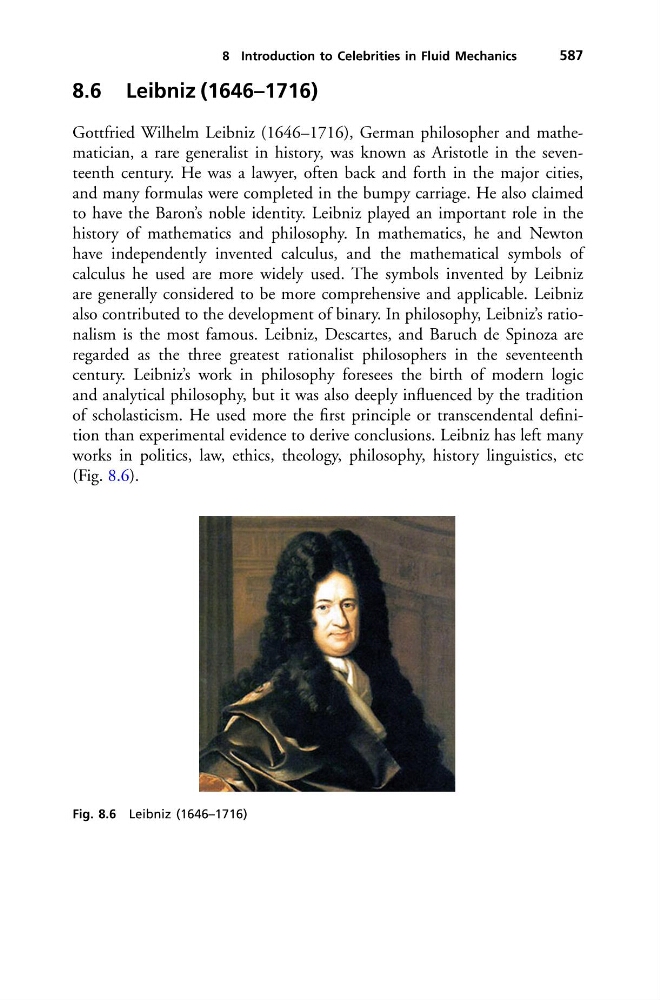
(Fig. 8.6).
Fig. 8.6 Leibniz (1646–1716)
587
8.6 Leibniz (1646–1716)
Gottfried Wilhelm Leibniz (1646–1716), German philosopher and mathematician, a rare generalist in history, was known as Aristotle in the seventeenth century. He was a lawyer, often back and forth in the major cities,
and many formulas were completed in the bumpy carriage. He also claimed
to have the Baron’s noble identity. Leibniz played an important role in the
history of mathematics and philosophy. In mathematics, he and Newton
have independently invented calculus, and the mathematical symbols of
calculus he used are more widely used. The symbols invented by Leibniz
are generally considered to be more comprehensive and applicable. Leibniz
also contributed to the development of binary. In philosophy, Leibniz’s rationalism is the most famous. Leibniz, Descartes, and Baruch de Spinoza are
regarded as the three greatest rationalist philosophers in the seventeenth
century. Leibniz’s work in philosophy foresees the birth of modern logic
and analytical philosophy, but it was also deeply influenced by the tradition
of scholasticism. He used more the first principle or transcendental definition than experimental evidence to derive conclusions. Leibniz has left many
works in politics, law, ethics, theology, philosophy, history linguistics, etc
(Fig. 8.6).
Fig. 8.6 Leibniz (1646–1716)