

586
P. Liu
8.5 Newton (1643–1727)
Isaac Newton (1643–1727), graduated from Trinity College of Cambridge
University, is a famous British physicist and president of the Royal Society.
He is encyclopedic “all-rounder” and has written Mathematical Principles of
Natural Philosophy and Optics. In his paper The Law of Nature, published
in 1687, he described gravity and the three laws of motion. These descriptions laid the scientific view of the physical world for the next three centuries
and became the foundation of modern engineering. By demonstrating the
consistency between Kepler’s laws of motion of planets and his theory of
gravitation, he showed that the motion of objects on the ground and celestial bodies follow the same laws of nature, which provides strong theoretical
support for the theory of sun center and promotes the scientific revolution.
In mechanics, Newton clarified the principle of conservation of momentum
and angular momentum, and proposed Newton’s law of motion. In optics,
he invented the reflection telescope and developed the color theory based
on the observation of the white light emitted by the prism into the visible
spectrum. He also formulated the cooling law systematically and studied the
speed of sound. In mathematics, Newton shared the honor of developing
calculus with Leibniz. He also proved the generalized binomial theorem,
proposed “Newton method” to approach the zero point of function, and
made contribution to the research of power series (Fig. 8.5).
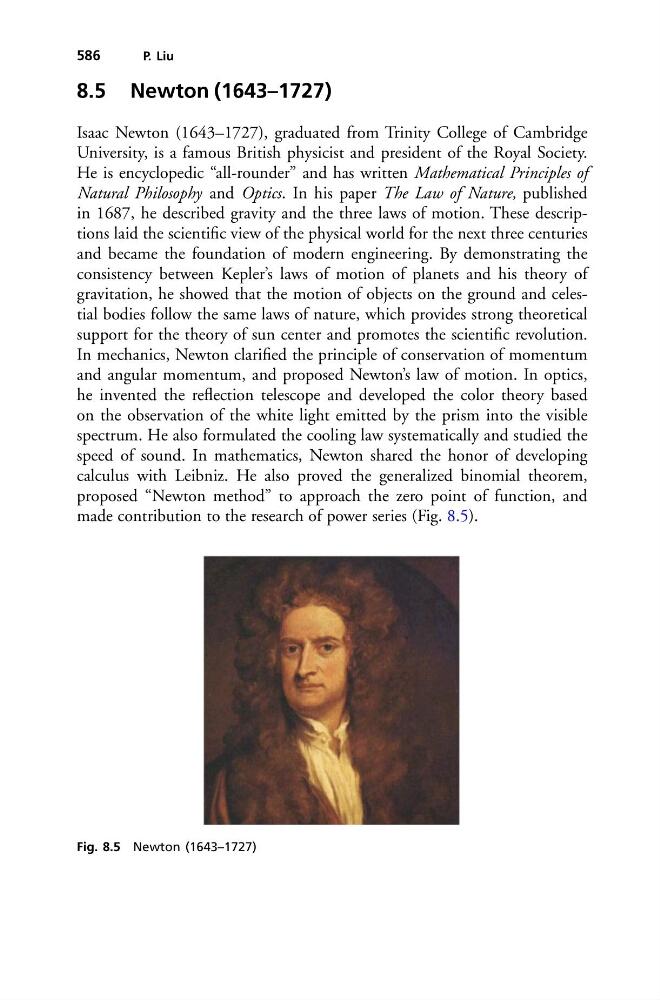
Fig. 8.5 Newton (1643–1727)
P. Liu
8.5 Newton (1643–1727)
Isaac Newton (1643–1727), graduated from Trinity College of Cambridge
University, is a famous British physicist and president of the Royal Society.
He is encyclopedic “all-rounder” and has written Mathematical Principles of
Natural Philosophy and Optics. In his paper The Law of Nature, published
in 1687, he described gravity and the three laws of motion. These descriptions laid the scientific view of the physical world for the next three centuries
and became the foundation of modern engineering. By demonstrating the
consistency between Kepler’s laws of motion of planets and his theory of
gravitation, he showed that the motion of objects on the ground and celestial bodies follow the same laws of nature, which provides strong theoretical
support for the theory of sun center and promotes the scientific revolution.
In mechanics, Newton clarified the principle of conservation of momentum
and angular momentum, and proposed Newton’s law of motion. In optics,
he invented the reflection telescope and developed the color theory based
on the observation of the white light emitted by the prism into the visible
spectrum. He also formulated the cooling law systematically and studied the
speed of sound. In mathematics, Newton shared the honor of developing
calculus with Leibniz. He also proved the generalized binomial theorem,
proposed “Newton method” to approach the zero point of function, and
made contribution to the research of power series (Fig. 8.5).
Fig. 8.5 Newton (1643–1727)