

8 Introduction to Celebrities in Fluid Mechanics
585
8.4 Pascal (1623–1662)
Blaise Pascal (1623–1662) was a French mathematician, physicist, philosopher, and essayist. At the age of 16, he discovered the famous hexagon
theorem and he completed The Theory of Conic Curve at the age of 17.
In 1642, he designed and manufactured an automatic carry addition and
subtraction calculation device, which is called the first digital calculator in
the world and provides the basic principle for later computer design. In
1654, he began to study several aspects of mathematical problems, deeply
discussed the principle of indivisibility in infinitesimal analysis, obtained the
general method to find the area and center of gravity enclosed by different
curves, solved the cycloid problem with the principle of integral theory, and
completed The Theory of Cycloid in 1658. His manuscript of the paper has a
great inspiration for Leibniz to establish calculus. When studying the properties of binomial coefficients, he wrote Arithmetical Triangle, which was
included in his complete works and published in 1665, and submitted it to
the Paris Academy of Sciences. The expansion binomial coefficient is called
“Pascal triangle”, which was known by Chinese mathematician Jia Xian in
1100. He also made a mercury barometer (1646), wrote papers on liquid
balance, air weight and density (1651–1654) and classic works such as Pensees
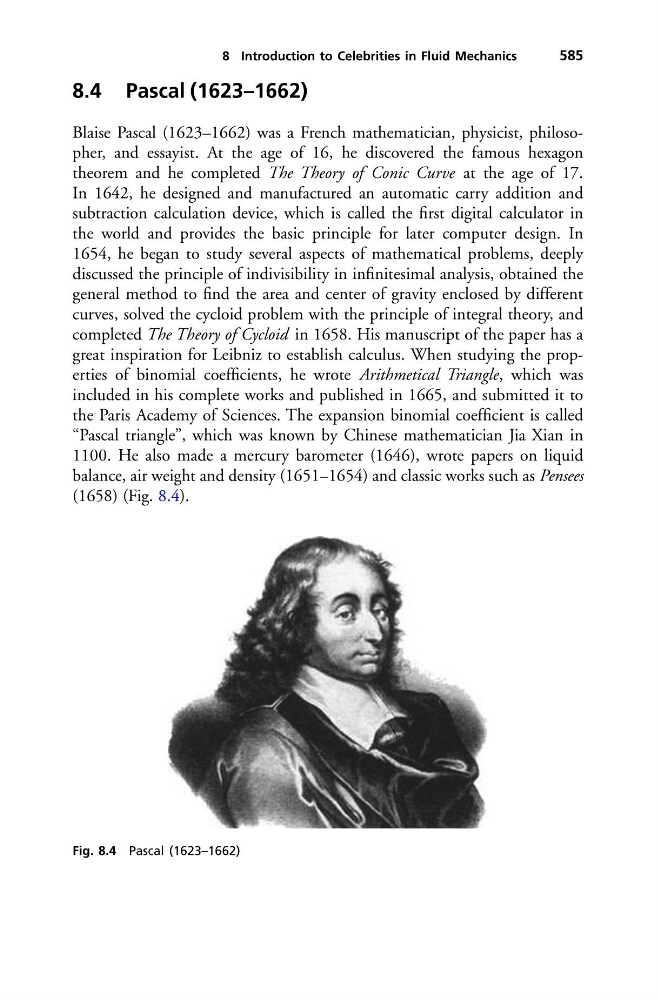
(1658) (Fig. 8.4).
Fig. 8.4 Pascal (1623–1662)
585
8.4 Pascal (1623–1662)
Blaise Pascal (1623–1662) was a French mathematician, physicist, philosopher, and essayist. At the age of 16, he discovered the famous hexagon
theorem and he completed The Theory of Conic Curve at the age of 17.
In 1642, he designed and manufactured an automatic carry addition and
subtraction calculation device, which is called the first digital calculator in
the world and provides the basic principle for later computer design. In
1654, he began to study several aspects of mathematical problems, deeply
discussed the principle of indivisibility in infinitesimal analysis, obtained the
general method to find the area and center of gravity enclosed by different
curves, solved the cycloid problem with the principle of integral theory, and
completed The Theory of Cycloid in 1658. His manuscript of the paper has a
great inspiration for Leibniz to establish calculus. When studying the properties of binomial coefficients, he wrote Arithmetical Triangle, which was
included in his complete works and published in 1665, and submitted it to
the Paris Academy of Sciences. The expansion binomial coefficient is called
“Pascal triangle”, which was known by Chinese mathematician Jia Xian in
1100. He also made a mercury barometer (1646), wrote papers on liquid
balance, air weight and density (1651–1654) and classic works such as Pensees
(1658) (Fig. 8.4).
Fig. 8.4 Pascal (1623–1662)