

584
P. Liu
Ptolemy’s geocentric system, and strongly supported Copernicus’s heliocentric theory. With systematic experiments and observations, he overthrew the
traditional natural view of speculation and created a modern science based
on experimental facts and a strict logical system. Therefore, he is known
as “the father of modern mechanics” and “the father of modern science".
His work laid a foundation for the establishment of Newton’s theoretical
system. Galileo advocated the research method of combining mathematics
with experiment, which is the source of his great achievements in science and
the most important contribution to modern science. According to Galileo,
experience is the only source of knowledge. He advocated the experimental
mathematical method to study the laws of nature and opposed the mysterious speculation of scholasticism. He believed that the book of nature is
written in mathematical language. Only the shape, size, and speed that can
be attributed to quantitative characteristics are the objective properties of
objects. He was the first person to make a lot of achievements in observing
celestial bodies with telescopes. Galileo played an important role in the development of natural science and world outlook in the seventeenth century.
Experimental science, which was initiated by Galileo and Newton, is the
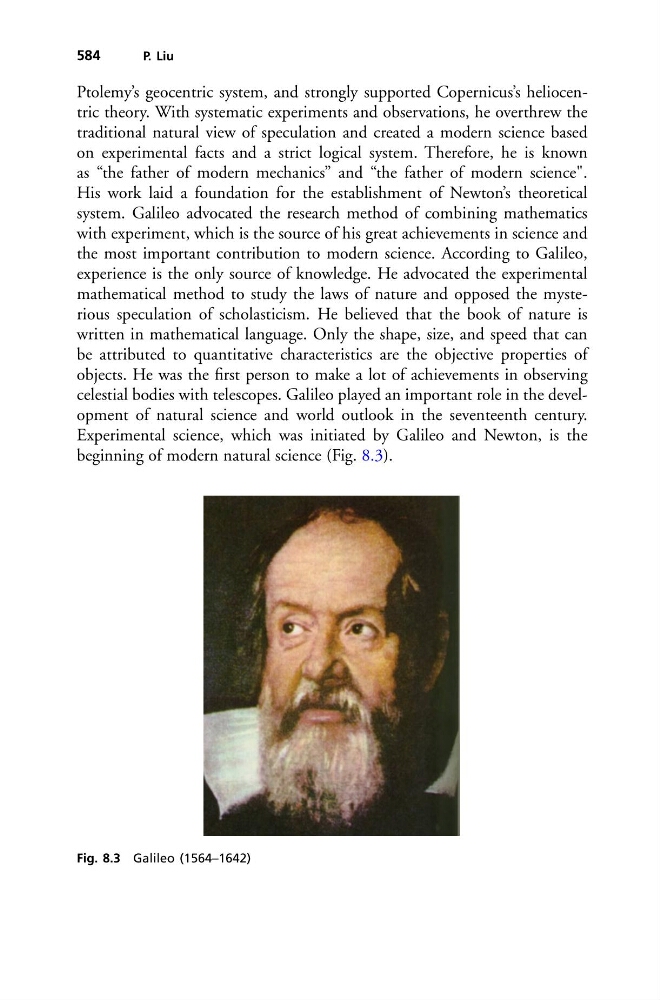
beginning of modern natural science (Fig. 8.3).
Fig. 8.3 Galileo (1564–1642)
P. Liu
Ptolemy’s geocentric system, and strongly supported Copernicus’s heliocentric theory. With systematic experiments and observations, he overthrew the
traditional natural view of speculation and created a modern science based
on experimental facts and a strict logical system. Therefore, he is known
as “the father of modern mechanics” and “the father of modern science".
His work laid a foundation for the establishment of Newton’s theoretical
system. Galileo advocated the research method of combining mathematics
with experiment, which is the source of his great achievements in science and
the most important contribution to modern science. According to Galileo,
experience is the only source of knowledge. He advocated the experimental
mathematical method to study the laws of nature and opposed the mysterious speculation of scholasticism. He believed that the book of nature is
written in mathematical language. Only the shape, size, and speed that can
be attributed to quantitative characteristics are the objective properties of
objects. He was the first person to make a lot of achievements in observing
celestial bodies with telescopes. Galileo played an important role in the development of natural science and world outlook in the seventeenth century.
Experimental science, which was initiated by Galileo and Newton, is the
beginning of modern natural science (Fig. 8.3).
Fig. 8.3 Galileo (1564–1642)