

8 Introduction to Celebrities in Fluid Mechanics
583
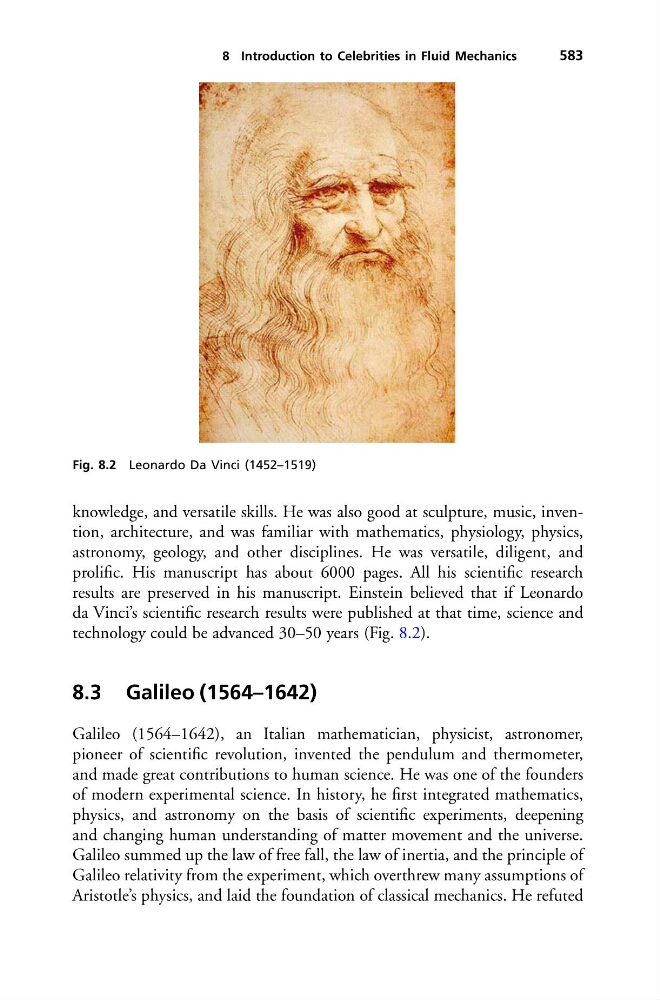
Fig. 8.2 Leonardo Da Vinci (1452–1519)
knowledge, and versatile skills. He was also good at sculpture, music, invention, architecture, and was familiar with mathematics, physiology, physics,
astronomy, geology, and other disciplines. He was versatile, diligent, and
prolific. His manuscript has about 6000 pages. All his scientific research
results are preserved in his manuscript. Einstein believed that if Leonardo
da Vinci’s scientific research results were published at that time, science and
technology could be advanced 30–50 years (Fig. 8.2).
8.3 Galileo (1564–1642)
Galileo (1564–1642), an Italian mathematician, physicist, astronomer,
pioneer of scientific revolution, invented the pendulum and thermometer,
and made great contributions to human science. He was one of the founders
of modern experimental science. In history, he first integrated mathematics,
physics, and astronomy on the basis of scientific experiments, deepening
and changing human understanding of matter movement and the universe.
Galileo summed up the law of free fall, the law of inertia, and the principle of
Galileo relativity from the experiment, which overthrew many assumptions of
Aristotle’s physics, and laid the foundation of classical mechanics. He refuted
583
Fig. 8.2 Leonardo Da Vinci (1452–1519)
knowledge, and versatile skills. He was also good at sculpture, music, invention, architecture, and was familiar with mathematics, physiology, physics,
astronomy, geology, and other disciplines. He was versatile, diligent, and
prolific. His manuscript has about 6000 pages. All his scientific research
results are preserved in his manuscript. Einstein believed that if Leonardo
da Vinci’s scientific research results were published at that time, science and
technology could be advanced 30–50 years (Fig. 8.2).
8.3 Galileo (1564–1642)
Galileo (1564–1642), an Italian mathematician, physicist, astronomer,
pioneer of scientific revolution, invented the pendulum and thermometer,
and made great contributions to human science. He was one of the founders
of modern experimental science. In history, he first integrated mathematics,
physics, and astronomy on the basis of scientific experiments, deepening
and changing human understanding of matter movement and the universe.
Galileo summed up the law of free fall, the law of inertia, and the principle of
Galileo relativity from the experiment, which overthrew many assumptions of
Aristotle’s physics, and laid the foundation of classical mechanics. He refuted