

582
P. Liu
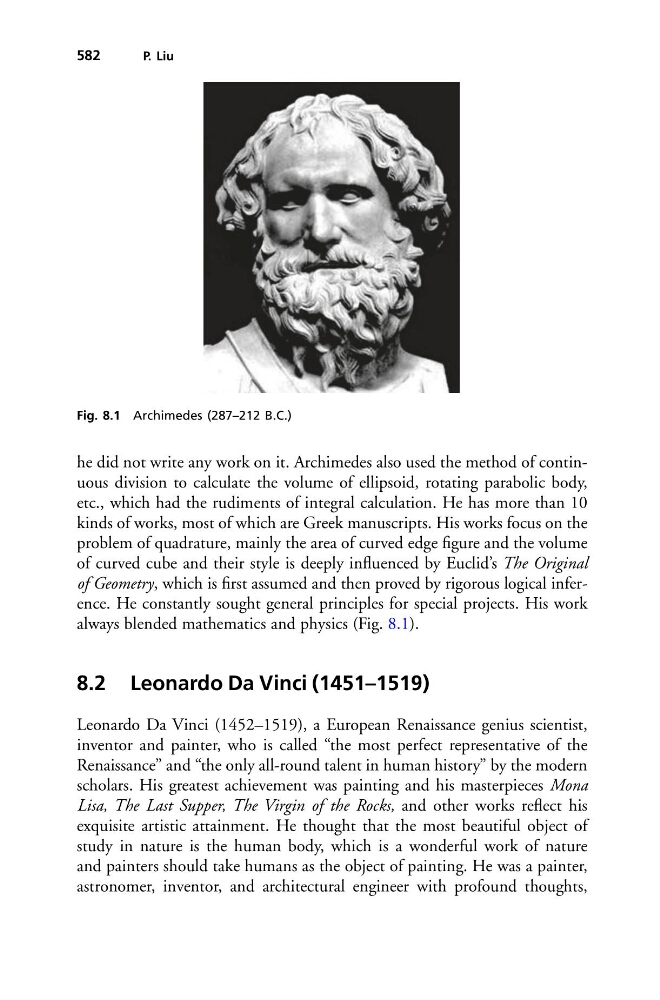
Fig. 8.1 Archimedes (287–212 B.C.)
he did not write any work on it. Archimedes also used the method of continuous division to calculate the volume of ellipsoid, rotating parabolic body,
etc., which had the rudiments of integral calculation. He has more than 10
kinds of works, most of which are Greek manuscripts. His works focus on the
problem of quadrature, mainly the area of curved edge figure and the volume
of curved cube and their style is deeply influenced by Euclid’s The Original
of Geometry, which is first assumed and then proved by rigorous logical inference. He constantly sought general principles for special projects. His work
always blended mathematics and physics (Fig. 8.1).
8.2 Leonardo Da Vinci (1451–1519)
Leonardo Da Vinci (1452–1519), a European Renaissance genius scientist,
inventor and painter, who is called “the most perfect representative of the
Renaissance” and “the only all-round talent in human history” by the modern
scholars. His greatest achievement was painting and his masterpieces Mona
Lisa, The Last Supper, The Virgin of the Rocks, and other works reflect his
exquisite artistic attainment. He thought that the most beautiful object of
study in nature is the human body, which is a wonderful work of nature
and painters should take humans as the object of painting. He was a painter,
astronomer, inventor, and architectural engineer with profound thoughts,
P. Liu
Fig. 8.1 Archimedes (287–212 B.C.)
he did not write any work on it. Archimedes also used the method of continuous division to calculate the volume of ellipsoid, rotating parabolic body,
etc., which had the rudiments of integral calculation. He has more than 10
kinds of works, most of which are Greek manuscripts. His works focus on the
problem of quadrature, mainly the area of curved edge figure and the volume
of curved cube and their style is deeply influenced by Euclid’s The Original
of Geometry, which is first assumed and then proved by rigorous logical inference. He constantly sought general principles for special projects. His work
always blended mathematics and physics (Fig. 8.1).
8.2 Leonardo Da Vinci (1451–1519)
Leonardo Da Vinci (1452–1519), a European Renaissance genius scientist,
inventor and painter, who is called “the most perfect representative of the
Renaissance” and “the only all-round talent in human history” by the modern
scholars. His greatest achievement was painting and his masterpieces Mona
Lisa, The Last Supper, The Virgin of the Rocks, and other works reflect his
exquisite artistic attainment. He thought that the most beautiful object of
study in nature is the human body, which is a wonderful work of nature
and painters should take humans as the object of painting. He was a painter,
astronomer, inventor, and architectural engineer with profound thoughts,