

588
P. Liu
8.7 Bernoulli (1700–1782)
Daniel Bernoulli (1700–1782) was one of the important members of
Bernoulli family, a famous scientific family in Switzerland. From 1726 to
1733, he presided over the department of mathematics at the Academy of
Sciences in St. Petersburg, Russia. Daniel Bernoulli had a solid mathematical foundation and keen insight, and often showed his originality in solving
problems. From 1725 to 1749, he won ten bonuses from the French Academy
of Sciences. His research fields included mathematics, mechanics, magnetism,
tide, ocean current, planetary orbit, etc. He has collaborated with Swiss mathematician L. Euler and Scottish mathematician C. Makrolin to write papers
on tides. In 1738, he published the book Hydrodynamics, which laid the foundation of this subject, and thus gained a high reputation. He put forward
the law of conservation of energy of ideal fluid, that is, the sum of position
potential energy, pressure potential energy, and kinetic energy per unit weight
of liquid remains constant, which is called Bernoulli’s theorem. On this
basis, the relationship between pressure and velocity of water was expounded,
and the important conclusion that the pressure decreases when the fluid
velocity increases was put forward. Daniel Bernoulli also has many works on
solid mechanics. For example, the vibration equation of cantilever beam was
proposed in 1735, and the superposition principle of elastic vibration theory
was proposed in 1742 (Fig. 8.7).
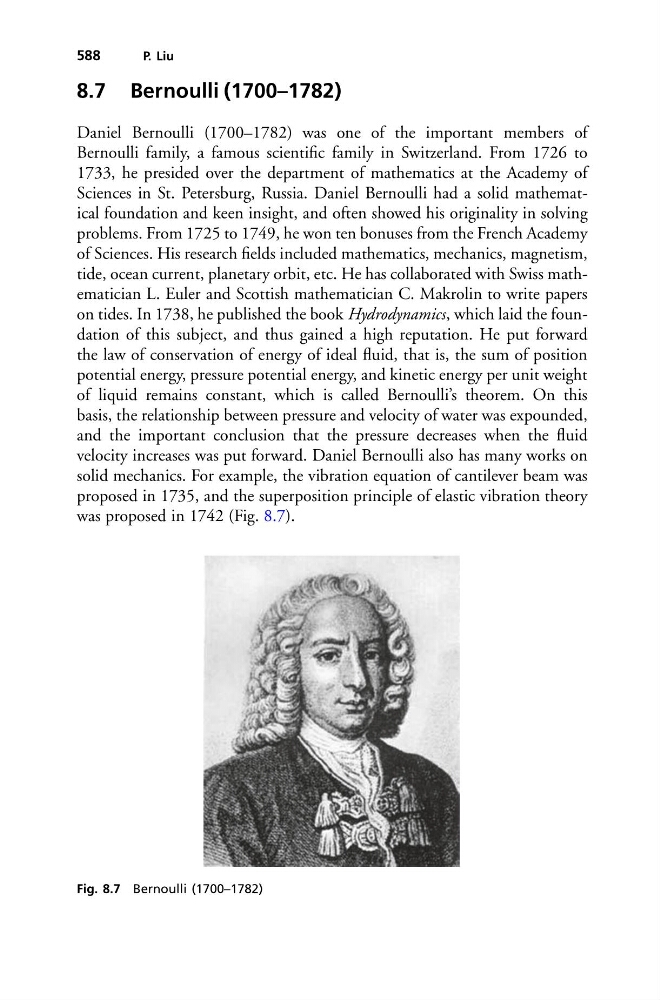
Fig. 8.7 Bernoulli (1700–1782)
P. Liu
8.7 Bernoulli (1700–1782)
Daniel Bernoulli (1700–1782) was one of the important members of
Bernoulli family, a famous scientific family in Switzerland. From 1726 to
1733, he presided over the department of mathematics at the Academy of
Sciences in St. Petersburg, Russia. Daniel Bernoulli had a solid mathematical foundation and keen insight, and often showed his originality in solving
problems. From 1725 to 1749, he won ten bonuses from the French Academy
of Sciences. His research fields included mathematics, mechanics, magnetism,
tide, ocean current, planetary orbit, etc. He has collaborated with Swiss mathematician L. Euler and Scottish mathematician C. Makrolin to write papers
on tides. In 1738, he published the book Hydrodynamics, which laid the foundation of this subject, and thus gained a high reputation. He put forward
the law of conservation of energy of ideal fluid, that is, the sum of position
potential energy, pressure potential energy, and kinetic energy per unit weight
of liquid remains constant, which is called Bernoulli’s theorem. On this
basis, the relationship between pressure and velocity of water was expounded,
and the important conclusion that the pressure decreases when the fluid
velocity increases was put forward. Daniel Bernoulli also has many works on
solid mechanics. For example, the vibration equation of cantilever beam was
proposed in 1735, and the superposition principle of elastic vibration theory
was proposed in 1742 (Fig. 8.7).
Fig. 8.7 Bernoulli (1700–1782)