

574
P. Liu
lower than that of wind tunnel test. Szodruch carried out the flight test
of drag reduction by riblets on A320. Under the flight condition of Mach
number M = 0.77–0.79, the riblet can reduce drag by about 2%, which is
similar to the expected effect.
In addition, there is a passive control device for reducing the turbulent
boundary layer drag, which is called the large eddy breakup device. This
device can reduce the drag of the boundary layer near it, but it will introduce a lot of additional drag, which may cause the net drag to rise. This
device is still under study.
Active turbulence control
The results show that it is a very effective turbulence control method to apply
the spanwise vibration in the turbulent boundary layer. The spanwise vibration control method can reduce the wall drag by generating the spanwise
vorticity in the Stokes layer and then affecting the time-averaged velocity
gradient in the viscous sublayer. The spanwise vibration of the turbulent flow
can be directly achieved by the vibration of the wall surface. In the experiment by Choi et al. the control method can reduce drag by 45%. Another
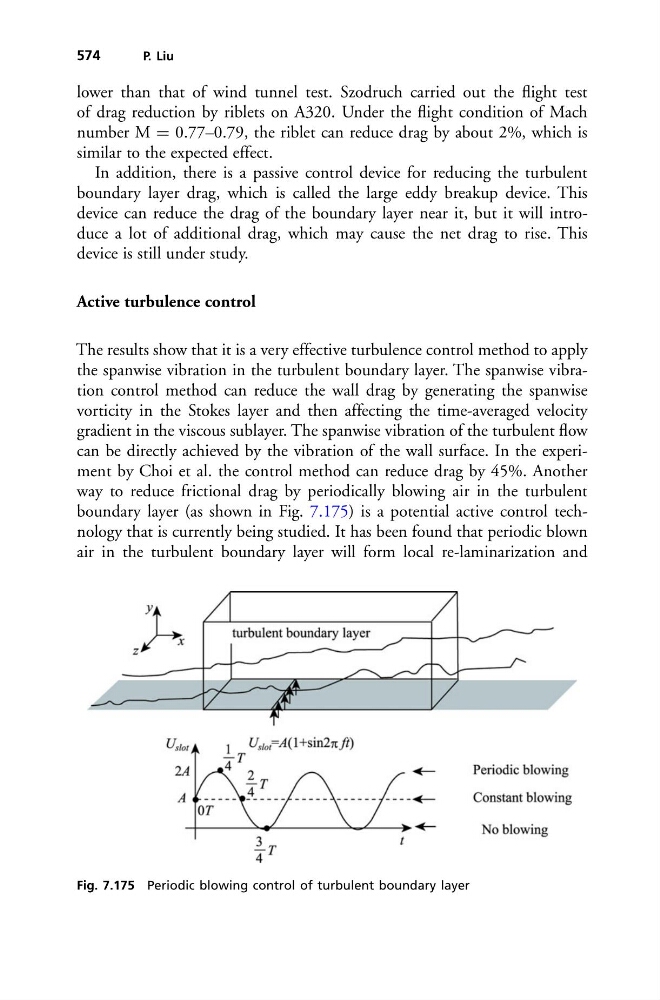
way to reduce frictional drag by periodically blowing air in the turbulent
boundary layer (as shown in Fig. 7.175) is a potential active control technology that is currently being studied. It has been found that periodic blown
air in the turbulent boundary layer will form local re-laminarization and
Fig. 7.175 Periodic blowing control of turbulent boundary layer
P. Liu
lower than that of wind tunnel test. Szodruch carried out the flight test
of drag reduction by riblets on A320. Under the flight condition of Mach
number M = 0.77–0.79, the riblet can reduce drag by about 2%, which is
similar to the expected effect.
In addition, there is a passive control device for reducing the turbulent
boundary layer drag, which is called the large eddy breakup device. This
device can reduce the drag of the boundary layer near it, but it will introduce a lot of additional drag, which may cause the net drag to rise. This
device is still under study.
Active turbulence control
The results show that it is a very effective turbulence control method to apply
the spanwise vibration in the turbulent boundary layer. The spanwise vibration control method can reduce the wall drag by generating the spanwise
vorticity in the Stokes layer and then affecting the time-averaged velocity
gradient in the viscous sublayer. The spanwise vibration of the turbulent flow
can be directly achieved by the vibration of the wall surface. In the experiment by Choi et al. the control method can reduce drag by 45%. Another
way to reduce frictional drag by periodically blowing air in the turbulent
boundary layer (as shown in Fig. 7.175) is a potential active control technology that is currently being studied. It has been found that periodic blown
air in the turbulent boundary layer will form local re-laminarization and
Fig. 7.175 Periodic blowing control of turbulent boundary layer