

572
P. Liu
also divided into active control and passive control, which are described
below.
Passive Turbulence Control
The frictional drag of turbulent boundary layer can be reduced by controlling
the spanwise fluctuation effectively. At present, the wall riblet control is a
passive control technology. In the study of turbulent boundary layer control,
the mechanism of shark skin riblet drag reduction has been widely concerned.
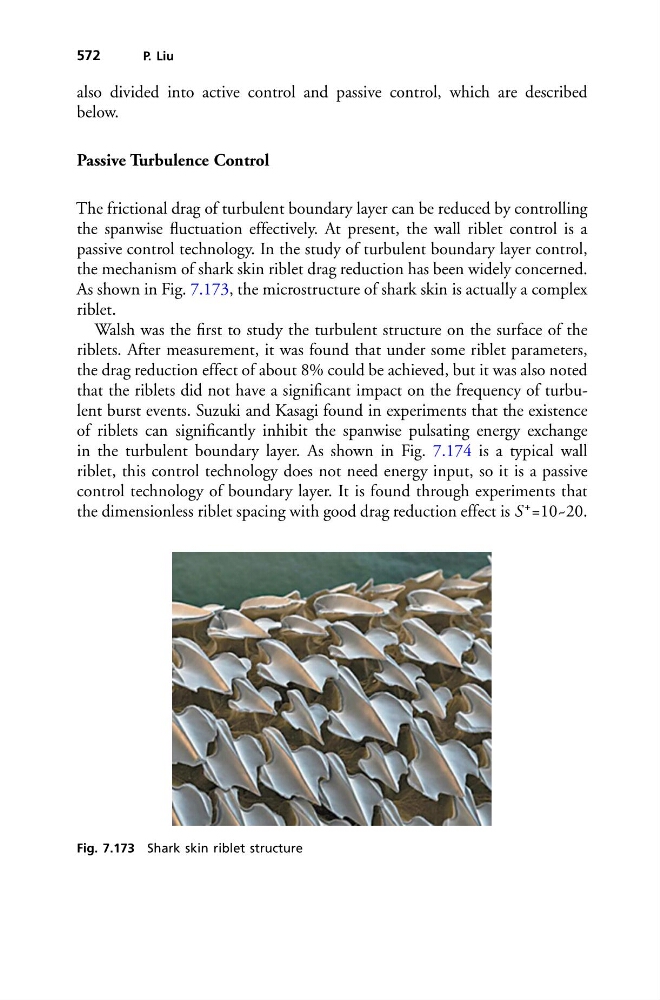
As shown in Fig. 7.173, the microstructure of shark skin is actually a complex
riblet.
Walsh was the first to study the turbulent structure on the surface of the
riblets. After measurement, it was found that under some riblet parameters,
the drag reduction effect of about 8% could be achieved, but it was also noted
that the riblets did not have a significant impact on the frequency of turbulent burst events. Suzuki and Kasagi found in experiments that the existence
of riblets can significantly inhibit the spanwise pulsating energy exchange
in the turbulent boundary layer. As shown in Fig. 7.174 is a typical wall
riblet, this control technology does not need energy input, so it is a passive
control technology of boundary layer. It is found through experiments that
the dimensionless riblet spacing with good drag reduction effect is S + =10~20.
Fig. 7.173 Shark skin riblet structure
P. Liu
also divided into active control and passive control, which are described
below.
Passive Turbulence Control
The frictional drag of turbulent boundary layer can be reduced by controlling
the spanwise fluctuation effectively. At present, the wall riblet control is a
passive control technology. In the study of turbulent boundary layer control,
the mechanism of shark skin riblet drag reduction has been widely concerned.
As shown in Fig. 7.173, the microstructure of shark skin is actually a complex
riblet.
Walsh was the first to study the turbulent structure on the surface of the
riblets. After measurement, it was found that under some riblet parameters,
the drag reduction effect of about 8% could be achieved, but it was also noted
that the riblets did not have a significant impact on the frequency of turbulent burst events. Suzuki and Kasagi found in experiments that the existence
of riblets can significantly inhibit the spanwise pulsating energy exchange
in the turbulent boundary layer. As shown in Fig. 7.174 is a typical wall
riblet, this control technology does not need energy input, so it is a passive
control technology of boundary layer. It is found through experiments that
the dimensionless riblet spacing with good drag reduction effect is S + =10~20.
Fig. 7.173 Shark skin riblet structure