

7 Flight Mystery and Aerodynamic Principles
567
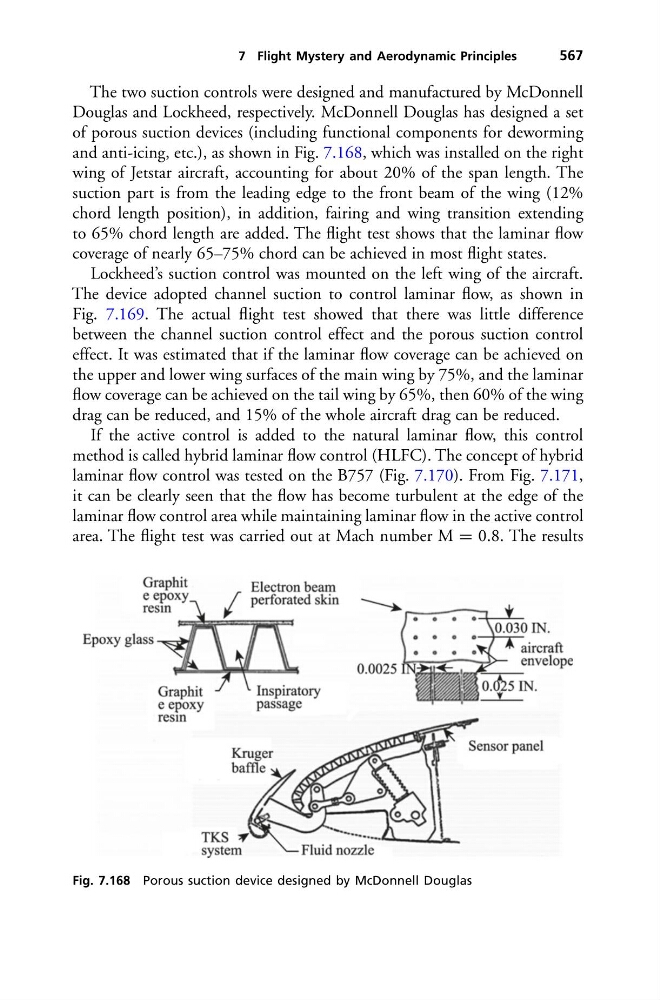
The two suction controls were designed and manufactured by McDonnell
Douglas and Lockheed, respectively. McDonnell Douglas has designed a set
of porous suction devices (including functional components for deworming
and anti-icing, etc.), as shown in Fig. 7.168, which was installed on the right
wing of Jetstar aircraft, accounting for about 20% of the span length. The
suction part is from the leading edge to the front beam of the wing (12%
chord length position), in addition, fairing and wing transition extending
to 65% chord length are added. The flight test shows that the laminar flow
coverage of nearly 65–75% chord can be achieved in most flight states.
Lockheed’s suction control was mounted on the left wing of the aircraft.
The device adopted channel suction to control laminar flow, as shown in
Fig. 7.169. The actual flight test showed that there was little difference
between the channel suction control effect and the porous suction control
effect. It was estimated that if the laminar flow coverage can be achieved on
the upper and lower wing surfaces of the main wing by 75%, and the laminar
flow coverage can be achieved on the tail wing by 65%, then 60% of the wing
drag can be reduced, and 15% of the whole aircraft drag can be reduced.
If the active control is added to the natural laminar flow, this control
method is called hybrid laminar flow control (HLFC). The concept of hybrid
laminar flow control was tested on the B757 (Fig. 7.170). From Fig. 7.171,
it can be clearly seen that the flow has become turbulent at the edge of the
laminar flow control area while maintaining laminar flow in the active control
area. The flight test was carried out at Mach number M = 0.8. The results
Fig. 7.168 Porous suction device designed by McDonnell Douglas
567
The two suction controls were designed and manufactured by McDonnell
Douglas and Lockheed, respectively. McDonnell Douglas has designed a set
of porous suction devices (including functional components for deworming
and anti-icing, etc.), as shown in Fig. 7.168, which was installed on the right
wing of Jetstar aircraft, accounting for about 20% of the span length. The
suction part is from the leading edge to the front beam of the wing (12%
chord length position), in addition, fairing and wing transition extending
to 65% chord length are added. The flight test shows that the laminar flow
coverage of nearly 65–75% chord can be achieved in most flight states.
Lockheed’s suction control was mounted on the left wing of the aircraft.
The device adopted channel suction to control laminar flow, as shown in
Fig. 7.169. The actual flight test showed that there was little difference
between the channel suction control effect and the porous suction control
effect. It was estimated that if the laminar flow coverage can be achieved on
the upper and lower wing surfaces of the main wing by 75%, and the laminar
flow coverage can be achieved on the tail wing by 65%, then 60% of the wing
drag can be reduced, and 15% of the whole aircraft drag can be reduced.
If the active control is added to the natural laminar flow, this control
method is called hybrid laminar flow control (HLFC). The concept of hybrid
laminar flow control was tested on the B757 (Fig. 7.170). From Fig. 7.171,
it can be clearly seen that the flow has become turbulent at the edge of the
laminar flow control area while maintaining laminar flow in the active control
area. The flight test was carried out at Mach number M = 0.8. The results
Fig. 7.168 Porous suction device designed by McDonnell Douglas