

566
P. Liu
which is the first kind of laminar flow nacelle control that has been put into
commercial operation.
However, the design of laminar airfoil alone cannot solve the laminar flow
control problem of large transport aircraft. For cruising at a higher speed,
such as Mach number M = 0.8, the swept wing is usually used to control the
shock wave so as to increase the drag divergence Mach number, so the crossflow instability becomes the dominant factor of the boundary layer transition.
However, the cross-flow instability develops rapidly in the negative pressure
gradient region, so other ways are needed to control it.
Active Laminar Flow Control
The active laminar flow control methods include suction control, temperature
control, active flexible wall control, plasma control, etc. Among them, the
development of suction control is more mature, and through a large number
of flight tests, it is proved that the drag reduction effect is obvious. The principle of suction control can be simply understood as changing the average
velocity profile of the local boundary layer, and then restraining the growth
of the related instability disturbance. There are usually two ways of suction
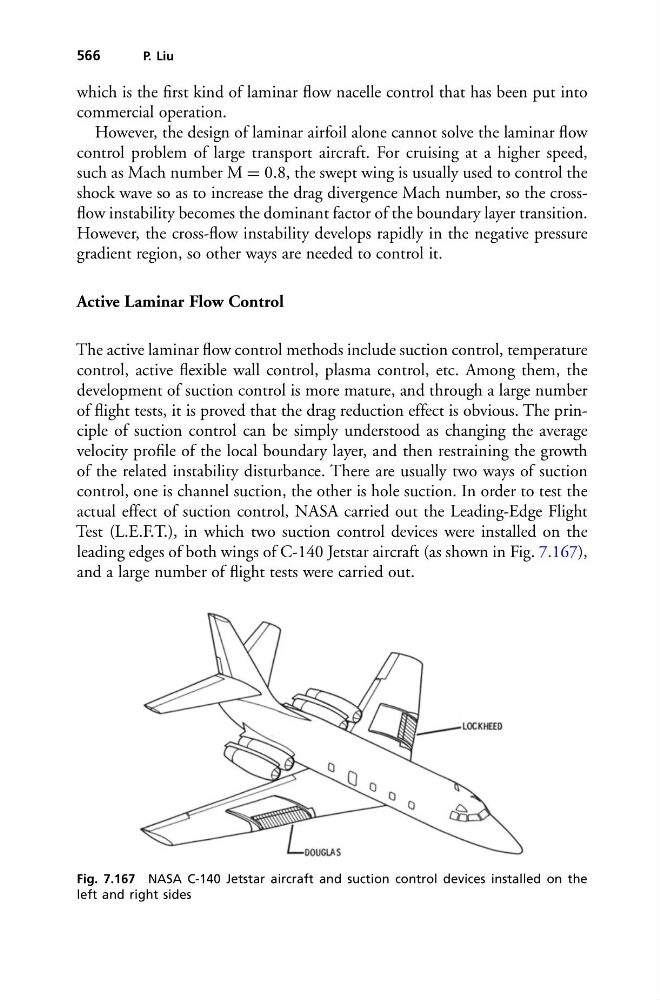
control, one is channel suction, the other is hole suction. In order to test the
actual effect of suction control, NASA carried out the Leading-Edge Flight
Test (L.E.F.T.), in which two suction control devices were installed on the
leading edges of both wings of C-140 Jetstar aircraft (as shown in Fig. 7.167),
and a large number of flight tests were carried out.
Fig. 7.167 NASA C-140 Jetstar aircraft and suction control devices installed on the
left and right sides
P. Liu
which is the first kind of laminar flow nacelle control that has been put into
commercial operation.
However, the design of laminar airfoil alone cannot solve the laminar flow
control problem of large transport aircraft. For cruising at a higher speed,
such as Mach number M = 0.8, the swept wing is usually used to control the
shock wave so as to increase the drag divergence Mach number, so the crossflow instability becomes the dominant factor of the boundary layer transition.
However, the cross-flow instability develops rapidly in the negative pressure
gradient region, so other ways are needed to control it.
Active Laminar Flow Control
The active laminar flow control methods include suction control, temperature
control, active flexible wall control, plasma control, etc. Among them, the
development of suction control is more mature, and through a large number
of flight tests, it is proved that the drag reduction effect is obvious. The principle of suction control can be simply understood as changing the average
velocity profile of the local boundary layer, and then restraining the growth
of the related instability disturbance. There are usually two ways of suction
control, one is channel suction, the other is hole suction. In order to test the
actual effect of suction control, NASA carried out the Leading-Edge Flight
Test (L.E.F.T.), in which two suction control devices were installed on the
leading edges of both wings of C-140 Jetstar aircraft (as shown in Fig. 7.167),
and a large number of flight tests were carried out.
Fig. 7.167 NASA C-140 Jetstar aircraft and suction control devices installed on the
left and right sides