

7 Flight Mystery and Aerodynamic Principles
565
the cross-flow vortices rotate in the same direction. Similar to the cross-flow
instability, the breaking of Görtler vortex is also caused by the rapid amplification of the secondary instability on the vortex, which causes the transition
of boundary layer.
Attachment-line instability usually means that in the three-dimensional
flow of the wing leading edge, the instability wave develops, amplifies along
the spanwise, and leads to the transition of the boundary layer. Generally, the
connecting part of the wing and the fuselage does not isolate the turbulent
boundary layer on the fuselage, so the turbulent fluctuation on the fuselage
surface will propagate to the wing surface flow, which is easy to cause the flow
on the wing surface to be polluted and then transition.
Natural laminar flow control
For example, NACA-6 series airfoils designed in the early stage are representative of natural laminar flow control. The early results of laminar airfoil design
are usually unsatisfactory. For example, although the NACA 632-215 airfoil
can achieve low drag, the lift range that can be used is much smaller than
that of the turbulent NACA 23015 airfoil. Of course, with the development
of airfoil design technology, the performance of natural laminar flow airfoil is
getting better and better. For example, NLF (2)–0415 airfoil is often used for
boundary layer transition test because of its very effective negative pressure
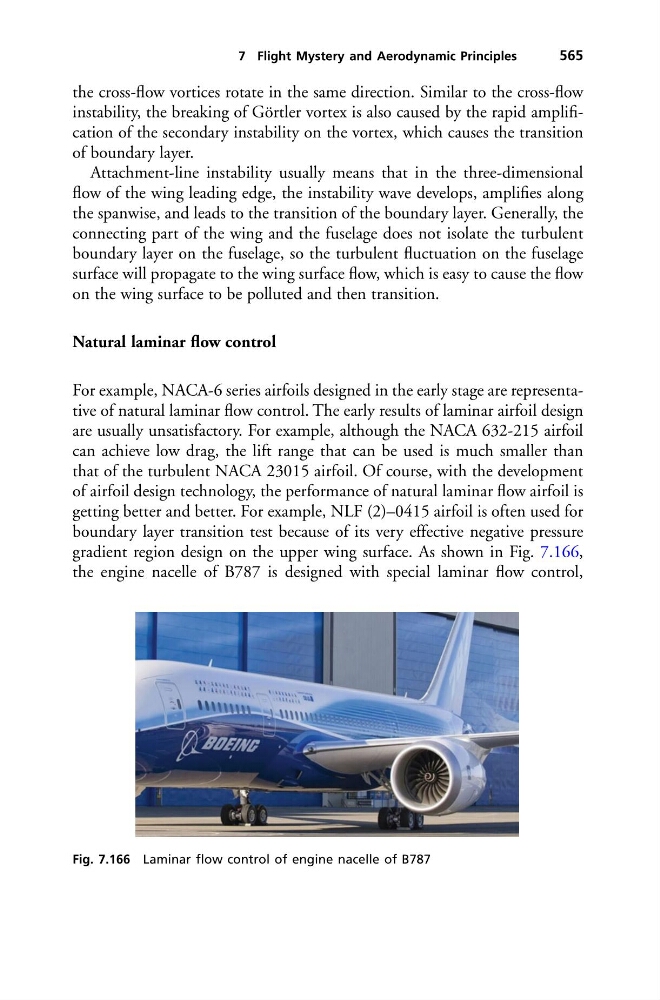
gradient region design on the upper wing surface. As shown in Fig. 7.166,
the engine nacelle of B787 is designed with special laminar flow control,
Fig. 7.166 Laminar flow control of engine nacelle of B787
565
the cross-flow vortices rotate in the same direction. Similar to the cross-flow
instability, the breaking of Görtler vortex is also caused by the rapid amplification of the secondary instability on the vortex, which causes the transition
of boundary layer.
Attachment-line instability usually means that in the three-dimensional
flow of the wing leading edge, the instability wave develops, amplifies along
the spanwise, and leads to the transition of the boundary layer. Generally, the
connecting part of the wing and the fuselage does not isolate the turbulent
boundary layer on the fuselage, so the turbulent fluctuation on the fuselage
surface will propagate to the wing surface flow, which is easy to cause the flow
on the wing surface to be polluted and then transition.
Natural laminar flow control
For example, NACA-6 series airfoils designed in the early stage are representative of natural laminar flow control. The early results of laminar airfoil design
are usually unsatisfactory. For example, although the NACA 632-215 airfoil
can achieve low drag, the lift range that can be used is much smaller than
that of the turbulent NACA 23015 airfoil. Of course, with the development
of airfoil design technology, the performance of natural laminar flow airfoil is
getting better and better. For example, NLF (2)–0415 airfoil is often used for
boundary layer transition test because of its very effective negative pressure
gradient region design on the upper wing surface. As shown in Fig. 7.166,
the engine nacelle of B787 is designed with special laminar flow control,
Fig. 7.166 Laminar flow control of engine nacelle of B787