

558
P. Liu
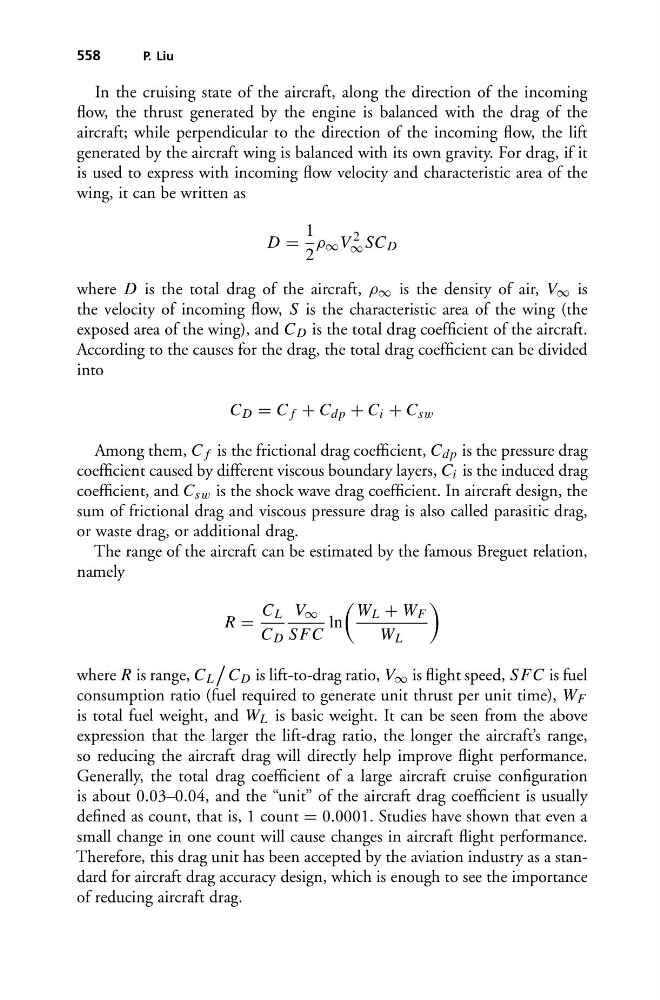
In the cruising state of the aircraft, along the direction of the incoming
flow, the thrust generated by the engine is balanced with the drag of the
aircraft; while perpendicular to the direction of the incoming flow, the lift
generated by the aircraft wing is balanced with its own gravity. For drag, if it
is used to express with incoming flow velocity and characteristic area of the
wing, it can be written as
D =
1
2
ρ ∞ V
2
∞ SC D
where D is the total drag of the aircraft, ρ ∞ is the density of air, V ∞ is
the velocity of incoming flow, S is the characteristic area of the wing (the
exposed area of the wing), and C D is the total drag coefficient of the aircraft.
According to the causes for the drag, the total drag coefficient can be divided
into
C D = C f + C dp + C i + C sw
Among them, C f is the frictional drag coefficient, C dp is the pressure drag
coefficient caused by different viscous boundary layers, C i is the induced drag
coefficient, and C sw is the shock wave drag coefficient. In aircraft design, the
sum of frictional drag and viscous pressure drag is also called parasitic drag,
or waste drag, or additional drag.
The range of the aircraft can be estimated by the famous Breguet relation,
namely
R =
C L
C D
V ∞
S FC
ln
W L + W F
W L
where R is range, C L
C D is lift-to-drag ratio, V ∞ is flight speed, S FC is fuel
consumption ratio (fuel required to generate unit thrust per unit time), W F
is total fuel weight, and W L is basic weight. It can be seen from the above
expression that the larger the lift-drag ratio, the longer the aircraft’s range,
so reducing the aircraft drag will directly help improve flight performance.
Generally, the total drag coefficient of a large aircraft cruise configuration
is about 0.03–0.04, and the “unit” of the aircraft drag coefficient is usually
defined as count, that is, 1 count = 0.0001. Studies have shown that even a
small change in one count will cause changes in aircraft flight performance.
Therefore, this drag unit has been accepted by the aviation industry as a standard for aircraft drag accuracy design, which is enough to see the importance
of reducing aircraft drag.
P. Liu
In the cruising state of the aircraft, along the direction of the incoming
flow, the thrust generated by the engine is balanced with the drag of the
aircraft; while perpendicular to the direction of the incoming flow, the lift
generated by the aircraft wing is balanced with its own gravity. For drag, if it
is used to express with incoming flow velocity and characteristic area of the
wing, it can be written as
D =
1
2
ρ ∞ V
2
∞ SC D
where D is the total drag of the aircraft, ρ ∞ is the density of air, V ∞ is
the velocity of incoming flow, S is the characteristic area of the wing (the
exposed area of the wing), and C D is the total drag coefficient of the aircraft.
According to the causes for the drag, the total drag coefficient can be divided
into
C D = C f + C dp + C i + C sw
Among them, C f is the frictional drag coefficient, C dp is the pressure drag
coefficient caused by different viscous boundary layers, C i is the induced drag
coefficient, and C sw is the shock wave drag coefficient. In aircraft design, the
sum of frictional drag and viscous pressure drag is also called parasitic drag,
or waste drag, or additional drag.
The range of the aircraft can be estimated by the famous Breguet relation,
namely
R =
C L
C D
V ∞
S FC
ln
W L + W F
W L
where R is range, C L
C D is lift-to-drag ratio, V ∞ is flight speed, S FC is fuel
consumption ratio (fuel required to generate unit thrust per unit time), W F
is total fuel weight, and W L is basic weight. It can be seen from the above
expression that the larger the lift-drag ratio, the longer the aircraft’s range,
so reducing the aircraft drag will directly help improve flight performance.
Generally, the total drag coefficient of a large aircraft cruise configuration
is about 0.03–0.04, and the “unit” of the aircraft drag coefficient is usually
defined as count, that is, 1 count = 0.0001. Studies have shown that even a
small change in one count will cause changes in aircraft flight performance.
Therefore, this drag unit has been accepted by the aviation industry as a standard for aircraft drag accuracy design, which is enough to see the importance
of reducing aircraft drag.