

480
P. Liu
crane engine. The main wing is a large aspect ratio, medium-swept supercritical wing. The lifting device is a leading edge slat and a push-back Fowler flap,
and the wing tip is equipped with a winglet. It achieves better cruise aerodynamic efficiency than the same type of aircraft in service, and has comparable
cruise aerodynamic efficiency with competitive aircraft in the market ten
years later. Advanced engines are used to reduce fuel consumption, noise,
and emissions. A large number of advanced composite materials, advanced
aluminum-lithium alloys, etc., are used. The composite material usage will
reach 20%, which will reduce the structural weight of the aircraft. Advanced
fly-by-wire and active control technologies are used to enhance the overall
performance of the aircraft and improve human factor and comfort. The
advanced integrated avionics technology is adopted to reduce pilot burden,
improve navigation performance and perfect man-machine interface.
2. Aerodynamic coefficient of the wing
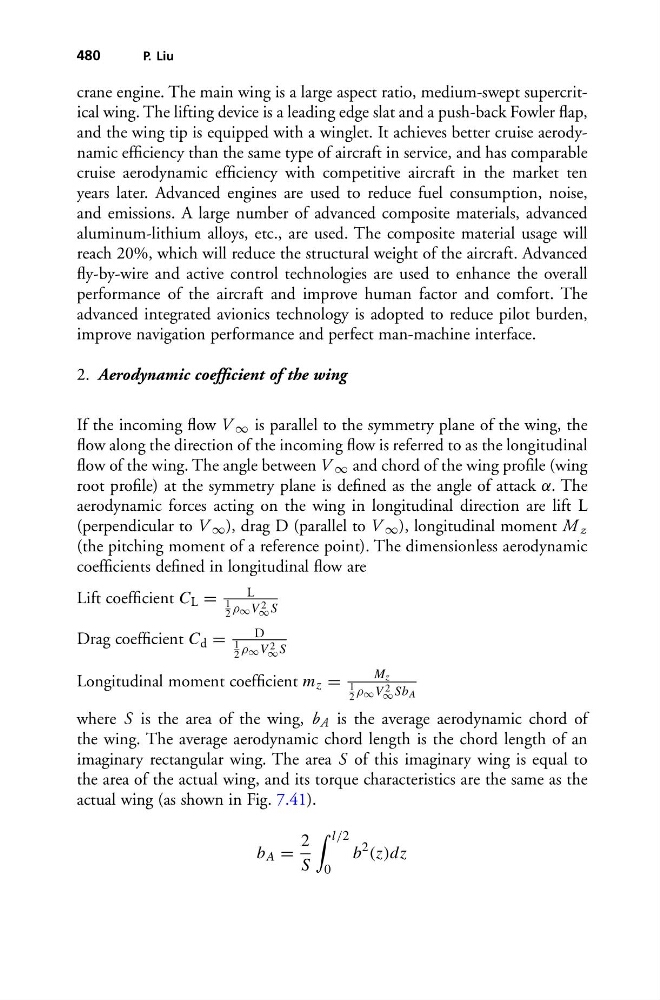
If the incoming flow V ∞ is parallel to the symmetry plane of the wing, the
flow along the direction of the incoming flow is referred to as the longitudinal
flow of the wing. The angle between V ∞ and chord of the wing profile (wing
root profile) at the symmetry plane is defined as the angle of attack α. The
aerodynamic forces acting on the wing in longitudinal direction are lift L
(perpendicular to V ∞ ), drag D (parallel to V ∞ ), longitudinal moment M z
(the pitching moment of a reference point). The dimensionless aerodynamic
coefficients defined in longitudinal flow are
Lift coefficient C L =
L
1
2 ρ ∞ V 2
∞ S
Drag coefficient C d =
D
1
2 ρ ∞ V 2
∞ S
Longitudinal moment coefficient m z =
M z
1
2 ρ ∞ V 2
∞ Sb A
where S is the area of the wing, b A is the average aerodynamic chord of
the wing. The average aerodynamic chord length is the chord length of an
imaginary rectangular wing. The area S of this imaginary wing is equal to
the area of the actual wing, and its torque characteristics are the same as the
actual wing (as shown in Fig. 7.41).
b A =
2
S
l/2
0
b
2
(z)dz
P. Liu
crane engine. The main wing is a large aspect ratio, medium-swept supercritical wing. The lifting device is a leading edge slat and a push-back Fowler flap,
and the wing tip is equipped with a winglet. It achieves better cruise aerodynamic efficiency than the same type of aircraft in service, and has comparable
cruise aerodynamic efficiency with competitive aircraft in the market ten
years later. Advanced engines are used to reduce fuel consumption, noise,
and emissions. A large number of advanced composite materials, advanced
aluminum-lithium alloys, etc., are used. The composite material usage will
reach 20%, which will reduce the structural weight of the aircraft. Advanced
fly-by-wire and active control technologies are used to enhance the overall
performance of the aircraft and improve human factor and comfort. The
advanced integrated avionics technology is adopted to reduce pilot burden,
improve navigation performance and perfect man-machine interface.
2. Aerodynamic coefficient of the wing
If the incoming flow V ∞ is parallel to the symmetry plane of the wing, the
flow along the direction of the incoming flow is referred to as the longitudinal
flow of the wing. The angle between V ∞ and chord of the wing profile (wing
root profile) at the symmetry plane is defined as the angle of attack α. The
aerodynamic forces acting on the wing in longitudinal direction are lift L
(perpendicular to V ∞ ), drag D (parallel to V ∞ ), longitudinal moment M z
(the pitching moment of a reference point). The dimensionless aerodynamic
coefficients defined in longitudinal flow are
Lift coefficient C L =
L
1
2 ρ ∞ V 2
∞ S
Drag coefficient C d =
D
1
2 ρ ∞ V 2
∞ S
Longitudinal moment coefficient m z =
M z
1
2 ρ ∞ V 2
∞ Sb A
where S is the area of the wing, b A is the average aerodynamic chord of
the wing. The average aerodynamic chord length is the chord length of an
imaginary rectangular wing. The area S of this imaginary wing is equal to
the area of the actual wing, and its torque characteristics are the same as the
actual wing (as shown in Fig. 7.41).
b A =
2
S
l/2
0
b
2
(z)dz