

7 Flight Mystery and Aerodynamic Principles
479
aircraft has no winglets, and it is equipped with a lifting device including a
leading edge slat and a push-back Fowler flap system. The cantilever T-tail
is used, and the small dorsal fin is extended forward at the joint between
the vertical stabilizer and the fuselage. The embedded rudder is divided into
upper and lower sections, and the elevator is divided into two sections. The
hydraulic retractable front three-point landing gear can be freely lowered by
gravity during emergency. The front landing gear has two wheels and the
main landing gear has six wheels. The front landing gear retracts forward
into the fuselage, and the main landing gear rotates 90° and retracts into the
fairing on both sides of the fuselage. The Y-20 is based on the design of the
IL-76 transport aircraft, but it is larger in size, more capable of carrying and
the electronic equipment is also very advanced.
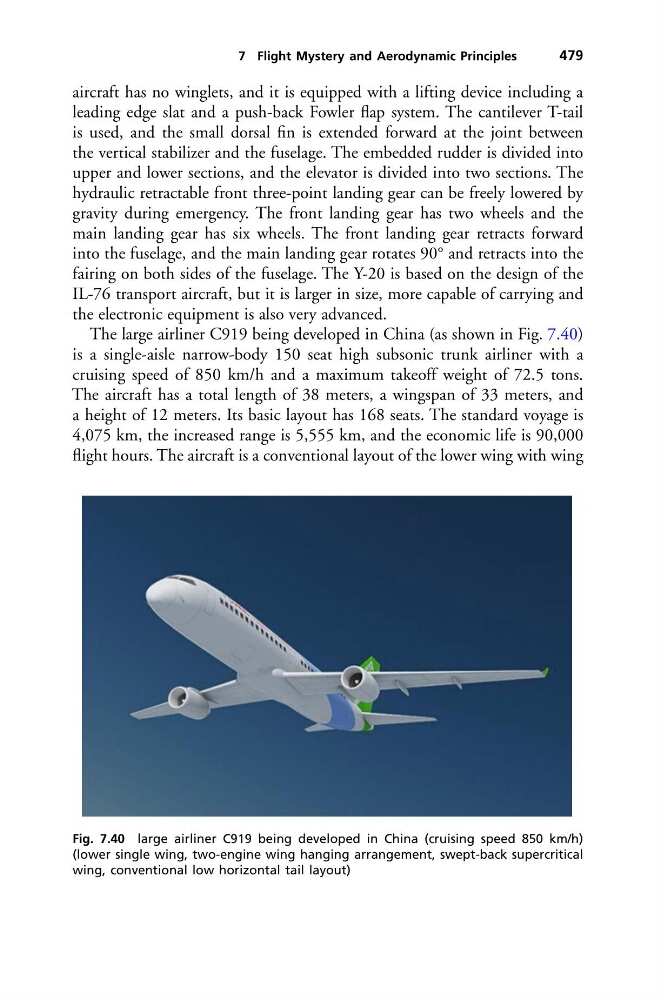
The large airliner C919 being developed in China (as shown in Fig. 7.40)
is a single-aisle narrow-body 150 seat high subsonic trunk airliner with a
cruising speed of 850 km/h and a maximum takeoff weight of 72.5 tons.
The aircraft has a total length of 38 meters, a wingspan of 33 meters, and
a height of 12 meters. Its basic layout has 168 seats. The standard voyage is
4,075 km, the increased range is 5,555 km, and the economic life is 90,000
flight hours. The aircraft is a conventional layout of the lower wing with wing
Fig. 7.40 large airliner C919 being developed in China (cruising speed 850 km/h)
(lower single wing, two-engine wing hanging arrangement, swept-back supercritical
wing, conventional low horizontal tail layout)
479
aircraft has no winglets, and it is equipped with a lifting device including a
leading edge slat and a push-back Fowler flap system. The cantilever T-tail
is used, and the small dorsal fin is extended forward at the joint between
the vertical stabilizer and the fuselage. The embedded rudder is divided into
upper and lower sections, and the elevator is divided into two sections. The
hydraulic retractable front three-point landing gear can be freely lowered by
gravity during emergency. The front landing gear has two wheels and the
main landing gear has six wheels. The front landing gear retracts forward
into the fuselage, and the main landing gear rotates 90° and retracts into the
fairing on both sides of the fuselage. The Y-20 is based on the design of the
IL-76 transport aircraft, but it is larger in size, more capable of carrying and
the electronic equipment is also very advanced.
The large airliner C919 being developed in China (as shown in Fig. 7.40)
is a single-aisle narrow-body 150 seat high subsonic trunk airliner with a
cruising speed of 850 km/h and a maximum takeoff weight of 72.5 tons.
The aircraft has a total length of 38 meters, a wingspan of 33 meters, and
a height of 12 meters. Its basic layout has 168 seats. The standard voyage is
4,075 km, the increased range is 5,555 km, and the economic life is 90,000
flight hours. The aircraft is a conventional layout of the lower wing with wing
Fig. 7.40 large airliner C919 being developed in China (cruising speed 850 km/h)
(lower single wing, two-engine wing hanging arrangement, swept-back supercritical
wing, conventional low horizontal tail layout)