

478
P. Liu
wing, four engines, and large cargo door at the tail. This layout laid the
design “standard” for the medium-sized transport aircraft after the Second
World War. The most striking feature of the C-130 is its design to thoroughly meet the actual requirements of tactical air transport, so it is very
suitable for a variety of air transport tasks, for example, a large tail cargo door
of an aluminum alloy semi-monocoque structure fuselage. The airfoil of the
wing root is NACA 64A318, the airfoil of the wing tip is NACA 64A412,
the dihedral angle is 2°30 , the wing root installation angle is 3°, the wing
tip installation angle is 0°, and the ¼ chord sweep angle is 0°。 The all-metal
double-beam forced skin structure and the machined integral reinforced variable thickness skin panels with a length of 14.63 m are adopted. The ailerons
are made of ordinary aluminum alloy. A tandem hydraulic booster is used
to supply pressure from two separate hydraulic systems. There are tabs on
the aileron. The Fowler aluminum alloy trailing edge flaps are used, and the
leading edge of the wing uses engine bleed air to prevent ice.
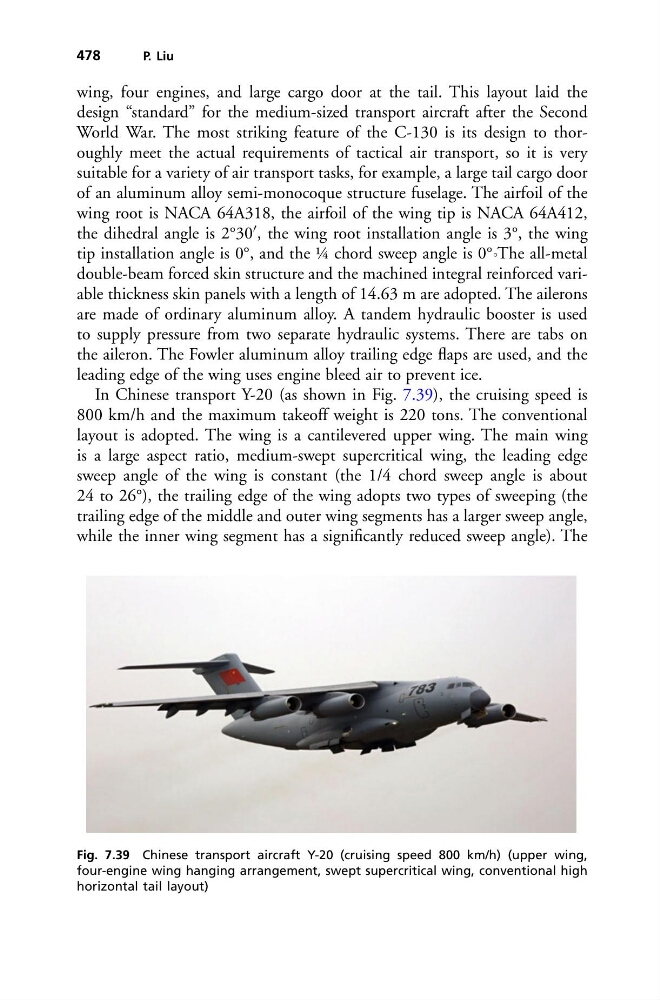
In Chinese transport Y-20 (as shown in Fig. 7.39), the cruising speed is
800 km/h and the maximum takeoff weight is 220 tons. The conventional
layout is adopted. The wing is a cantilevered upper wing. The main wing
is a large aspect ratio, medium-swept supercritical wing, the leading edge
sweep angle of the wing is constant (the 1/4 chord sweep angle is about
24 to 26°), the trailing edge of the wing adopts two types of sweeping (the
trailing edge of the middle and outer wing segments has a larger sweep angle,
while the inner wing segment has a significantly reduced sweep angle). The
Fig. 7.39 Chinese transport aircraft Y-20 (cruising speed 800 km/h) (upper wing,
four-engine wing hanging arrangement, swept supercritical wing, conventional high
horizontal tail layout)
P. Liu
wing, four engines, and large cargo door at the tail. This layout laid the
design “standard” for the medium-sized transport aircraft after the Second
World War. The most striking feature of the C-130 is its design to thoroughly meet the actual requirements of tactical air transport, so it is very
suitable for a variety of air transport tasks, for example, a large tail cargo door
of an aluminum alloy semi-monocoque structure fuselage. The airfoil of the
wing root is NACA 64A318, the airfoil of the wing tip is NACA 64A412,
the dihedral angle is 2°30 , the wing root installation angle is 3°, the wing
tip installation angle is 0°, and the ¼ chord sweep angle is 0°。 The all-metal
double-beam forced skin structure and the machined integral reinforced variable thickness skin panels with a length of 14.63 m are adopted. The ailerons
are made of ordinary aluminum alloy. A tandem hydraulic booster is used
to supply pressure from two separate hydraulic systems. There are tabs on
the aileron. The Fowler aluminum alloy trailing edge flaps are used, and the
leading edge of the wing uses engine bleed air to prevent ice.
In Chinese transport Y-20 (as shown in Fig. 7.39), the cruising speed is
800 km/h and the maximum takeoff weight is 220 tons. The conventional
layout is adopted. The wing is a cantilevered upper wing. The main wing
is a large aspect ratio, medium-swept supercritical wing, the leading edge
sweep angle of the wing is constant (the 1/4 chord sweep angle is about
24 to 26°), the trailing edge of the wing adopts two types of sweeping (the
trailing edge of the middle and outer wing segments has a larger sweep angle,
while the inner wing segment has a significantly reduced sweep angle). The
Fig. 7.39 Chinese transport aircraft Y-20 (cruising speed 800 km/h) (upper wing,
four-engine wing hanging arrangement, swept supercritical wing, conventional high
horizontal tail layout)