

7 Flight Mystery and Aerodynamic Principles
481
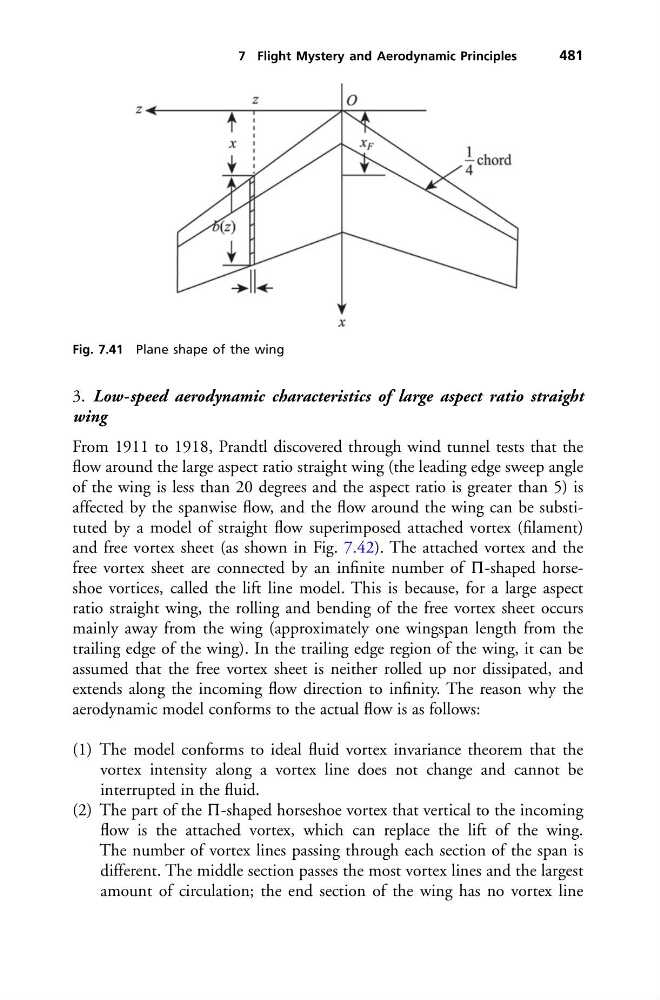
Fig. 7.41 Plane shape of the wing
3. Low-speed aerodynamic characteristics of large aspect ratio straight
wing
From 1911 to 1918, Prandtl discovered through wind tunnel tests that the
flow around the large aspect ratio straight wing (the leading edge sweep angle
of the wing is less than 20 degrees and the aspect ratio is greater than 5) is
affected by the spanwise flow, and the flow around the wing can be substituted by a model of straight flow superimposed attached vortex (filament)
and free vortex sheet (as shown in Fig. 7.42). The attached vortex and the
free vortex sheet are connected by an infinite number of -shaped horseshoe vortices, called the lift line model. This is because, for a large aspect
ratio straight wing, the rolling and bending of the free vortex sheet occurs
mainly away from the wing (approximately one wingspan length from the
trailing edge of the wing). In the trailing edge region of the wing, it can be
assumed that the free vortex sheet is neither rolled up nor dissipated, and
extends along the incoming flow direction to infinity. The reason why the
aerodynamic model conforms to the actual flow is as follows:
(1) The model conforms to ideal fluid vortex invariance theorem that the
vortex intensity along a vortex line does not change and cannot be
interrupted in the fluid.
(2) The part of the -shaped horseshoe vortex that vertical to the incoming
flow is the attached vortex, which can replace the lift of the wing.
The number of vortex lines passing through each section of the span is
different. The middle section passes the most vortex lines and the largest
amount of circulation; the end section of the wing has no vortex line
481
Fig. 7.41 Plane shape of the wing
3. Low-speed aerodynamic characteristics of large aspect ratio straight
wing
From 1911 to 1918, Prandtl discovered through wind tunnel tests that the
flow around the large aspect ratio straight wing (the leading edge sweep angle
of the wing is less than 20 degrees and the aspect ratio is greater than 5) is
affected by the spanwise flow, and the flow around the wing can be substituted by a model of straight flow superimposed attached vortex (filament)
and free vortex sheet (as shown in Fig. 7.42). The attached vortex and the
free vortex sheet are connected by an infinite number of -shaped horseshoe vortices, called the lift line model. This is because, for a large aspect
ratio straight wing, the rolling and bending of the free vortex sheet occurs
mainly away from the wing (approximately one wingspan length from the
trailing edge of the wing). In the trailing edge region of the wing, it can be
assumed that the free vortex sheet is neither rolled up nor dissipated, and
extends along the incoming flow direction to infinity. The reason why the
aerodynamic model conforms to the actual flow is as follows:
(1) The model conforms to ideal fluid vortex invariance theorem that the
vortex intensity along a vortex line does not change and cannot be
interrupted in the fluid.
(2) The part of the -shaped horseshoe vortex that vertical to the incoming
flow is the attached vortex, which can replace the lift of the wing.
The number of vortex lines passing through each section of the span is
different. The middle section passes the most vortex lines and the largest
amount of circulation; the end section of the wing has no vortex line