

470
P. Liu
the glider, the driver and the glider stand at a high position, and then the
glider floats all the way down. At this time, the force component of gravity
overcomes the aerodynamic drag. But sometimes we can see that the glider
can also float upwards. What is the reason? It turns out that if the glider flies
over the airflow with the upward velocity component, the glider is lifted up.
But if there is no upward airflow, the glider can only slide down from the
high platform.
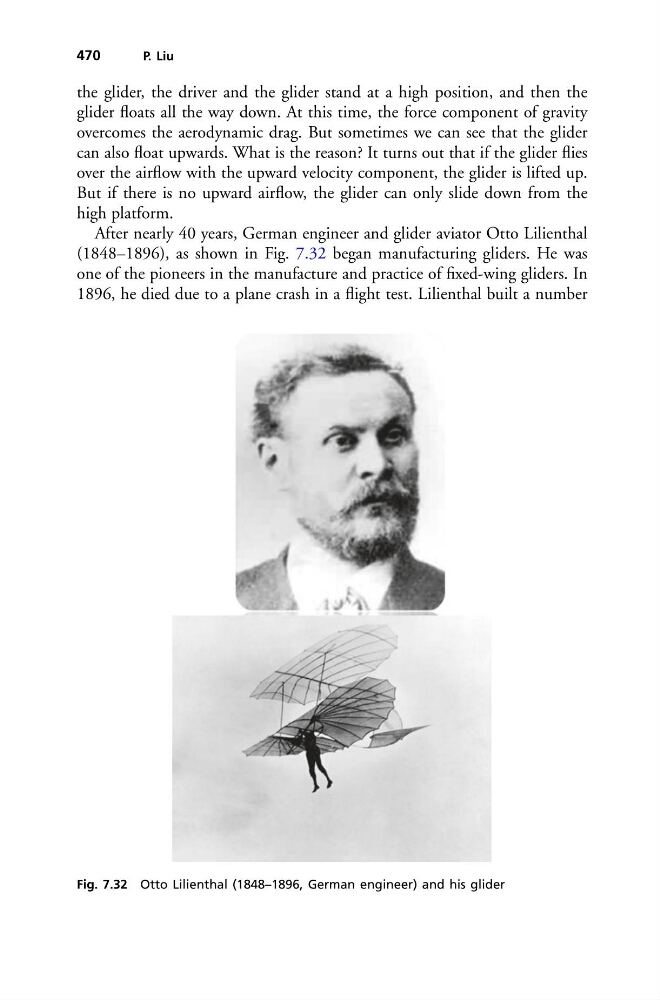
After nearly 40 years, German engineer and glider aviator Otto Lilienthal
(1848–1896), as shown in Fig. 7.32 began manufacturing gliders. He was
one of the pioneers in the manufacture and practice of fixed-wing gliders. In
1896, he died due to a plane crash in a flight test. Lilienthal built a number
Fig. 7.32 Otto Lilienthal (1848–1896, German engineer) and his glider
P. Liu
the glider, the driver and the glider stand at a high position, and then the
glider floats all the way down. At this time, the force component of gravity
overcomes the aerodynamic drag. But sometimes we can see that the glider
can also float upwards. What is the reason? It turns out that if the glider flies
over the airflow with the upward velocity component, the glider is lifted up.
But if there is no upward airflow, the glider can only slide down from the
high platform.
After nearly 40 years, German engineer and glider aviator Otto Lilienthal
(1848–1896), as shown in Fig. 7.32 began manufacturing gliders. He was
one of the pioneers in the manufacture and practice of fixed-wing gliders. In
1896, he died due to a plane crash in a flight test. Lilienthal built a number
Fig. 7.32 Otto Lilienthal (1848–1896, German engineer) and his glider