

7 Flight Mystery and Aerodynamic Principles
469
The eagle glides without power, the open mouth can never function as
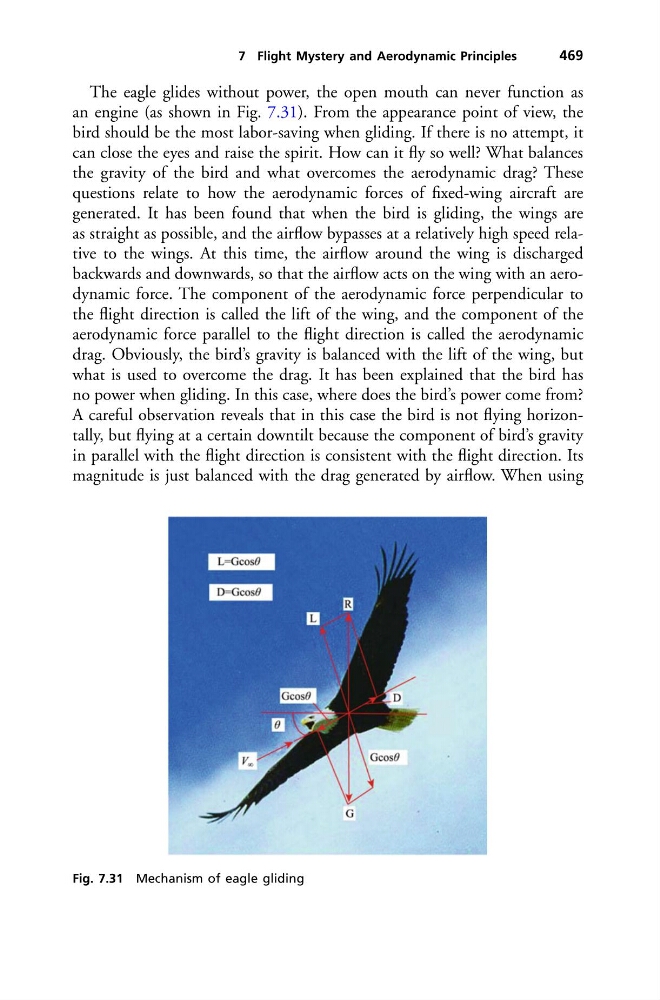
an engine (as shown in Fig. 7.31). From the appearance point of view, the
bird should be the most labor-saving when gliding. If there is no attempt, it
can close the eyes and raise the spirit. How can it fly so well? What balances
the gravity of the bird and what overcomes the aerodynamic drag? These
questions relate to how the aerodynamic forces of fixed-wing aircraft are
generated. It has been found that when the bird is gliding, the wings are
as straight as possible, and the airflow bypasses at a relatively high speed relative to the wings. At this time, the airflow around the wing is discharged
backwards and downwards, so that the airflow acts on the wing with an aerodynamic force. The component of the aerodynamic force perpendicular to
the flight direction is called the lift of the wing, and the component of the
aerodynamic force parallel to the flight direction is called the aerodynamic
drag. Obviously, the bird’s gravity is balanced with the lift of the wing, but
what is used to overcome the drag. It has been explained that the bird has
no power when gliding. In this case, where does the bird’s power come from?
A careful observation reveals that in this case the bird is not flying horizontally, but flying at a certain downtilt because the component of bird’s gravity
in parallel with the flight direction is consistent with the flight direction. Its
magnitude is just balanced with the drag generated by airflow. When using
Fig. 7.31 Mechanism of eagle gliding
469
The eagle glides without power, the open mouth can never function as
an engine (as shown in Fig. 7.31). From the appearance point of view, the
bird should be the most labor-saving when gliding. If there is no attempt, it
can close the eyes and raise the spirit. How can it fly so well? What balances
the gravity of the bird and what overcomes the aerodynamic drag? These
questions relate to how the aerodynamic forces of fixed-wing aircraft are
generated. It has been found that when the bird is gliding, the wings are
as straight as possible, and the airflow bypasses at a relatively high speed relative to the wings. At this time, the airflow around the wing is discharged
backwards and downwards, so that the airflow acts on the wing with an aerodynamic force. The component of the aerodynamic force perpendicular to
the flight direction is called the lift of the wing, and the component of the
aerodynamic force parallel to the flight direction is called the aerodynamic
drag. Obviously, the bird’s gravity is balanced with the lift of the wing, but
what is used to overcome the drag. It has been explained that the bird has
no power when gliding. In this case, where does the bird’s power come from?
A careful observation reveals that in this case the bird is not flying horizontally, but flying at a certain downtilt because the component of bird’s gravity
in parallel with the flight direction is consistent with the flight direction. Its
magnitude is just balanced with the drag generated by airflow. When using
Fig. 7.31 Mechanism of eagle gliding