

468
P. Liu
downward component and gravity are balanced with the aerodynamic lift.
If the horizontal tension of the rope is replaced by the thrust of the engine,
which is balanced with the aerodynamic drag of the kite, then the pull-down
force in the vertical direction of the rope is replaced by the gravity of the
aircraft, and it is balanced with the aerodynamic lift of the kite. This achieves
the concept of balancing lift and drag separately. That is to say, when building
an aircraft, the parts that generate lift and the parts that generate thrust can
be considered separately, unlike the flapping-wing aircraft, which is considered together (the wing tip portion is both the lift surface and the thrust
surface). The decomposition principle proposed by George Kelly played an
important role in guiding the later Wright brothers to invent the powered
fixed-wing aircraft. Although it was not possible to manufacture a suitable
thrust component (the engine) under the technical conditions at that time,
he did a lot of practice on the parts that generate lift. He made many gliders,
so he is also called the inventor of the glider.
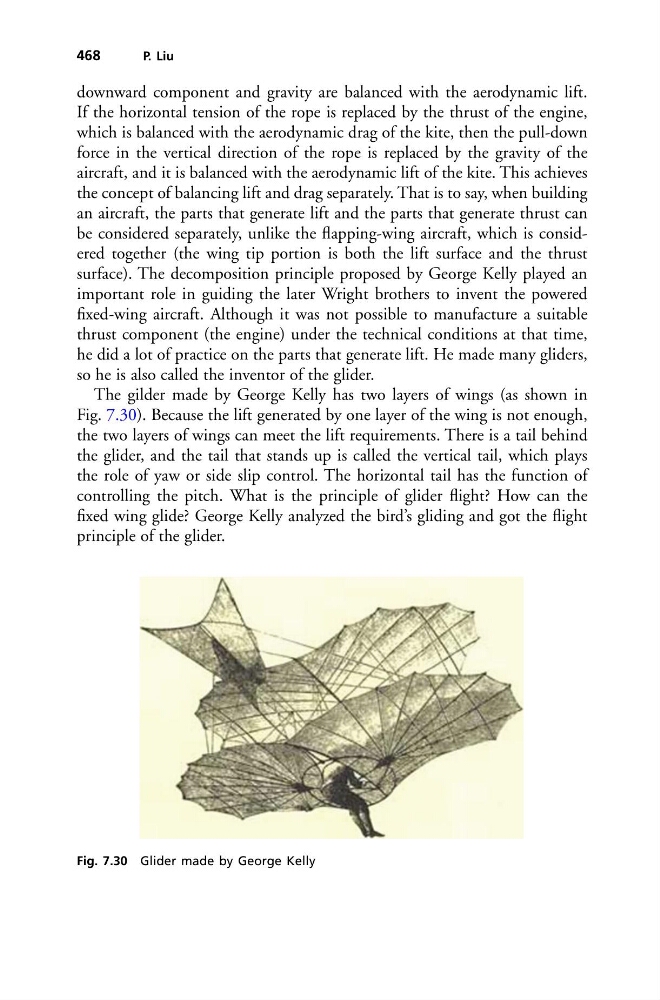
The gilder made by George Kelly has two layers of wings (as shown in
Fig. 7.30). Because the lift generated by one layer of the wing is not enough,
the two layers of wings can meet the lift requirements. There is a tail behind
the glider, and the tail that stands up is called the vertical tail, which plays
the role of yaw or side slip control. The horizontal tail has the function of
controlling the pitch. What is the principle of glider flight? How can the
fixed wing glide? George Kelly analyzed the bird’s gliding and got the flight
principle of the glider.
Fig. 7.30 Glider made by George Kelly
P. Liu
downward component and gravity are balanced with the aerodynamic lift.
If the horizontal tension of the rope is replaced by the thrust of the engine,
which is balanced with the aerodynamic drag of the kite, then the pull-down
force in the vertical direction of the rope is replaced by the gravity of the
aircraft, and it is balanced with the aerodynamic lift of the kite. This achieves
the concept of balancing lift and drag separately. That is to say, when building
an aircraft, the parts that generate lift and the parts that generate thrust can
be considered separately, unlike the flapping-wing aircraft, which is considered together (the wing tip portion is both the lift surface and the thrust
surface). The decomposition principle proposed by George Kelly played an
important role in guiding the later Wright brothers to invent the powered
fixed-wing aircraft. Although it was not possible to manufacture a suitable
thrust component (the engine) under the technical conditions at that time,
he did a lot of practice on the parts that generate lift. He made many gliders,
so he is also called the inventor of the glider.
The gilder made by George Kelly has two layers of wings (as shown in
Fig. 7.30). Because the lift generated by one layer of the wing is not enough,
the two layers of wings can meet the lift requirements. There is a tail behind
the glider, and the tail that stands up is called the vertical tail, which plays
the role of yaw or side slip control. The horizontal tail has the function of
controlling the pitch. What is the principle of glider flight? How can the
fixed wing glide? George Kelly analyzed the bird’s gliding and got the flight
principle of the glider.
Fig. 7.30 Glider made by George Kelly