

7 Flight Mystery and Aerodynamic Principles
467
Fig. 7.28 Glider from George Kelly (1773–1857)
made people abandon the flapping flight that mimics the bird and gradually
accept and practice the correct principle of generating lift with fixed wing. It
has also become an important concept for humans to manufacture fixed-wing
aircraft.
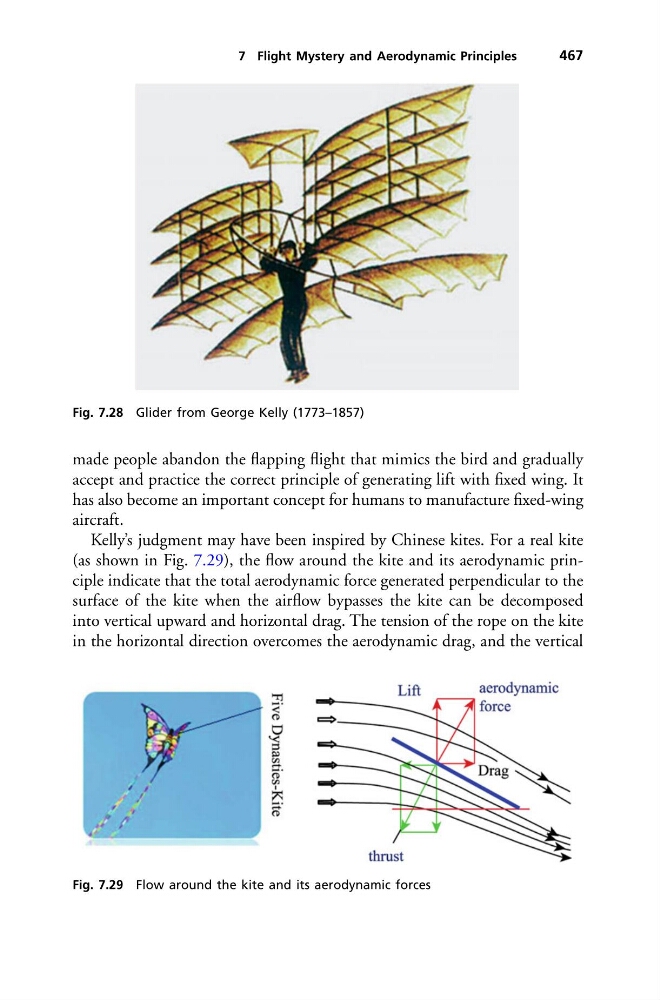
Kelly’s judgment may have been inspired by Chinese kites. For a real kite
(as shown in Fig. 7.29), the flow around the kite and its aerodynamic principle indicate that the total aerodynamic force generated perpendicular to the
surface of the kite when the airflow bypasses the kite can be decomposed
into vertical upward and horizontal drag. The tension of the rope on the kite
in the horizontal direction overcomes the aerodynamic drag, and the vertical
Fig. 7.29 Flow around the kite and its aerodynamic forces
467
Fig. 7.28 Glider from George Kelly (1773–1857)
made people abandon the flapping flight that mimics the bird and gradually
accept and practice the correct principle of generating lift with fixed wing. It
has also become an important concept for humans to manufacture fixed-wing
aircraft.
Kelly’s judgment may have been inspired by Chinese kites. For a real kite
(as shown in Fig. 7.29), the flow around the kite and its aerodynamic principle indicate that the total aerodynamic force generated perpendicular to the
surface of the kite when the airflow bypasses the kite can be decomposed
into vertical upward and horizontal drag. The tension of the rope on the kite
in the horizontal direction overcomes the aerodynamic drag, and the vertical
Fig. 7.29 Flow around the kite and its aerodynamic forces