

7 Flight Mystery and Aerodynamic Principles
471
of single-wing or double-wing fixed-wing gliders and tested more than 2000
times near Berlin. He accumulated a wealth of information. Although he
eventually failed to achieve power flight, his valuable flight experience and a
large amount of data accumulated have provided a lot of valuable experience
for the successful power flight of the American Wright brothers.
Under the guidance of the aviation experience and knowledge of the predecessors George Kelly and Otto Lilienthal, the American Wright brothers built
their own powered aircraft based on their experimental data. On December
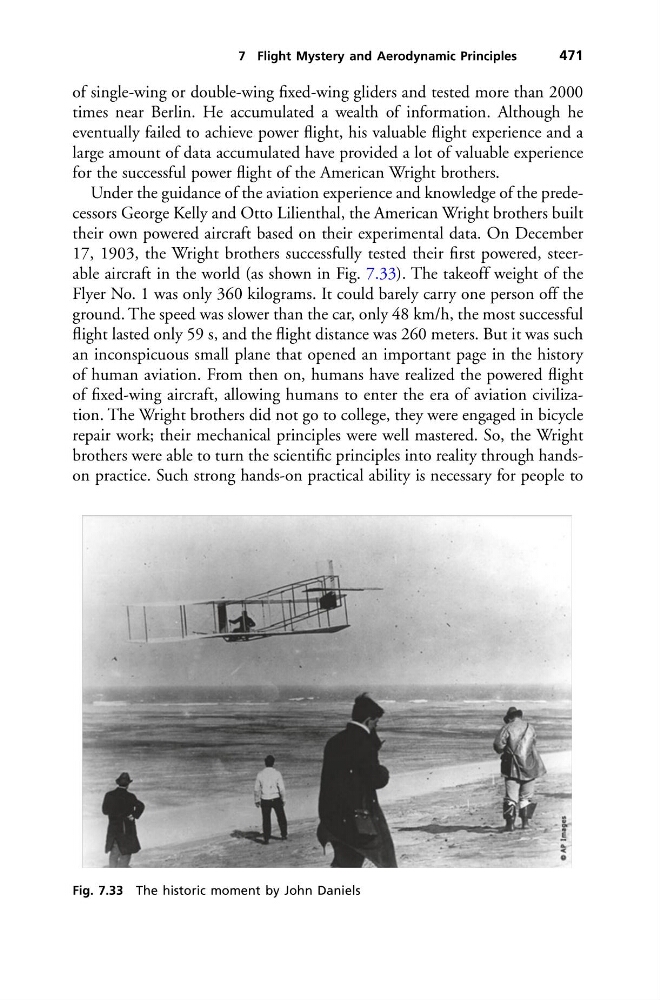
17, 1903, the Wright brothers successfully tested their first powered, steerable aircraft in the world (as shown in Fig. 7.33). The takeoff weight of the
Flyer No. 1 was only 360 kilograms. It could barely carry one person off the
ground. The speed was slower than the car, only 48 km/h, the most successful
flight lasted only 59 s, and the flight distance was 260 meters. But it was such
an inconspicuous small plane that opened an important page in the history
of human aviation. From then on, humans have realized the powered flight
of fixed-wing aircraft, allowing humans to enter the era of aviation civilization. The Wright brothers did not go to college, they were engaged in bicycle
repair work; their mechanical principles were well mastered. So, the Wright
brothers were able to turn the scientific principles into reality through handson practice. Such strong hands-on practical ability is necessary for people to
Fig. 7.33 The historic moment by John Daniels
471
of single-wing or double-wing fixed-wing gliders and tested more than 2000
times near Berlin. He accumulated a wealth of information. Although he
eventually failed to achieve power flight, his valuable flight experience and a
large amount of data accumulated have provided a lot of valuable experience
for the successful power flight of the American Wright brothers.
Under the guidance of the aviation experience and knowledge of the predecessors George Kelly and Otto Lilienthal, the American Wright brothers built
their own powered aircraft based on their experimental data. On December
17, 1903, the Wright brothers successfully tested their first powered, steerable aircraft in the world (as shown in Fig. 7.33). The takeoff weight of the
Flyer No. 1 was only 360 kilograms. It could barely carry one person off the
ground. The speed was slower than the car, only 48 km/h, the most successful
flight lasted only 59 s, and the flight distance was 260 meters. But it was such
an inconspicuous small plane that opened an important page in the history
of human aviation. From then on, humans have realized the powered flight
of fixed-wing aircraft, allowing humans to enter the era of aviation civilization. The Wright brothers did not go to college, they were engaged in bicycle
repair work; their mechanical principles were well mastered. So, the Wright
brothers were able to turn the scientific principles into reality through handson practice. Such strong hands-on practical ability is necessary for people to
Fig. 7.33 The historic moment by John Daniels