

6 Wind and Water Tunnel Equipment
387
the test section. The wind tunnel can be classified according to the Ma
range of the test section. Wind tunnel with the test section Ma ≤ 0.3
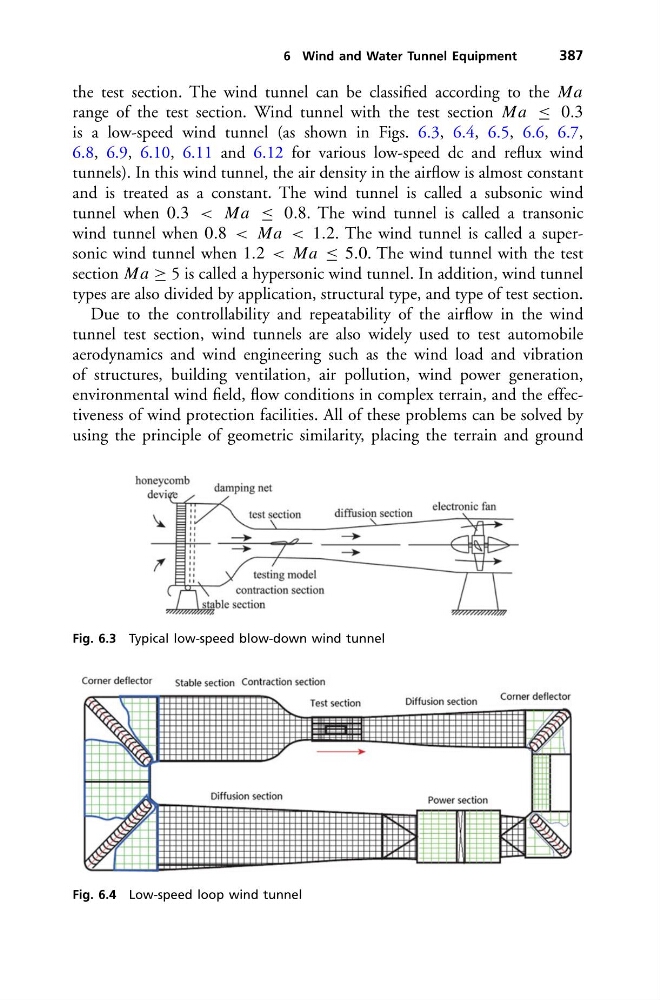
is a low-speed wind tunnel (as shown in Figs. 6.3, 6.4, 6.5, 6.6, 6.7,
6.8, 6.9, 6.10, 6.11 and 6.12 for various low-speed dc and reflux wind
tunnels). In this wind tunnel, the air density in the airflow is almost constant
and is treated as a constant. The wind tunnel is called a subsonic wind
tunnel when 0.3 < Ma ≤ 0.8. The wind tunnel is called a transonic
wind tunnel when 0.8 < Ma < 1.2. The wind tunnel is called a supersonic wind tunnel when 1.2 < Ma ≤ 5.0. The wind tunnel with the test
section Ma ≥ 5 is called a hypersonic wind tunnel. In addition, wind tunnel
types are also divided by application, structural type, and type of test section.
Due to the controllability and repeatability of the airflow in the wind
tunnel test section, wind tunnels are also widely used to test automobile
aerodynamics and wind engineering such as the wind load and vibration
of structures, building ventilation, air pollution, wind power generation,
environmental wind field, flow conditions in complex terrain, and the effectiveness of wind protection facilities. All of these problems can be solved by
using the principle of geometric similarity, placing the terrain and ground
Fig. 6.3 Typical low-speed blow-down wind tunnel
Fig. 6.4 Low-speed loop wind tunnel
387
the test section. The wind tunnel can be classified according to the Ma
range of the test section. Wind tunnel with the test section Ma ≤ 0.3
is a low-speed wind tunnel (as shown in Figs. 6.3, 6.4, 6.5, 6.6, 6.7,
6.8, 6.9, 6.10, 6.11 and 6.12 for various low-speed dc and reflux wind
tunnels). In this wind tunnel, the air density in the airflow is almost constant
and is treated as a constant. The wind tunnel is called a subsonic wind
tunnel when 0.3 < Ma ≤ 0.8. The wind tunnel is called a transonic
wind tunnel when 0.8 < Ma < 1.2. The wind tunnel is called a supersonic wind tunnel when 1.2 < Ma ≤ 5.0. The wind tunnel with the test
section Ma ≥ 5 is called a hypersonic wind tunnel. In addition, wind tunnel
types are also divided by application, structural type, and type of test section.
Due to the controllability and repeatability of the airflow in the wind
tunnel test section, wind tunnels are also widely used to test automobile
aerodynamics and wind engineering such as the wind load and vibration
of structures, building ventilation, air pollution, wind power generation,
environmental wind field, flow conditions in complex terrain, and the effectiveness of wind protection facilities. All of these problems can be solved by
using the principle of geometric similarity, placing the terrain and ground
Fig. 6.3 Typical low-speed blow-down wind tunnel
Fig. 6.4 Low-speed loop wind tunnel