

366
P. Liu
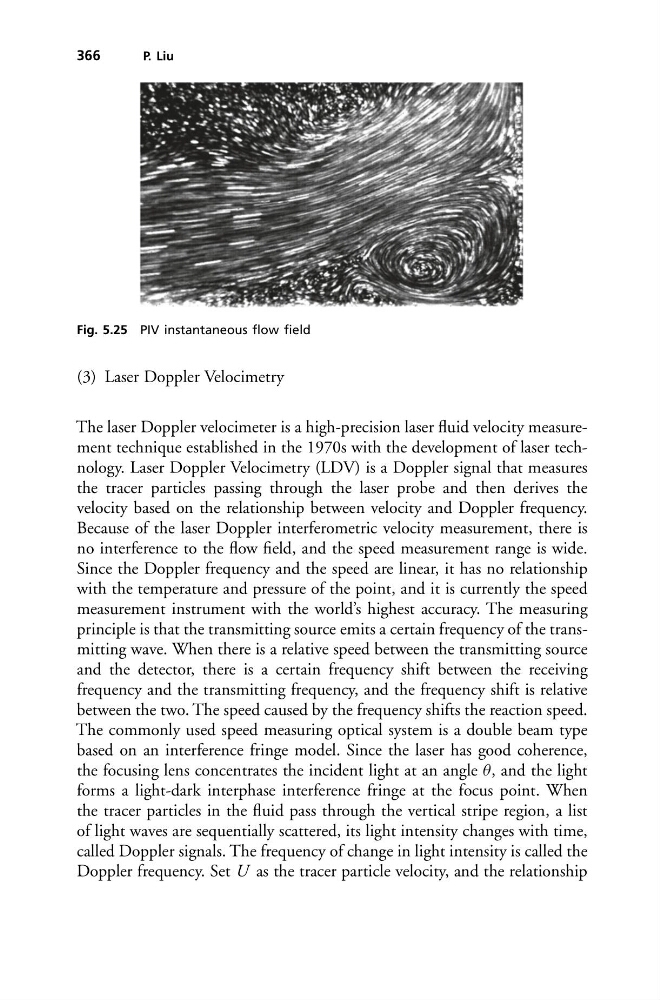
Fig. 5.25 PIV instantaneous flow field
(3) Laser Doppler Velocimetry
The laser Doppler velocimeter is a high-precision laser fluid velocity measurement technique established in the 1970s with the development of laser technology. Laser Doppler Velocimetry (LDV) is a Doppler signal that measures
the tracer particles passing through the laser probe and then derives the
velocity based on the relationship between velocity and Doppler frequency.
Because of the laser Doppler interferometric velocity measurement, there is
no interference to the flow field, and the speed measurement range is wide.
Since the Doppler frequency and the speed are linear, it has no relationship
with the temperature and pressure of the point, and it is currently the speed
measurement instrument with the world’s highest accuracy. The measuring
principle is that the transmitting source emits a certain frequency of the transmitting wave. When there is a relative speed between the transmitting source
and the detector, there is a certain frequency shift between the receiving
frequency and the transmitting frequency, and the frequency shift is relative
between the two. The speed caused by the frequency shifts the reaction speed.
The commonly used speed measuring optical system is a double beam type
based on an interference fringe model. Since the laser has good coherence,
the focusing lens concentrates the incident light at an angle θ, and the light
forms a light-dark interphase interference fringe at the focus point. When
the tracer particles in the fluid pass through the vertical stripe region, a list
of light waves are sequentially scattered, its light intensity changes with time,
called Doppler signals. The frequency of change in light intensity is called the
Doppler frequency. Set U as the tracer particle velocity, and the relationship
P. Liu
Fig. 5.25 PIV instantaneous flow field
(3) Laser Doppler Velocimetry
The laser Doppler velocimeter is a high-precision laser fluid velocity measurement technique established in the 1970s with the development of laser technology. Laser Doppler Velocimetry (LDV) is a Doppler signal that measures
the tracer particles passing through the laser probe and then derives the
velocity based on the relationship between velocity and Doppler frequency.
Because of the laser Doppler interferometric velocity measurement, there is
no interference to the flow field, and the speed measurement range is wide.
Since the Doppler frequency and the speed are linear, it has no relationship
with the temperature and pressure of the point, and it is currently the speed
measurement instrument with the world’s highest accuracy. The measuring
principle is that the transmitting source emits a certain frequency of the transmitting wave. When there is a relative speed between the transmitting source
and the detector, there is a certain frequency shift between the receiving
frequency and the transmitting frequency, and the frequency shift is relative
between the two. The speed caused by the frequency shifts the reaction speed.
The commonly used speed measuring optical system is a double beam type
based on an interference fringe model. Since the laser has good coherence,
the focusing lens concentrates the incident light at an angle θ, and the light
forms a light-dark interphase interference fringe at the focus point. When
the tracer particles in the fluid pass through the vertical stripe region, a list
of light waves are sequentially scattered, its light intensity changes with time,
called Doppler signals. The frequency of change in light intensity is called the
Doppler frequency. Set U as the tracer particle velocity, and the relationship