

5 Experimental Fluid Mechanics
367
between Doppler shift and particle velocity is
f d =
2n
λ
sin
θ
2
U
where f d is the Doppler frequency shift, λ is the emission wavelength, θ is
the incident angle, and n is the refractive index of the fluid.
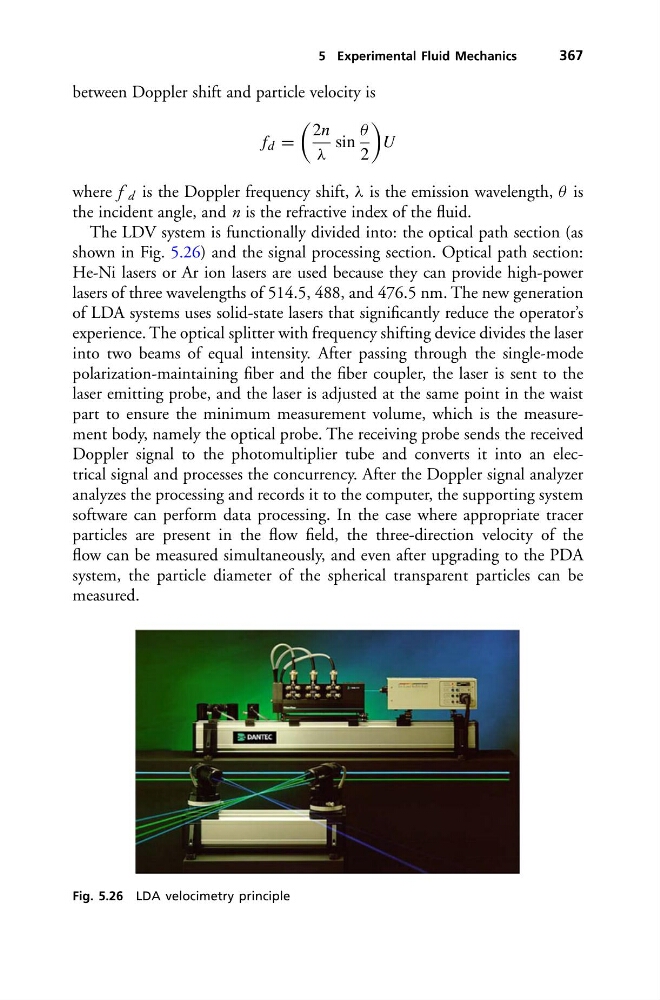
The LDV system is functionally divided into: the optical path section (as
shown in Fig. 5.26) and the signal processing section. Optical path section:
He-Ni lasers or Ar ion lasers are used because they can provide high-power
lasers of three wavelengths of 514.5, 488, and 476.5 nm. The new generation
of LDA systems uses solid-state lasers that significantly reduce the operator’s
experience. The optical splitter with frequency shifting device divides the laser
into two beams of equal intensity. After passing through the single-mode
polarization-maintaining fiber and the fiber coupler, the laser is sent to the
laser emitting probe, and the laser is adjusted at the same point in the waist
part to ensure the minimum measurement volume, which is the measurement body, namely the optical probe. The receiving probe sends the received
Doppler signal to the photomultiplier tube and converts it into an electrical signal and processes the concurrency. After the Doppler signal analyzer
analyzes the processing and records it to the computer, the supporting system
software can perform data processing. In the case where appropriate tracer
particles are present in the flow field, the three-direction velocity of the
flow can be measured simultaneously, and even after upgrading to the PDA
system, the particle diameter of the spherical transparent particles can be
measured.
Fig. 5.26 LDA velocimetry principle
367
between Doppler shift and particle velocity is
f d =
2n
λ
sin
θ
2
U
where f d is the Doppler frequency shift, λ is the emission wavelength, θ is
the incident angle, and n is the refractive index of the fluid.
The LDV system is functionally divided into: the optical path section (as
shown in Fig. 5.26) and the signal processing section. Optical path section:
He-Ni lasers or Ar ion lasers are used because they can provide high-power
lasers of three wavelengths of 514.5, 488, and 476.5 nm. The new generation
of LDA systems uses solid-state lasers that significantly reduce the operator’s
experience. The optical splitter with frequency shifting device divides the laser
into two beams of equal intensity. After passing through the single-mode
polarization-maintaining fiber and the fiber coupler, the laser is sent to the
laser emitting probe, and the laser is adjusted at the same point in the waist
part to ensure the minimum measurement volume, which is the measurement body, namely the optical probe. The receiving probe sends the received
Doppler signal to the photomultiplier tube and converts it into an electrical signal and processes the concurrency. After the Doppler signal analyzer
analyzes the processing and records it to the computer, the supporting system
software can perform data processing. In the case where appropriate tracer
particles are present in the flow field, the three-direction velocity of the
flow can be measured simultaneously, and even after upgrading to the PDA
system, the particle diameter of the spherical transparent particles can be
measured.
Fig. 5.26 LDA velocimetry principle